
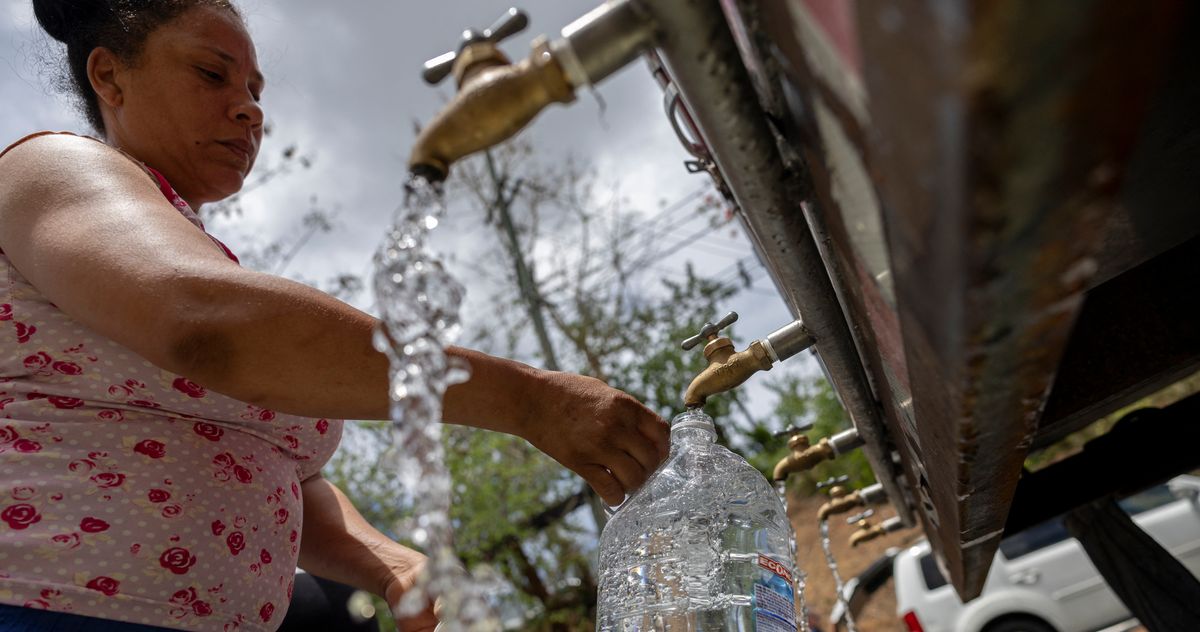
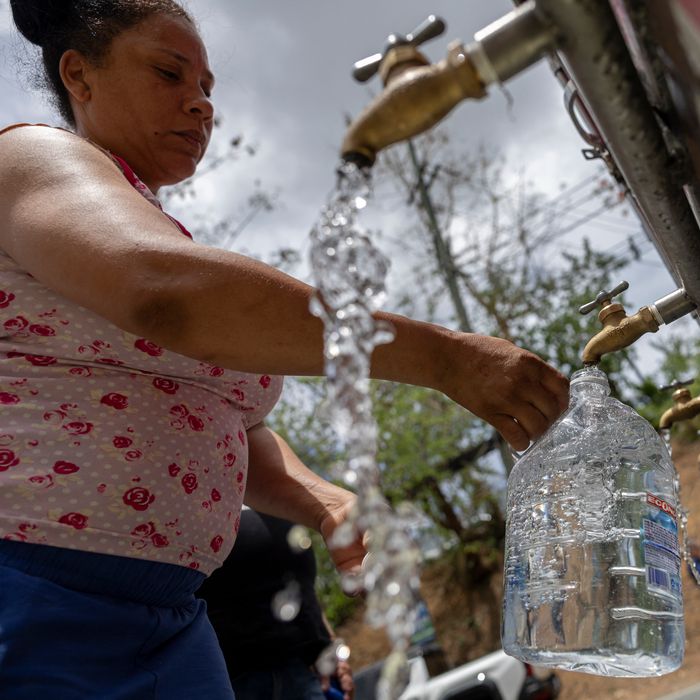
A resident collects water from a tanker truck at a distribution point in San Juan, Puerto Rico, on August 6, 2026.
Photo: Ricardo ARDUENGO / AFP via Getty Images
Cassandra Ramirez King had gone nearly two weeks without washing her hair when her neighborhood group chat lit up early in the morning: “The water is back! Hay un chorrito, aprovechen.” Ramirez King, an engineer, immediately grabbed buckets to fill them with whatever small stream was trickling out of the faucets of her home in Ocean Park, a beachfront community in San Juan, Puerto Rico. Her neighborhood had been without water since August 1. With no cistern at home, she and her husband had been surviving on buying water and whatever they were able to grab when the city’s emergency water trucks came through — sometimes running out of the house late at night to catch them. So as soon as her neighbors hit her up, Ramirez King rushed to take care of her hair and also did a couple of loads of laundry by pouring the buckets into her washing machine.
“We woke up today, on August 10, with water. We weren’t supposed to. We’re within the 48-hour rationing window. This situation is just a constant state of chaos,” she says bitterly. “We have a water crisis, sure, but also a crisis of leadership.”
Ramirez King is one of more than 180,000 Puerto Ricans across the cities of San Juan, Carolina, Juncos, Gurabo, Trujillo Alto, Canóvanas, and Loíza who are currently experiencing mandatory water shutoffs every 48 hours, after Governor Jenniffer González-Colón declared an island-wide state of emergency on August 4. Not only was July the driest month on record for San Juan in more than 120 years, but nearly 25 percent of the U.S. colony is currently experiencing a severe drought, and another 36 percent is under moderate drought conditions, according to the U.S. Drought Monitor. González-Colón has requested the assistance of the federal government; on Monday, FEMA confirmed it will be providing water trailers to support local efforts for up to 30 days. President Trump has yet to comment on the crisis. (The U.S. Virgin Islands, another American colony, is also experiencing extreme drought conditions and requested a federal disaster declaration on Monday, though its plight has not caught as much attention as neighboring Puerto Rico.) It is unclear how long the rationing measures will be in place or whether they’ll widen to include the rest of the island. But experts have warned that drought conditions could extend into early 2027.
Dry taps have put Puerto Ricans, who already struggle with rolling blackouts due to the island’s unstable power grid, in an impossible position, according to people I’ve spoken with over the past few days. One woman’s husband has taken to bathing in the sea to conserve water for their children; she has also spotted local businesses setting out buckets to collect water dripping from their air-conditioning units. Another woman has been forced to go from store to store seeking bottled water, only to find the shelves routinely empty. A third one, who is 71 years old and lives alone, has been forced to climb her roof to refill her small cistern and is terrified she’ll suffer a fatal fall.
Everyone is worried about what the water crisis may mean to vulnerable populations like the elderly and the ill. Experts have also warned the lack of water constitutes a public health crisis, putting people at risk of gastrointestinal illnesses as well as diseases such as the Zika and dengue viruses. Routinely purchasing bottled water and constantly refilling cisterns are out of reach for many Boricuas, as more than 40 percent of the American colony lives in poverty. Community group chats have become a lifeline, alerting neighbors of when an emergency water truck comes by or when a small trickle comes out of the faucet.
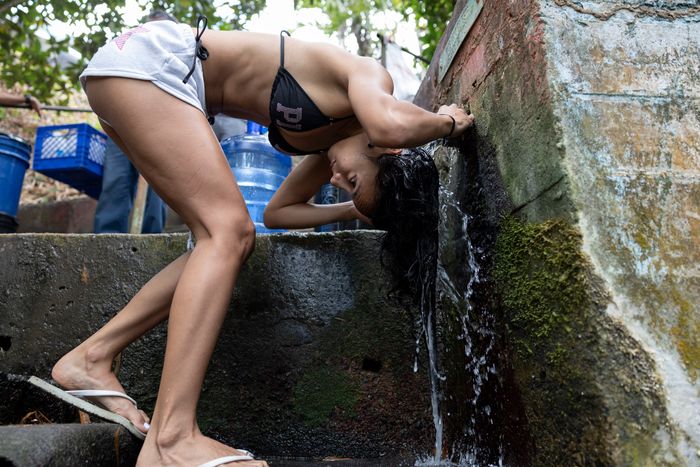
A woman washes her hair using water from a natural spring as residents collect water in Trujillo Alto, Puerto Rico, on August 6, 2026.
Photo: Ricardo ARDUENGO / AFP via Getty Images
“We are helping each other while the government remains silent,” says Ramirez King. She says she’s frustrated by the conflicting directives from the administration or that it was seemingly unprepared for the drought, even though experts began warning of these conditions earlier this year. For example, the president of the Puerto Rico Aqueduct and Sewer Authority’s board of directors quit his post on August 6, saying the government didn’t consult the water utility’s board before implementing its rationing plan. And, as of August 8, the González-Colón administration had not called upon a scientific committee tasked by law with advising agencies on public policies to handle this kind of crisis.
The government, which has set up more than 50 distribution points for water, has warned islanders to brace for a prolonged emergency situation, including extending the 48-hour rotating schedule to a 72-hour one. As of Tuesday, 13 reservoirs across the island reported declining water levels. “This situation is out of our hands,” González-Colón, a longtime politician and pro-statehood Trump supporter, said about the rationing measures last week. “Nothing prevents this from worsening.”
But outraged Puerto Ricans say that’s far from the full story.
For the past five years, Hilda Rodriguez has kept a tracker of days she has spent without water at her home in Monteflores, a community in San Juan’s Santurce neighborhood. Monteflores, which sits about 75 feet above sea level, has struggled with occasional water issues for most of Rodriguez’s life; her family first purchased a cistern as a backup plan in the 1990s. But since 2021, the situation has considerably worsened. That year her community went without water for 22 days. In 2022, it jumped to 136 days. In 2023, 100 days. In 2024, it went up again to 142 days. In 2025, 175 days. This year so far? An astonishing 193 days without water and only 30 days with. And, while it’s true that unlike many other Boricuas, Rodriguez, a nonprofit executive director, is lucky enough to have a cistern, that’s meant to help her only during emergencies — not daily life.
“I’ve regularly complained to the water utility’s customer-service line. I’ve contacted lawmakers. My neighbors and I have written letters to the editor. We even put up a banner across the street that read ‘We Need Water,’” Rodriguez says. With a sigh, she adds, “No one has paid attention.”
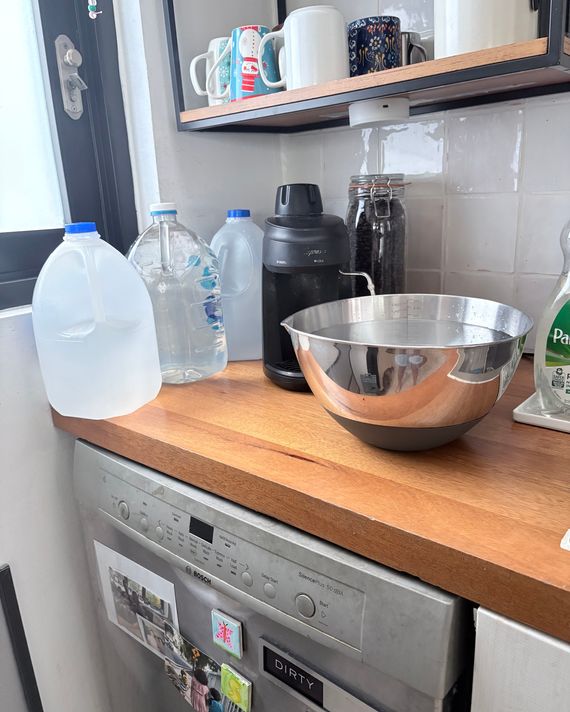
Carla López de Azúa, a mom of three, has been stocking up water in her home in San Juan, Puerto Rico.
Photo: Carla López de Azúa
Local experts say that, for years, the government has failed to update and fix Puerto Rico’s aging water infrastructure, just as with its crumbling power grid. A cursory look through PRASA’s social-media accounts shows announcements for potential service interruptions: On Tuesday alone, it showed alerts for at least 20 towns plus the seven cities in the metropolitan area currently under rationing measures. Most of the warnings were due to either failures of the power grid or leaks.
PRASA estimates that every year it fixes between 50,000 and 55,000 of such leaks — known locally as salideros. However, the agency can’t fully know how much water is lost through those. Félix Aponte Ortiz, a water-management expert, estimates that up to 60 percent of the water in PRASA’s systems doesn’t make it to Boricua households. “There’s an emphasis in producing more water and in rehabbing the big infrastructure, but not so much in updating pipes,” he recently told the New York Times. (Multiple calls to PRASA’s press office went unanswered.) In June, there was a rupture in the supertubo — a 25-year-old major pipeline — leaving tens of thousands in the San Juan area without water. While the rupture was eventually fixed, customers are still experiencing intermittent service and low pressure. Ramirez King was one of them. All in all, she spent 52 days without water this summer before the current drought. “It’s an atrocity,” she says.
It’s an exhausting way of living for Rodriguez too. Cooking is challenging and she often showers using buckets. She barely washes her car and certain areas of her house. Often, she needs to think about when she should flush the toilet. Rodriguez only does laundry once a week, but you can forget about her splitting her clothes by colors or even separating towels and bedsheets — everything goes together in the largest load possible. She’s unable to clean or do routine maintenance on her cistern because she’s afraid of emptying it and being unable to refill it again. And she’s constantly in communication with her neighbors in case el camión cisterna swings by and she isn’t home. “The other day one of the muchachos from the truck did the impossible,” she says. “He connected three 50-feet hoses to be able to reach my house.” The worst part is that, despite the literal lack of service, she still has to pay a water bill to PRASA every month.
To hear González-Colón tell it, the people of Puerto Rico need to do more to mitigate the effects of the drought. “Washing cars, hosing down driveways, watering plants, filling plastic pools, leaving hoses or faucets running — all of that limits our ability to maintain water availability in the metropolitan area. This is not a joke,” she said when she announced the rationing measures. The governor’s scolding tone has infuriated Boricuas, especially as they say they’ve spotted sprinklers watering private golf courses, hotels’ greenery, and even the lawn of El Morro. So much for not wasting water.
Add that to the fact that her administration has made it harder for community organizations to challenge development projects and that it recently approved the construction of Proyecto Esencia, a controversial $2 billion two-acre planned luxury community in the southwestern town of Cabo Rojo — which opponents warn could have devastating environmental consequences, including impacting the availability of water for the town’s residents. It all has made many Puerto Ricans feel like their elected officials care very little about the overlapping crisis they are facing.
“We clearly have an administration that has absolutely no empathy for what’s going on and it’s just completely overrun by incompetence and corruption,” says Jossie Valentín, who runs the tour company Aventuras Yuiza with her wife. “There’s some real cognitive dissonance going on in terms of telling us, You need to go save water, but we’re going to go approve a project like Esencia.”
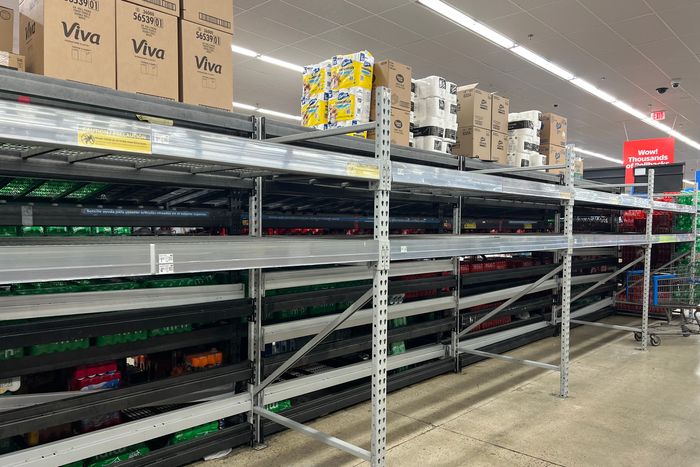
When Jossie Valentín went to her local Walmart store last week, she found the bottled water shelves empty.
Photo: Jossie Valentín
The San Juan resident says her entire life nowadays revolves around when and how to find water. The other day, Valentín picked up her 83-year-old aunt, who is also facing water rationing, and took her to a laundromat. Trips to the grocery store to find water often become multi-hour journeys because the shelves have been cleaned out. Living in a first-floor apartment, Valentín and her wife sometimes have a trickle of water while their neighbors don’t, so on those occasions they’ll have people over to replenish their containers. The couple’s tour business has also taken a hit as visitors cancel their trips to Puerto Rico out of concern for the current shortage.
“The situation is draining people’s minds, bodies, and bank accounts,” Valentín says. “This is a humanitarian crisis.”
Puerto Ricans know a thing or two about living through extreme circumstances. For the past 15 years, Boricuas have faced a series of cascading fiscal, political, social, and climate crises that have completely reshaped life in the American colony. A lack of reliable access to water is yet another entry on the list of structural issues those who live on the island deal with on a daily basis, including political corruption, a crumbling health-care system, rolling blackouts, the decimation of public schools, and the displacement of locals. For Ramirez King, the Ocean Park resident, it’s too much to ask of Puerto Ricans. “I’m tired of being resilient,” she says. “I’ll tell you something, however. I know exactly how I will vote in 2028.”
Stay in touch.
The latest in style, self, culture, and power in your inbox.
Vox Media, LLC Terms and Privacy Notice
Related