
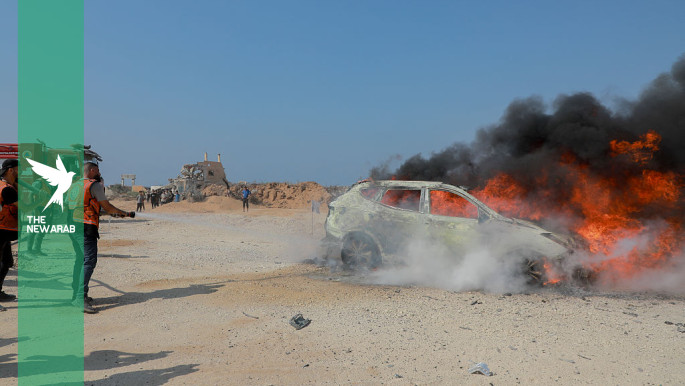
A civil defense worker stands near a burning vehicle after an Israeli airstrike as flames and smoke rise on Al-Rashid Street in Gaza City, Gaza Strip, on 13 August 2026. [Getty]
The sound of Israeli warplanes has returned to parts of Gaza after days of relative quiet, reviving fears that the ceasefire may be little more than a pause before another escalation.
On Thursday, Israeli strikes killed two Palestinians, including Gaza’s police chief, Jamal Abu Kmeil, and a man identified by Palestinian sources as a Hamas member.
Israel claimed the men were Hamas operatives involved in planning attacks and maintained that its forces were operating within the terms of the ceasefire.
Hamas, however, described the strikes as violations of the agreement and accused Israel of seeking to destabilise Gaza.
For Palestinians, the distinction offers little reassurance.
“The word ceasefire means very little when we still hear strikes and people are being killed,” Mohammed Ayoub, a Gaza resident, told The New Arab. “We thought the quiet meant that perhaps the war was finally ending. Now we are afraid that the strikes will start increasing again.”
The attacks come as negotiations over the next stage of the ceasefire remain centred on Hamas’s disarmament, an Israeli withdrawal and future security arrangements in Gaza.
Israel continues killing Hamas officials
Abu Kmeil, 43, was travelling in his vehicle in the Sheikh Ajleen area of southwestern Gaza City when an Israeli aircraft struck it, according to Gaza’s Interior Ministry and the Palestinian Red Crescent.
Several people were wounded and taken to Al-Shifa Hospital.
Abu Kmeil had remained at his post throughout the war, according to Gaza’s Interior Ministry, and had spoken publicly about efforts by police and local community leaders to maintain order.
The Israeli army claimed the strike was carried out under Shin Bet direction and described Abu Kmeil as a “Hamas operative who infiltrated Israeli territory during the 7 October 2023 massacre.”
It accused him of advancing plans for attacks against Israeli troops and civilians during the war and in recent months, saying it acted “to eliminate the threat.”
The army provided no further details about the alleged plans or Abu Kmeil’s role in the 7 October attack.
Hamas called the killing a “treacherous and brutal crime”, saying Israel was seeking to create “chaos and lawlessness” in Gaza.
It identified Abu Kmeil as the director of the civil police in Gaza Governorate and called on mediators to intervene over what it described as Israel’s “daily violations”.
The killing has also raised concerns among Palestinians about the future of basic security in the Strip, where much of the civilian infrastructure has been devastated.
“Even if Abu Kmeil worked for the Hamas-run government, that does not mean he was a Hamas member,” Jalal Abu Hasira, a Gaza resident, told TNA. “And if Israel kills all the policemen in Gaza, what do you think the situation will be like?”
“People need someone to keep the streets safe. We are already living without functioning hospitals, schools and many basic services. When those responsible for security are also targeted, it makes everyone feel more vulnerable,” he said.
Fears of wider war
Hours earlier, another Israeli strike hit an electric motorcycle near a Palestinian Red Crescent building in the Al-Amal neighbourhood west of Khan Younis, killing Huzaifa Kawareh and critically wounding another person.
Israel confirmed the attack and claimed, with no evidence, Kawareh as a “company commander in Hamas’ military wing in the Khan Younis area”, accusing him of planning attacks against Israeli troops.
It said the strike was intended “to eliminate the threat to the troops” and that forces under the Southern Command were operating “in accordance with the agreement”.
The army did not provide details about the alleged attacks or explain why it considered the threat immediate.
Palestinian security sources said the strike was the third Israeli attack since Wednesday to hit an area beyond the Israeli-proclaimed “Yellow Line”, the demarcation separating areas where Israeli forces remain deployed from other parts of Gaza.
On Wednesday evening, an Israeli strike targeting a motorcycle in Beit Lahia in northern Gaza also killed a Palestinian and wounded others.
Palestinian sources have accused Israeli forces of pushing the “Yellow Line” westwards, bringing more territory under de facto Israeli control, while demolition operations have continued in several areas.
“We do not know where the ‘Yellow Line’ is anymore or whether it will move again tomorrow,” Saied Hamada, a Gaza resident, told TNA. “Every time people begin returning to an area or trying to rebuild their lives, something happens, and they are reminded that the war is still around them.”
“People are exhausted. They do not want to hear about another war. Whatever Israel and Hamas disagree about, they need to find a way to stop the killing,” he said.
The latest attacks have sharpened fears that the ceasefire could gradually erode without formally collapsing.
Truce terms
Israel maintains that the agreement does not prevent it from striking Hamas members it considers to be posing a security threat. Hamas says such attacks violate the ceasefire.
Yedioth Ahronoth, citing an Israeli security source, reported that Israel had told the US it would continue targeting Hamas operatives involved in the 7 October attack as well as “any emerging threats, whether immediate or subsequent”.
The source claimed Washington accepts the Israeli position and that coordination with the American headquarters in Kiryat Gat had been strengthened.
Hamas spokesperson Hazem Qassem rejected Israeli accusations that the movement had resumed military operations or violated the ceasefire, describing them as “propaganda” intended to justify what he called Israel’s continuing violations.
Qassem reiterated Hamas’s “full commitment” to the ceasefire agreement and its roadmap, and called on mediators to compel Israel to respect the terms already agreed.
The dispute comes as negotiations over the second phase focus on Hamas’s weapons and the future of Israeli forces in Gaza.
Israeli Prime Minister Benjamin Netanyahu’s 3 August meeting in Tel Aviv with Nickolay Mladenov, a representative of the so-called “Board of Peace,” focused on implementing the second phase, including Hamas’s disarmament and an Israeli withdrawal.
Gaza-based political analyst Akram Attallah told TNA that Israel’s continued targeting of Hamas members reflected its desire to maintain military pressure on the movement while negotiations continue.
“Israel views the targeting of Hamas figures as a way to prevent the group from rebuilding its military capabilities and to reinforce its demand for the movement’s disarmament,” Attallah said.
He said the strikes also showed that Israel does not view the ceasefire as preventing military action against people it considers security threats.
But Attallah warned that continued attacks could undermine the truce and make the transition to the next phase more difficult.
The unresolved questions of Hamas’s disarmament, an Israeli withdrawal and future security arrangements leave the ceasefire vulnerable to further escalation, he noted.
Gaza’s Health Ministry says 1,260 Palestinians have been killed and 4,154 wounded since the ceasefire took effect on 10 October 2025.
The ministry puts the overall death toll since October 2023 at more than 73,389, with 174,266 wounded.