
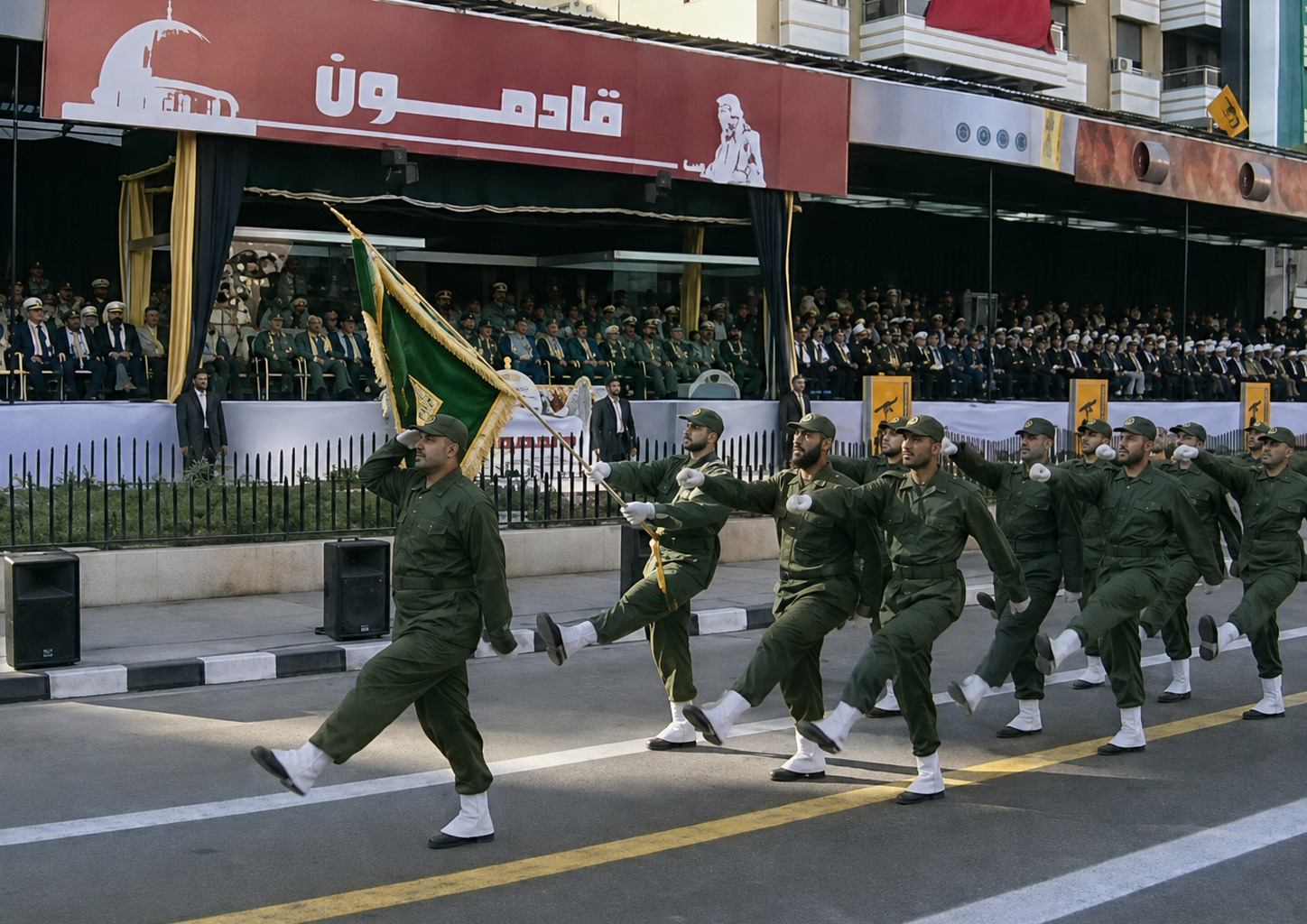
Behind the rhetoric of sovereignty lies an armed exception called Hezbollah
What exactly is meant by Lebanese sovereignty? Is it a principle by which Beirut possesses supreme authority over Lebanese territory, or merely a useful incantation to be uttered whenever an Israeli soldier crosses the frontier? And if Lebanon is indeed sovereign, one is entitled to ask the rather elementary question: by what constitutional miracle does Hezbollah maintain an army, an arsenal and an independent capacity for war without making nonsense of the word?
There is a small but revealing dishonesty concealed inside much of the diplomatic language applied to Lebanon. Israel is instructed to respect Lebanese sovereignty, withdraw its forces and honour the integrity of the border. Very well. These are not outrageous demands. But anyone making them acquires, at the same moment, an obligation to explain why the identical doctrine of sovereignty apparently loses its force a few kilometres farther north, where Hezbollah has for years maintained weapons, commanders, military infrastructure and a political authority that no ordinary sovereign state could permit without confessing that sovereignty had become conditional. The contradiction is obvious. What is remarkable is the discipline with which diplomacy pretends not to see it.
A country is not sovereign because it has a flag, an anthem and a UN seat. These are the upholstery of statehood. Sovereignty rests on authority: who bears arms, who commands them and who may take the country to war. Without that authority, sovereignty is largely decorative, a handsome façade over institutional ruin.
This is why the argument over southern Lebanon has so often been conducted backwards. Israel is told that it cannot remain indefinitely on Lebanese territory in order to guarantee its own security. OK. But it requires an almost theological devotion to abstraction to insist upon Israeli withdrawal while treating Hezbollah’s military power as an entirely separate question. Separate to whom? Certainly not to Israelis living within rocket range.
Resolution 1701 was clear: southern Lebanon was not to remain Hezbollah’s military estate. Yet Hezbollah stayed armed while its obligations dissolved into diplomatic evasion.
One notices the asymmetry: when Israel violates an agreement, there is a government to condemn and institutions to pressure. When Hezbollah violates Lebanon’s political order, we are told to contemplate sectarian complexities. Responsibility thus falls hardest on the actor capable of bearing it: the state is punished for being a state; the militia discounted for being a militia.
The deployment of the Lebanese Armed Forces into territory vacated by Israel therefore matters considerably more than the movement of uniforms across a map. It asks whether Beirut can finally convert sovereignty from rhetoric into fact. If Lebanese soldiers replace Israeli troops, if the Lebanese government controls the frontier, and if no private organisation retains the power to decide independently when rockets are fired or wars begun, Israel ought to accept such an arrangement.
The alternative is the old fiction: Israel leaves, diplomats applaud, Hezbollah rearms, and everyone later professes astonishment when the entirely predictable happens again.
When credulity becomes complicity, the endless indulgence of Hezbollah begins to sound less like realism than contempt for Lebanon itself. We are told that Hezbollah cannot be disarmed, that its private army must be accommodated, and that Lebanese sovereignty requires infinite patience. How convenient. Lebanon may have the flag, the seat at the UN and the diplomatic courtesies; apparently, expecting it to exercise sovereignty would be asking rather too much.
There is also the fiction of the “Lebanese army,” invoked in diplomatic statements as though independence could be created by quotation marks and uniforms. Hezbollah’s personnel and sympathisers are embedded within its ranks, meaning that any serious confrontation may begin inside the barracks. The prescription that Israel should withdraw and let this army replace it is therefore not strategy but make-believe. It would give Hezbollah time, cover and access to its old positions, allowing the threat to regenerate beneath the supervision of the very institution supposedly sent to prevent it.
Otherwise we are left with a doctrine of such exquisite nonsense that only diplomacy could dignify it: Lebanese sovereignty is sacred when Israel crosses the frontier, conveniently elastic when Hezbollah subordinates the state, and apparently nonexistent when the militia points its guns inward.
Ab Boskany is an Australian writer of Kurdish-Jewish background. He writes fiction, poetry and literary essays, and has contributes to “The Jewish Report” (Melbourne and Sydney editions, every issue) and “All Israel News”. His work intertwines memory, exile and faith, engaging both with Jewish history and the wider cultural worlds of the Middle East. He publishes in Kurdish and Arabic. He holds a BA in English Literature from the University of Western Sydney, an MA in Literature (Texts and Writing), and an MA in TESOL.