
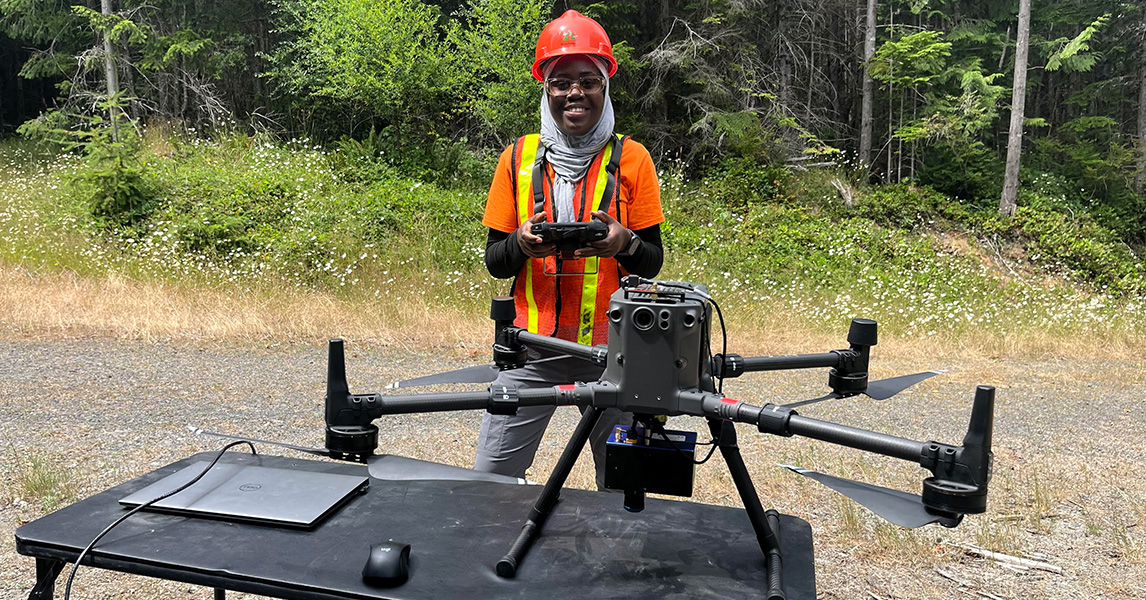
Titilayo Tajudeen, a third-year Ph.D. candidate studying geospatial analytics in the College of Natural Resources, recently completed a summer internship at Weyerhaeuser Company in Centralia, Washington.
Weyerhaeuser Company ranks among the world’s largest forest product companies. The company sustainably grows, harvests and sells trees from its extensive timberland holdings. It also manufactures wood and pulp products.
Tajudeen served as a remote sensing intern at Weyerhaeuser Company’s George R. Starler Forestry Research Center. Her primary responsibilities included assisting with forest inventory tasks and developing deep learning methods and spectral analysis to classify tree species.
Utilizing unmanned aerial vehicles (UAVs) outfitted with sensors, Tajudeen captured hyperspectral and LiDAR datasets, enabling detailed analysis of tree locations and characteristics. She then analyzed the collected data for “meaningful insights to support forest management decisions.”
“This combination of field and analytical work provided me with a well-rounded perspective on applying remote sensing technology to real-world environmental challenges,” Tajudeen said.
We recently caught up with Tajudeen to discuss her internship at Weyerhaeuser Company. Check out the Q&A below to learn more about her experience and how it’s contributed to her professional journey.
How did you find out about this internship and why were you interested in it?
Titilayo Tajudeen: I found out about this internship through LinkedIn. I have been going through LinkedIn to see potential internship opportunities available in remote sensing, forest biometrics, or geospatial data science. I was particularly drawn to this one because it aligned closely with my interest in using geospatial technologies such as UAVs and their application to forest inventory, monitoring, and mapping. The opportunity to work on interdisciplinary projects that integrated machine learning, UAV-derived datasets, and professional forest management appealed to both my academic and career goals.
What was the most interesting or surprising part of this internship experience?
Tajudeen: The most interesting part of my internship was seeing the forests on the West Coast. Brushing through the thick while maintaining a visual line of sight with the very rugged terrain was very interesting. One of the more surprising lessons I learned was that, as a forester, you might not harvest the trees you plant in your lifetime, given that on the West Coast, the rotation period can be as long as 45–50 years.
I also learned more about the different regulations that go into planting and harvesting, and how the states regulate and contribute to some of those decisions to help protect the natural habitats and riparian zones. Another surprising part was how much impact clear communication has on interdisciplinary projects. I learned that even with strong technical work, success often hinges on being able to translate that work into actionable insights for decision-makers, stakeholders and clients.
How did the College of Natural Resources prepare you for this internship?
Tajudeen: The College of Natural Resources equipped me with a strong foundation in remote sensing, spatial analysis, and forestry. Courses in remote sensing, geospatial artificial intelligence, geospatial modeling and forest mensuration gave me the tools, project experience and programming skills I needed to contribute meaningfully from day one.
Beyond the classroom, the College of Natural Resources also emphasized the importance of collaboration, stakeholder engagement and science communication, all of which proved essential during the internship. Given that I have had the opportunity to work on an interdisciplinary team in the Center for Geospatial Analytics, it has prepared me to understand just a little bit of what each group works on and how my team could help other teams.
What are your long-term goals and how does this internship factor in?
Tajudeen: My long-term goal is to work at the intersection of geospatial data science, environmental science, forest inventory and monitoring, and AI research by contributing to evidence-based decision-making for climate resilience, advancement in geospatial technologies, and forest management. This internship was a critical step toward that goal, allowing me to apply my academic training in a real-world context, build a network of professionals and refine the focus of my doctoral research. I am interested in this field, and this internship provides me with an opportunity to further prepare for my Part 107 exam, which is a prerequisite for obtaining my Trusted Operator™ Level 1–3 training. Lastly, it has also encouraged me to reflect deeply on the skills I need to develop during the remaining years of my Ph.D. program.
What advice would you give students who are looking for internships?
Tajudeen: Start early and be proactive. It is also very important to tailor your resume and cover letter to each opportunity, and be clear about what you hope to gain from the experience. Most importantly, stay open to learning because some internships that don’t seem like a perfect fit on paper can lead to unexpected growth and new directions. Additionally, during your internship, take advantage of every opportunity and be eager to ask questions and seek clarification.
Editor’s note: This interview has been edited for brevity and clarity.