
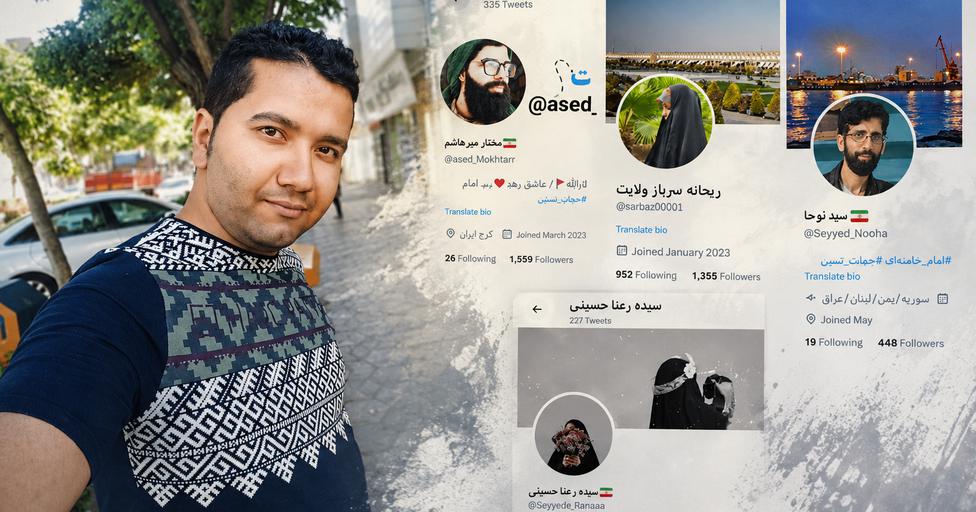
Born in April 1988, Qasem-Ali Gholami is an Afghan Twitter activist who lived in Mashhad from early childhood. Operating under pseudonyms with religious appearances, he created satirical content targeting the former Supreme Leader, Ali Khamenei, the Islamic Revolutionary Guard Corps (IRGC), and state officials.
Popular accounts such as “Seyyedeh Rana Hosseini,” “Seyyed Zakaria,” “Seyyed Noha,” and “Mokhtar Mir-Hashem,” which garnered thousands of followers, were created and managed by Gholami. Speaking to IranWire, Gholami explained: “I joined Twitter in 2022. The bulk of my activity was political satire and commentary on current affairs in Iran, presenting critical issues through dark humor.”
In August 2023, state-run news agency IRNA published a report titled “Religious Forgers, This Time on Persian Twitter,” accusing satirical accounts adopting government-aligned ideological personas of being affiliated with Israel. Several accounts highlighted in the state report were created and run by Gholami.
Concurrently, the 20:30 news program on IRIB Channel 2 – frequently used by Iranian security agencies to broadcast forced confessions and target civil activists, journalists, and dissidents—aired a broadcast making similar allegations against accounts managed by Gholami.
Gholami noted that during interrogations, officers used phrasing identical to that used by Ameneh Sadat Zabihpour, a state reporter labeled an “interrogator-journalist” by political opponents, including accusations of “serving the U.S. and Israel.” Interrogators forced him to write these statements on interrogation forms and repeat them on camera.
On December 23, 2024, between 20 and 30 security agents raided his brother’s workshop where Gholami worked: “They assaulted me severely. First, an agent forced me to read aloud a tweet from the Seyyed Zakaria account featuring an edited photo of Khamenei with profanity. When I read it, he struck my face with punches and kicks, yelling about our devotion to the Supreme Leader. They bound my hands, blindfolded the workshop workers, and made them face the wall. One agent picked up a kettle and poured boiling water over my hands, back, legs, and head while I was handcuffed.”
Gholami stated he asked agents not to strike his eye due to a recent surgery, prompting one officer to grab a pair of tailoring shears, remarking that he “lusted for the smell of blood,” and cut Gholami’s ear.
In Detention: Mock Executions and Account Seizures
Gholami spent the initial hours of his arrest at a Mashhad police station before being transferred to a Ministry of Intelligence detention facility, where he spent 57 days in solitary confinement under psychological duress.
“During those 57 days, I was permitted only five or six brief calls with my wife,” Gholami told IranWire. “Interrogations were grueling. I was coerced into declaring on camera that Netanyahu was my leader, that I worked for Israel, and that I intended to move there. Video confessions were recorded repeatedly until interrogators were satisfied.”
Regarding the identification of his identity and that of his associate Amir-Hossein Mousavi (owner of the “James Bi-Deen” account on X), Gholami described an intelligence entrapment operation. A honeypot account named “Sadaf” contacted them under the pretext of purchasing the “James Bi-Deen” and “Madaeh Faryabi” accounts, introducing sexual topics to move communications from X to Telegram: “Based on subsequent events, that account was operated directly by security agents.”
Gholami added that Ministry of Intelligence agents retained control over two of his active accounts that were not suspended by the platform: “Abbas Seyyedan” and “Ahmad Morvarid.”
Throughout his detention, interrogators repeatedly threatened to deport his family, including his elderly father. On his second night in custody, interrogators instructed Gholami to write a final will on paper in preparation for immediate execution, prompting him to write down his outstanding financial debts.
A 15-Minute Trial Without Counsel; One Year Imprisonment in Ward 104
Qasem-Ali Gholami recounted to IranWire how attempts by his family and close relatives to retain legal counsel proved futile due to the security classification of his case and exorbitant legal fees beyond his financial capacity: “Three lawyers declined to accept the case because of its security nature, while others requested fees ranging between 450 million to one billion tomans, which I could not afford. Before the hearing, intelligence officers assured me a court-appointed lawyer would be designated. However, the session granted for my defense took place via video conference and lasted less than 15 minutes.”
Documents reviewed by IranWire confirm his case was adjudicated in Branch 1 of the Mashhad Revolutionary Court under Judge Gholamreza Akbari Moghaddam. The magistrate sentenced Gholami to nearly eight years of imprisonment under standard charges, including “propaganda against the system,” “insulting the Supreme Leader,” “insulting Ayatollah Khomeini,” and “forming a group with the intent to disrupt national security.” Applying legal provisions requiring enforcement of the highest sentence, the term was adjusted to two years of active imprisonment alongside a four-year suspended sentence. After receiving a six-month reduction for waiving his right to appeal and 186 days of seasonal clemency, Gholami served one year of actual imprisonment in Vakilabad Prison in Mashhad. There, he was incarcerated alongside political prisoners such as monarchist activist Ali Pasban, Omid Fathi, Reza Sharafkhani, Mohammad Khodaparast (Nishaburi), Sajjad Mashhadi Hemmatabadi, and an educator identified as Mr. Akhlamadi.
Gholami and the political prisoners he named were housed in Ward 104 of Vakilabad Prison, a facility designated for inmates suffering from psychiatric conditions or undergoing treatment for addiction with methadone and B2 (buprenorphine) tablets. Explaining his placement in this ward, Gholami noted he suffered from Irritable Bowel Syndrome (IBS) and had used anti-anxiety medications to manage symptoms before his arrest. Consequently, he faced excessive medication administration during solitary confinement and was subsequently assigned to Ward 104 for the duration of his sentence.
Death Threats and Exile Behind Bars
Gholami described how threats against him and his family persisted even while he remained in custody: “About five or six months before my release, Ministry of Intelligence agents contacted my wife. They asked her: ‘Will you tell your husband to shut up, or should we choke him ourselves?'”
He added that agents stated: “We hear he hasn’t learned his lesson in prison and continues talking about the U.S. and Israel.” When his wife questioned how this related to her, agents responded: “Then why do you think his father and two brothers were deported?!”
Agents further threatened to transfer him to “an undisclosed location where no one will know whether he is dead or alive.” He recalled: “They threatened to transfer me to a city like Ahvaz so I would have no visits or phone calls. They told her to make sure I zipped my mouth shut, or they would make me disappear entirely.” The following evening, during a phone call with his family, Gholami learned his wife had been hospitalized due to severe distress.
Forced Deportation Despite a Binding Judicial Travel Ban
On December 1, 2025, Qasem-Ali Gholami was released from Vakilabad Prison in Mashhad: “Upon my release, prison authorities handed me over to Police Station 36 on Shahid Boronsi Street in Mashhad. I spent that night at the station with two other Afghan nationals. The following day, we were transferred to Hasanabad Shandiz, and subsequently to the Sang-e Sefid camp. After one night at Sang-e Sefid, agents transported me by van toward the border, and I was forcibly deported from Iran on December 3, 2025.”
He recalled earlier threats from his interrogator regarding the expulsion of his family: “They deported my two brothers and my elderly father. According to details I learned after my release, the officers acted with extreme violence. My brother-in-law was not even permitted to pick up a pacifier for his infant child, and my father was deported in the house clothes and pajamas he was wearing at home, and denied permission to put on standard attire.”
Following the conclusion of the Twelve-Day War in late June 2025, the Iranian government announced the expulsion of 1.5 million Afghan citizens, alleging that hundreds were “spying for Israel.” State media broadly amplified these claims, intensifying anti-Afghan rhetoric across the country. While these official espionage allegations were not formally cited in the Gholami family’s deportation papers, Gholami stated his interrogator explicitly warned him that “for seventy generations, no member of the Gholami family will ever set foot in Iran again.”
Today, his young son, who attended kindergarten during his imprisonment, is barred from enrolling in Iranian schools. His daughter has been denied access to further education, and his wife’s bank cards and mobile SIM registration have been revoked. “In Iran today, a bank card is essential for survival, as even bakeries require electronic card payments,” Gholami emphasized.