

Avigdor Liberman, chair of the hawkish Yisrael Beytenu opposition party, on Monday ruled out joining a minority governing coalition, after the prospect was floated by frontrunner Gadi Eisenkot, whose Yashar party is neck-and-neck with, or slightly ahead of, Prime Minister Benjamin Netanyahu’s Likud in opinion polls.
Eisenkot said last week that if the bloc of Jewish-majority parties opposed to Netanyahu were to receive 52 to 58 seats in the Knesset at the upcoming October 27 national election, they could form a coalition that “will decide to deal only with issues that have very broad national consensus.”
Polls have consistently shown that neither the pro- nor anti-Netanyahu bloc is slated to win a 61-seat majority in the Knesset, raising the possibility of a minority government running the country.
Such a government would potentially be approved in the Knesset via the support or abstention of majority-Arab parties.
But Liberman ruled out the possibility in a statement published on social media on Monday.
Get The Times of Israel’s Daily Edition
by email and never miss our top stories
By signing up, you agree to the terms
“I want to make it clear here and now that Yisrael Beytenu will not be a partner in any constellation of minority government, period,” wrote the hawkish lawmaker.
He reiterated his stance in an interview with Army Radio, saying that “when it comes to 58 seats, there won’t be a minority government. I won’t be there.”
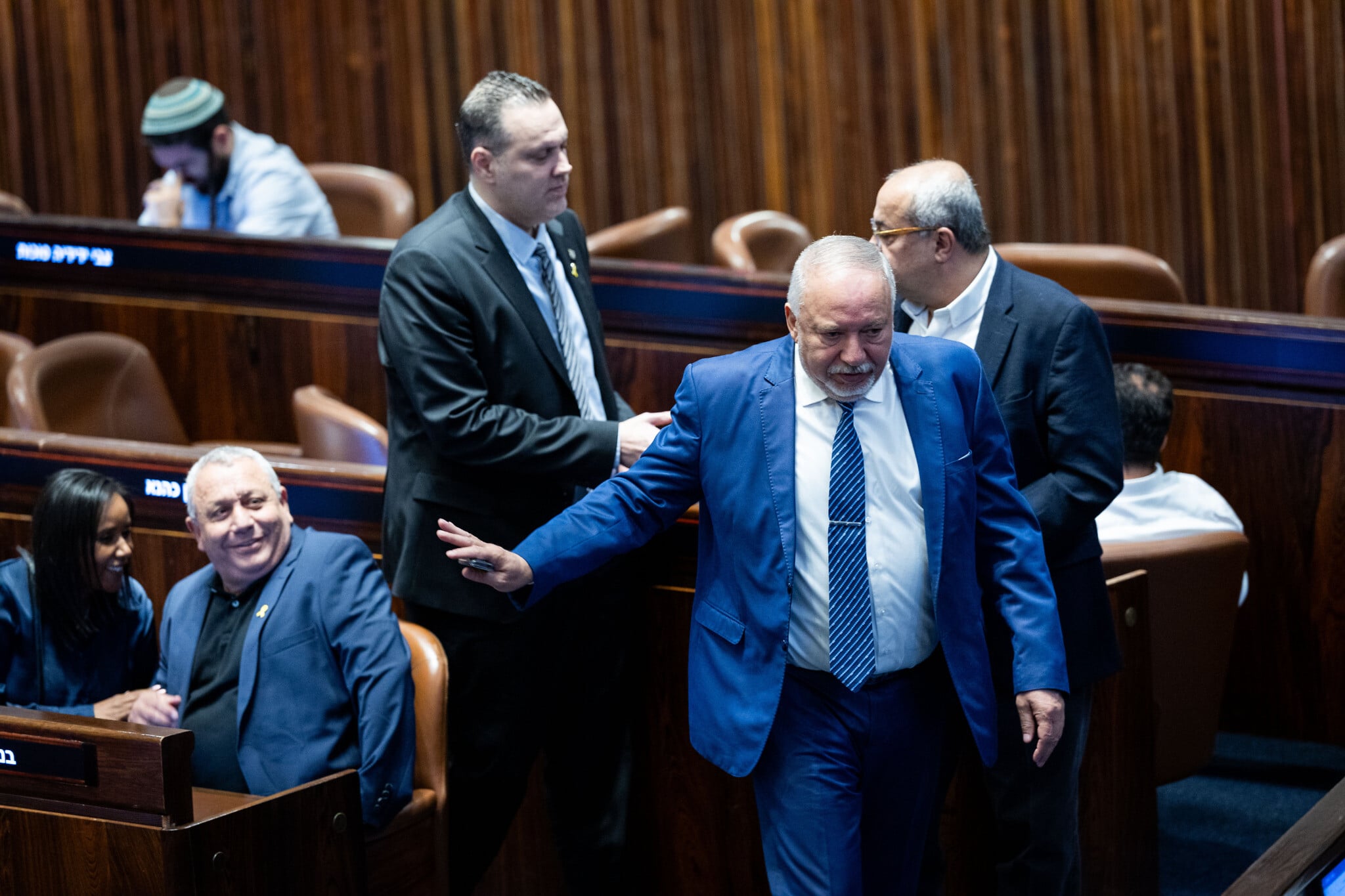
MKs Avigdor Liberman (front right) and Gadi Eisenkot (bottom left) in the Knesset, September 9, 2024. (Yonatan Sindel/Flash90)
Polls show Liberman winning around 10 seats in the October election, making it unlikely that Eisenkot would succeed in forming a minority government without his participation.
In his statement, Liberman also reiterated the key principles that make up Yisrael Beytenu’s 2026 electoral platform.
These included establishing a state commission of inquiry into the October 7, 2023, Hamas-led attack, a matter that he said would be “the government’s first decision” following its formation.
Liberman said Yisrael Beytenu would also demand “a conscription law for all, Jews, Muslims, Christians, Druze, and Circassians, in two tracks — military and civilian,” meaning that those who do not draft to the military would instead perform national service.
Additionally, he said his party would demand the introduction of term limits for prime ministers, a requirement that all schools that receive government funding to teach a core curriculum, and the appointment of a committee of experts to draft a constitution, which would then be approved by way of a national referendum.
Eisenkot pulls ahead in latest TV poll
While Eisenkot appeared to be bracing for results that put his bloc several seats below the required 61, the latest poll published by Channel 12 on Monday showed that it could be just one seat short.
The television poll found that Yashar would be the largest party in the Knesset with 24 seats, followed by Likud with 22.
The third-largest party would be Naftali Bennett and Yair Lapid’s B’Yachad with 15 seats, followed by Yair Golan’s left-wing Democrats with 11.
Liberman’s Yisrael Beytenu was again predicted to pick up 10 seats, while the Ashkenazi ultra-Orthodox United Torah Judaism and ultranationalist Otzma Yehudit would win eight apiece.
Ultra-Orthodox Sephardi party Shas would win seven seats, while Bezalel Smotrich’s Religious Zionism, the Arab-majority Hadash-Ta’al, and Ra’am would walk away with five seats each.
Arab nationalist party Balad and Benny Gantz’s Blue and White would both fall below the electoral threshold, as would the alliance between Yoaz Hendel and Chili Tropper and the one led by Gilad Erdan.
These results would leave the anti-Netanyahu bloc with 70 seats if they were to sit in government with the Arab parties — a prospect Bennett has thus far refused to entertain — or 60 without them, while the bloc led by Netanyahu would have 50 seats.
Help us report truthfully on social media

As a multimedia journalist, my job is to take the quality, fact-based journalism produced by The Times of Israel newsroom and make it accessible across every platform — from Instagram posts to podcasts to short-form videos.
This is how many, especially young people, consume news these days. But misinformation is rampant on social media. Our team at ToI produces accurate, responsible short-form reporting on Israel and the Jewish world.
If you believe in the importance of factual social media journalism, please consider joining our reader support group, The Times of Israel Community. Your financial support is essential to sustain responsible multimedia reporting.
— Gabriella Jacobs, multimedia journalist
Already a member? Sign in to stop seeing this
You’re a dedicated reader

That’s why we started the Times of Israel – to provide discerning readers like you with must-read coverage of Israel and the Jewish world.
So now we have a request. Unlike other news outlets, we haven’t put up a paywall. But as the journalism we do is costly, we invite readers for whom The Times of Israel has become important to help support our work by joining The Times of Israel Community.
For as little as $6 a month you can help support our quality journalism while enjoying The Times of Israel AD-FREE, as well as accessing exclusive content available only to Times of Israel Community members.
Thank you,
David Horovitz, Founding Editor of The Times of Israel