

In a previous article about “The Two Lone Star States” I stated, “Texas is not just Saudi Arabia with cowboy hats,” as a way of describing the diverse economic and industrial landscape beyond the energy sector. I would like to add that Israel is not just the Startup Nation, as the tech ecosystem has evolved beyond early-stage companies and matured into multi-billion-dollar firms leading the globe in nearly every sector.
Historically, Israel has led in biotech, agtech, water and sustainability, cybersecurity, and defense tech. Now, some of the biggest leaps and bounds are in AI and quantum computing, while still helping the planet navigate climate, water, and food scarcity solutions.

photo: courtesy Winslow Swart
Even so, let’s look at this current snapshot as a baseline for where we are heading in our bi-regional trajectory.
A Current Snapshot
For a decade, the Texas-Israel relationship has been described in trade numbers — steady, growing, mostly running through defense, energy, and semiconductors. That description is now out of date. What’s underway in 2026 is a structural shift: two governments formalizing a state-to-state economic presence for the first time, two capital markets exploring a direct bridge, and two AI and cybersecurity sectors moving from informal deal flow into deliberate, built infrastructure. The “Two Lone Star States” framing that’s followed this relationship for years is no longer just a talking point — it’s becoming the operating model.
The Numbers Behind the Momentum
Trade between Texas and Israel reached roughly $4 billion in 2024, with Texas exports to Israel at $757.9 million and imports from Israel into Texas at $3.2 billion, concentrated in industrial machinery, aircraft parts, and plastics alongside the state’s traditional aerospace and petrochemical strengths. Over the past decade, Israeli companies have completed 34 foreign direct investment projects in Texas worth $3.2 billion in capital and more than 4,200 jobs — making Israel the 19th-largest FDI source into the state even as that flow is heavily one-directional, with Texas companies investing a comparatively modest $178.6 million into Israel over the same period.
Capital markets confirm the direction of travel. In February, Texas’s acting comptroller doubled the state’s holdings of Israel bonds to $280 million — the largest single purchase of Israel bonds in Texas history — moving Texas from the sixth- to the second-largest state holder of the securities nationally. On the private side, momentum is building toward direct linkage between exchanges: Texas Israel Partnership CEO David Yaari has pointed to real potential for collaboration between the Tel Aviv Stock Exchange and the new Texas Stock Exchange being built in Dallas, with Bexar County Commissioner Grant Moody separately flagging dual listings and cross-border investment as near-term opportunities for San Antonio-area companies.
Formalizing the Government-to-Government Relationship
The most significant structural change is the State of Texas Israel Office. Following a November 2025 RFP issued by Governor Greg Abbott’s Economic Development and Tourism Office, Texas is finalizing the operator for what will be its first permanent economic outpost in the Middle East and just its fourth international trade office, alongside existing posts in Mexico and Taiwan. Framed by state leaders as an economic rather than symbolic move, the office is expected to serve not just Israel but the broader network of countries connected through the Abraham Accords — positioning Texas as a commercial gateway into the wider region.

Texas Governor Greg Abbott, pictured here with the author, is opening a trade office in Jerusalem led by the Texas Office of Economic Development, designed to advance bi-regional tech transfer. Photo: courtesy Winslow Swart
That institutional push follows a 2025 Memorandum of Understanding between the Texas Association of Business, the Texas Venture Alliance, and Israel’s Start-Up Nation Central, and was reinforced by both chambers of the Texas Legislature passing resolutions in support of the office. As Fleur Hassan-Nahoum, Israel’s special envoy for innovation, put it, a Texas business office in Jerusalem places the world’s eighth-largest economy inside one of the most dynamic innovation ecosystems anywhere.
AI and Cyber: From Deal Flow to Built Infrastructure
David Yahid, co-founder of CET Sandbox in Herzliya, Israel, says,
“Texas is the only state where an Israeli founder can sit with the people writing the requirement, the prime who will integrate the product, the unit that will actually field it, and a customer with a live operational problem, all inside a few hours’ drive. The Army put its transformation headquarters in Austin. The combat aircraft and rotorcraft industrial base sits in Fort Worth. The border and the Gulf supply a real mission set instead of a hypothetical one. That proximity is worth more to an early-stage Israeli company than any grant program, which is exactly why CET Sandbox is building relationships on the ground in Texas right now, with the commands, the primes, and the local investors, so that our companies arrive with introductions already made instead of starting cold. Over the next few years, I expect Texas to stop being a market Israeli companies sell into and start being a place they build from.”
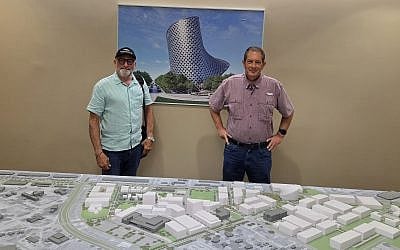
Led by CEO Jim Perschbach, TechPort SA (Boeing TechPort San Antonio) is a premier innovation hub for eVTOL, robotics, and gaming. It serves as a home base for the Air Force’s 16th Wing alongside commercial, global aviation, and cybersecurity operations. Photo: Winslow Swart
The AI wave is where the relationship is moving fastest. In January 2026, the U.S. and Israeli governments launched a formal Strategic Partnership on Artificial Intelligence, Research, and Critical Technologies, with joint initiatives spanning machine learning applications in healthcare, cybersecurity, and autonomous systems, alongside shared technical workforce training — part of a broader framework both governments have called Pax Silica. In August, Israel’s own National AI Directorate published an implementation plan targeting 100,000 AI accelerators domestically and a dedicated push into “Cyber AI” and “Physical AI,” building on a cybersecurity sector that alone drew $3.8 billion in investment in 2024 — 40% of all private U.S. cyber investment that year — and now hosts R&D centers for seven of the world’s ten largest cyber companies.
Building the Connective Tissue
What distinguishes this wave from the last decade of trade activity is the deliberate construction of infrastructure between the two ecosystems, rather than one-off deals. The Texas-Jerusalem trade office, the TASE-Texas Stock Exchange, expanding direct flight routes, and dedicated capital vehicles for Israeli defense-tech are each, individually, modest developments. Together, they function as connective tissue — the institutional plumbing that turns episodic investment into a durable channel of founders, VCs, and policymakers that both sides can actually build on.
That’s the opportunity in front of organizations working this corridor now: the relationship is no longer waiting to be discovered by the next Israeli company scouting a U.S. landing spot or the next Texas investor looking at Tel Aviv. The infrastructure connecting the two Lone Star states is actively being built in 2026 — and the next wave belongs to whoever helps founders, funds, and institutions find each other through it.
So, What’s Next?
$4 billion is only the data point. The bigger story is that Texas and Israel are building the institutional plumbing—government offices, investment channels, accelerators, AI partnerships, and defense-tech pathways—that can make the next decade of innovation flow faster, deeper, and in both directions. Texas offers scale, procurement pathways, infrastructure, capital, and real-world testbeds, while Israel brings frontier technology in AI, cyber, defense, water, agtech, and deep tech. The future will be defined not by individual transactions, but by the systems now being built to connect founders, investors, governments, and markets on both sides.
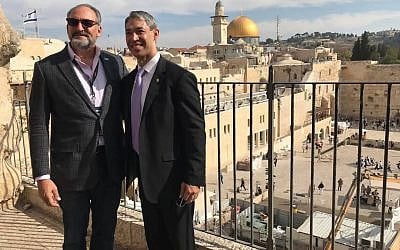
San Antonio Mayor Ron Nirenberg and Winslow Swart seen here on an economic trade mission to Israel, one of several connecting our regions and building vital relationships between policy makers and enterprise in the emerging technologies arena. Photo: Winslow Swart
Winslow Swart, founder at Sabra Ventures Ranch, is a full-stack organizational, leadership and economic development practitioner, facilitator, and speaker serving executives, managers, individual contributors and entrepreneurs regionally and internationally. Working in Texas, Israel, and beyond, Winslow helps public and private entities with international business acceleration, connecting innovation hubs, startup ecosystems, and founders with policy makers and markets.
Winslow also facilitates business transformation through Leadership Development, Strategic Planning, Team and Culture Building, Organizational Effectiveness and Change Management. He also serves as Chief Inspiration Officer at Winslow Consulting.