
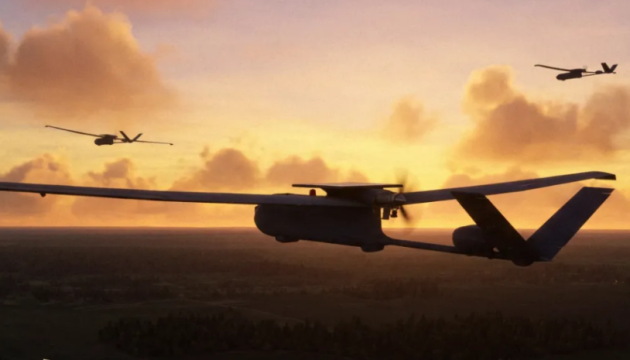
Deep rear areas, that is. As things currently stand, Ukraine has managed to send drones over 2,500km into Russia … to the amazement of most of the world. For the first time in modern history, a European nation has managed to strike beyond the Russian Ural Mountains.
Yep, Ukraine did that. On June 20th, 2026, Ukrainian drones reached beyond the Urals and attacked the Tyumen oil refinery in western Siberia, marking the farthest recorded penetration of Russian territory by a Ukrainian drone. The landmark long-range attack showed for the first time that attacks on major oil refineries, energy infrastructure, and military-industrial complex facilities that were previously considered safe became a real possibility.
But with the news today that the new Dovbush T40 has been officially approved for the Ukrainian military and will go into serial production, such raids deep into the Russian rear areas which for millennia had been perceived as “unreachable”, will become a regular occurrence. Russia is about to go through some things … for sure:
Ukraine has formalized the Dovbush T40 long-range UAV
The Ukrainian Ministry of Defense has officially recognized the new domestically produced unmanned aerial system, the “Dovbush T40.” The drone is designed for long-range reconnaissance, fire control, and precision strikes, and its stated operational range is sufficient to reach targets beyond the Ural Mountains and in Siberia.
One of the system’s key features is its range. According to the Ministry of Defense, it is sufficient to engage targets beyond the Ural Mountains and in Russian Siberia. The drone itself has a wingspan of nearly 5 meters. It can remain airborne for more than a day, allowing it to be used for extended reconnaissance missions. During testing, the “Dovbush T40” confirmed its stated tactical and technical specifications.
The developers also claim that the drone has low radar cross-section. This should make it more difficult for enemy air defense systems to detect it. The drone is equipped with a high-performance engine featuring an electronic fuel injection system. Resistance to electronic warfare measures is cited as a distinct advantage. The “Dovbush T40” can employ various methods of engaging targets. Specifically, the system includes an option where the drone itself serves as a strike vehicle, as well as the capability to drop munitions. The Ministry of Defense notes that the system features state-of-the-art technology and is capable of carrying out missions over long distances.
https://ua.news/en/war-vs-rf/ukrayina-kodifikuvala-dalekobiinii-bpak-dovbush-t40
More here:
Ukraine’s Defense Ministry clears Dovbush T40 strategic drone for military use
Its nearly five metre wingspan and more than 24 hours of endurance point to missions far beyond the immediate battlefield.
Specifications of the Dovbush T40 Drone
The Ministry of Defense noted that the drone has a wingspan of nearly five meters. It can remain airborne for more than a day, allowing it to carry out extended reconnaissance and strike missions.
During testing, the Dovbush T40 confirmed its stated tactical and technical specifications. The system’s key features include:
an extremely low radar signature;
a high-performance engine equipped with an electronic fuel injection system;
use as a kamikaze drone;
the ability to use the aircraft as a platform for dropping munitions;
advanced technological equipment.
Resistance to Electronic Warfare and System Development
The Dovbush T40 is highly resistant to electronic warfare systems. It is manufactured by a Ukrainian company whose unmanned aerial systems are already being used at the front.
But whence the name “Dovbush”? Here is another moment where the characteristically Ukrainian sense of history couched in a pointed wry jab comes to the fore. The term “Dovbush” refers to Oleksa Dovbush (1700–1745), a famous Ukrainian outlaw who became a legendary folk hero known as the “Carpathian Robin Hood” for robbing the rich to give to the poor. Born into extreme poverty; he and his family lived a hardscrabble life in the difficult vertiginous environment of the high Carpathians. Driven by grievances against serfdom and the exploitation of the poor by their noble overlords, Dovbush and his brother Ivan joined and led a movement called the opryshky … an armed band of outlaw peasants resisting feudal oppression. From their remote hideout(now known as “Dovbush Rocks”) Dovbush and the opryshky became famous for their guerrilla tactics against the the high and mighty nobility (mostly Polish at that time), wealthy merchants, usurers, and corrupt collaborationist clergy. They utilized the rugged mountain terrain to their benefit, sallying forth to execute swift strikes to seize wealth accumulated through peasant exploitation. Does that sound like something the Russians have done to Ukrainians for generations?
Oleksa Dovbush’s legacy still resonates in Ukrainian lore … portraying him as a protector who redistributed goods stolen from the rich to give to the destitute peasantry, earning him the title “Ukrainian Robin Hood.” While historical records confirm his role as a bandit leader, popular tradition emphasizes his altruism and resistance against foreign rule. So there you have it … the Dovbush T40, the weapon that will sally forth to execute swift strikes against the Putin’s malignant and exploitative Russia and its serial impositions, depredation and predation of the Ukrainian people. Like Dovbush, modern day ADAPTIVE INDOMITABLE UKRAINE is not gonna take it anymore and is striking back … fiercely.
SLAVA UKRAINI ! PEREMOHA(Victory) !!
We’ll get straight to the point: The financial hardships that Daily Kos is facing this year are tough.
We continue to be paywall-free. We continue to be supported by our readers, not billionaires or corporations. But we need to bring in more revenue. We are leaning on our community more than ever to help make ends meet.
Power matters.