
Western Europe has become so used to Russia’s petty violence on its territory that even assassinating a British defence-firm CEO might not give president Vladimir Putin the “shock” he needs to reassert authority, amid daily humiliations in the Ukraine war.
US intelligence warnings that he was planning to attack a Baltic state or Poland in the “coming months” to fix his strongman image prompted a snap Nato drill involving some 50 military aircraft in the Baltic Sea on Wednesday (20 August), in order to flex deterrence.
But Putin’s foreign minister, Sergei Lavrov, also renewed threats on Tuesday of a strike on the UK, because it had supplied long-range drones to Kyiv.
Lavrov spoke of “consequences”, but Kremlin propagandists, Vladimir Kornilov and Vladimir Solovyov, went on TV urging Russian people to get behind anything and everything, up to a nuclear strike.
And for Artem Voitovych, from the Olgian Strategies defence consultancy firm in Ukraine, there was another reason why a Russian escalation with Nato was becoming more likely – China.
“Chinese president Xi Jinping also wants to see how Nato would deal with a direct attack, due to his own agenda in the South China Sea,” he said, referring to Beijing’s territorial claims against Western allies in Asia, including Taiwan, as well as Japanese and Philippine islands.
“Now, they [the Chinese] have their own clown [Putin], their own puppet, to do it for them,” Voitovych said, given Russia’s dependence on Chinese tech-support in the Ukraine war.
And if Putin did outflank the US intelligence warning by going after the UK instead of a Baltic target, he had various options.
The most realistic ones, for defence experts, would be designed to fall below Nato’s threshold for a united ‘Article 5’ armed response.
These were, in order of escalation: harassing British diplomats in Moscow; a ‘deniable’ cyber-strike on vital British infrastructure (such as energy facilities) or economic interests; cutting UK undersea telecommunications cables; sabotage attacks on British warehouses, trains, or ports shipping weapons to Ukraine; and the assassination of a British defence-firm CEO.

“Psychological pressure on diplomats could involve KGB-type, almost schoolboy-type tricks, such as moving things around in their flats when they’re not home, to show that they’ve been visited,” said Katia Glod from the New Eurasian Strategies Centre (NEST) think-tank in the UK, referring to Russia’s Soviet-era spy service, which is now called the FSB.
Russia has already carried out cyber attacks on UK car maker Jaguar-Land Rover and retailer Marks & Spencer, halting production lines and online shopping services.
It has cut cables in the Baltic Sea and its agents burned down a warehouse storing Ukraine-bound equipment in east London in 2024, as well as starting fires in facilities in Estonia (last Saturday), Germany, and Poland in the past two years.
It has plotted to kill two German defence CEOs (Rheinmetall chief Armin Papperger and Donaustahl boss Stefan Thumann), German and US intelligence has said, and for Jamie Shea, a former senior Nato official, it was “highly likely” a British one could be targeted as well.
“Russia has infiltrated a number of GRU [military intelligence] hit squads into the UK for this purpose … and there’s no reason why only German CEOs would be targeted,” said Shea, who now teaches war studies at Exeter University in the UK.
But the problem with these options, from Putin’s point of view, Shea added, was that they were all “happening already”, meaning that Nato security services were ready for them, while the Western and Russian general publics had become blasé.
“Western intelligence services are clearly now on high alert to track and stop Russian plots,” said Shea.
“It would be just more of the same,” said Glod.
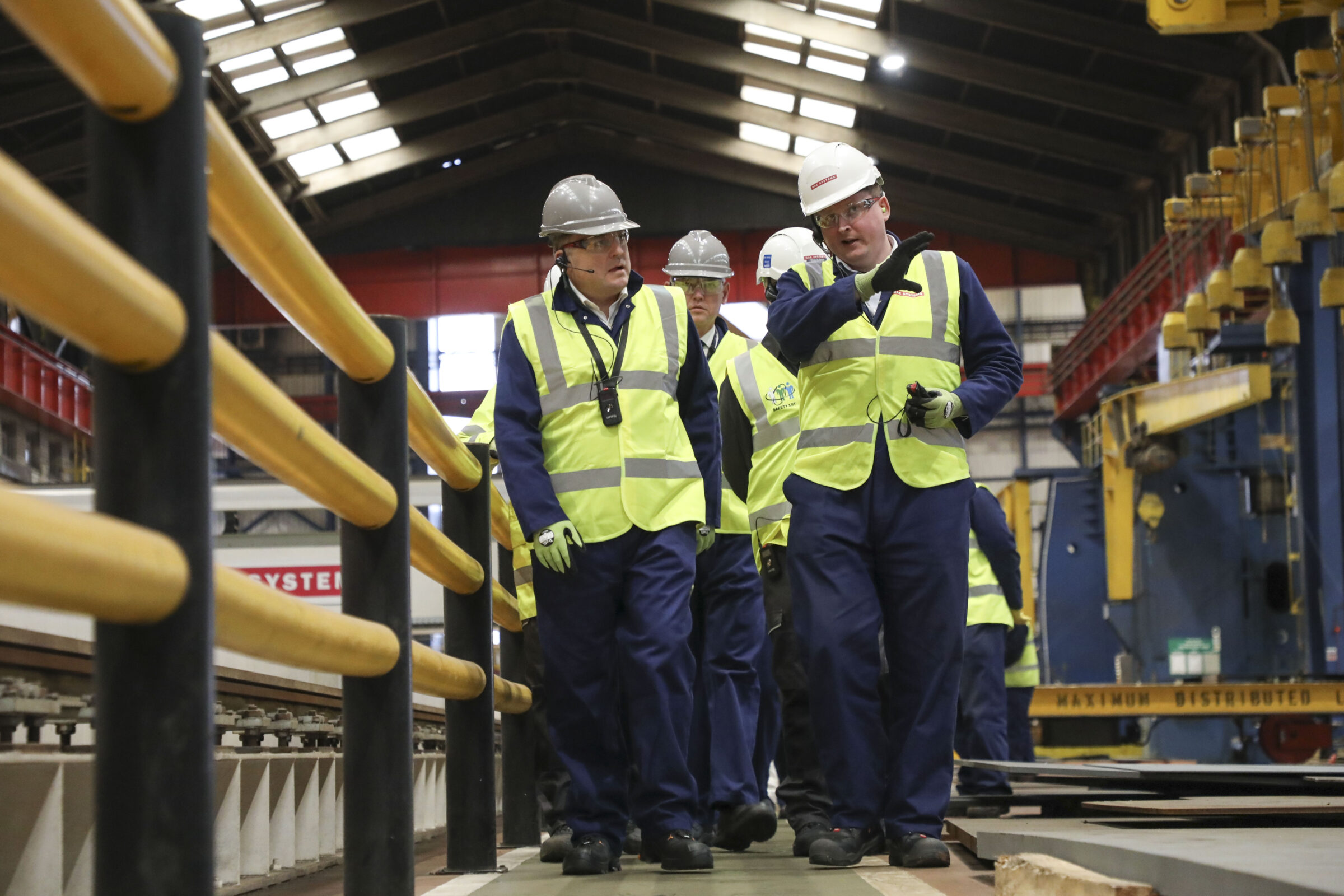 CEO of British defence firm BAE Systems, Charles Woodburn (r), seen as being at risk of Russian ‘hit squads’ (Source: UK Government)
‘Shock effect’
Katja Bego, from British think-tank Chatham House, also said: “They [the Russians] need a shock effect, to come up with something new”.
“They feel backed into a corner and need to signal both domestically and internationally that they have an answer to this [Ukraine’s drone strikes deep in Russian territory],” she said.
A more hawkish option could be to arm and pay a proxy force in Iraq or Syria to kill British soldiers stationed in the Middle East, said NEST’s Glod.