

Prime Minister Benjamin Netanyahu’s government was set to approve a NIS 31 billion ($9 billion) increase to the 2025 state budget on Tuesday, NIS 1.6 billion ($473 million) of which will go toward humanitarian aid for Gaza, the Kan public broadcaster reported.
According to Kan, the increase will primarily go toward defense spending and will be accompanied by an across-the-board cut of 3.35% of ministerial budgets set to go into effect at the beginning of next year.
According to Ynet, the ministries with the larger budgets will lose more to this change, with the National Security Ministry set to face the biggest cut.
The publication added that the government’s budget commissioner, Yogev Gardos, suggested cutting down the coalition’s discretionary funds by NIS 3 billion rather than making sweeping cuts to ministry budgets, but he was shot down by Finance Minister Bezalel Smotrich.
After it was passed in March, the controversial NIS 755 billion ($205 billion) budget was lauded by Smotrich, who declared that it had “everything we need to win on the front and on the home front.” Earlier this month, the far-right politician acknowledged advancing the transfer of billions of shekels from Israeli public coffers toward the provision of humanitarian aid to Gaza, after having previously opposed the entry of any assistance to the Hamas-ruled enclave.
Get The Times of Israel’s Daily Edition
by email and never miss our top stories
By signing up, you agree to the terms
National Security Minister Itamar Ben Gvir and Education Minister Yoav Kisch said in a joint statement on Tuesday morning that they would oppose the budget proposal being presented to the government later that day unless it included funding for security at educational institutions in the coming school year.

National Security Minister Itamar Ben Gvir leads an Otzma Yehudit faction meeting at the Knesset, in Jerusalem, on June 30, 2025. (Chaim Goldberg/Flash90)
“While seeking to increase the budget for humanitarian aid, the Finance Ministry is harming the security of our children,” Ben Gvir said, calling such a move “a disgrace that cannot be accepted.”
The changes to the budget were also opposed by the Knesset’s Haredi parties, which left the government last month as part of a dispute over the conscription of yeshiva students.
According to Kan, the new cuts include most of the funds set aside for Haredi schools’ eventual inclusion in the government’s New Horizon program, which funds work in small groups between teachers and pupils and bumps up teacher salaries, among other initiatives.
The program is currently restricted to state schools and does not apply to independent Haredi institutions, which do not teach secular subjects, and the money is currently being held aside until it can eventually be allocated.
In a statement, United Torah Judaism chairman Yitzhak Goldknopf threatened to oppose additional funds for Settlements and National Projects Minister Orit Strock in the Knesset plenum over the issue.
“It is unacceptable that the education budgets for children of the ultra-Orthodox community are cut again and again in favor of a budget whose goals and purposes are shrouded in fog,” he said.
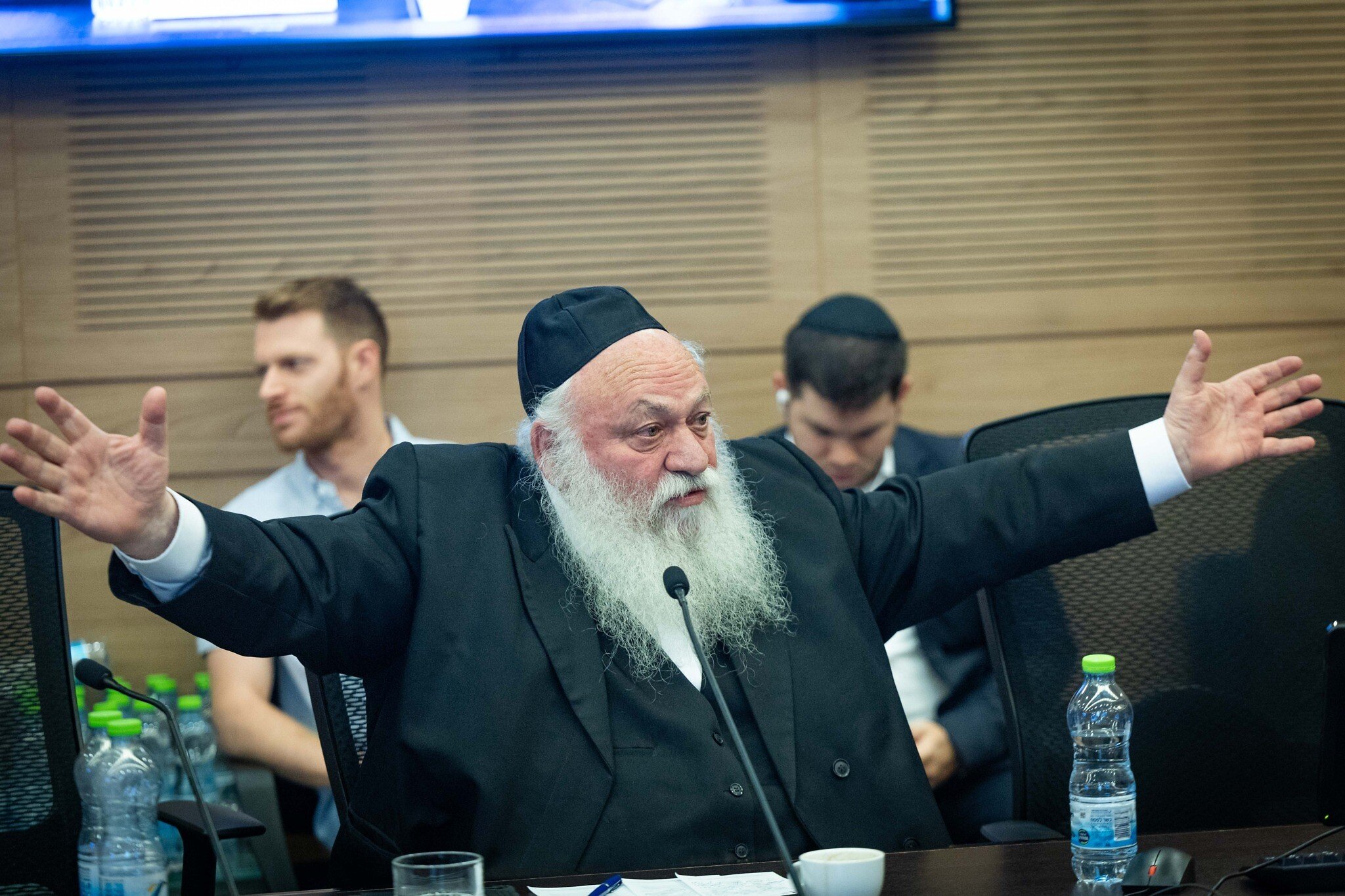
United Torah Judaism chairman Yitzhak Goldknopf attends a Knesset House Committee meeting, August 4, 2025. (Yonatan Sindel/Flash90)
United Torah Judaism MK Moshe Gafni appeared to threaten to vote against increases to the defense budget in response to the diversion of New Horizon funds.
Cutting these funds violates commitments made by the coalition, and “we will continue to fight with all our strength to protect the rights due to Haredi teaching staff,” said Gafni, who recently stepped down as the chairman of the Knesset Finance Committee after his party left the coalition over the conscription dispute.
“In parallel, next month, when the defense budget comes up for approval in the Knesset and the Finance Committee, which is supposed to be approved today in the Cabinet meeting, we will consult the great Torah sages on how to vote, in light of all the recent developments,” he added.
Opposition leader Yair Lapid also spoke out against the move in a post on X on Tuesday in which he accused Smotrich of prioritizing funds for Shifa hospital in Gaza over Soroka Medical Center, which suffered extensive damage when it was hit by an Iranian rocket during the Iran-Israel war in June.
Times of Israel staff contributed to this report.
Is The Times of Israel important to you?
If so, we have a request.
Every day, even during war, our journalists keep you abreast of the most important developments that merit your attention. Millions of people rely on ToI for fast, fair and free coverage of Israel and the Jewish world.
We care about Israel – and we know you do too. So today, we have an ask: show your appreciation for our work by joining The Times of Israel Community, an exclusive group for readers like you who appreciate and financially support our work.
Already a member? Sign in to stop seeing this
You appreciate our journalism

You clearly find our careful reporting valuable, in a time when facts are often distorted and news coverage often lacks context.
Your support is essential to continue our work. We want to continue delivering the professional journalism you value, even as the demands on our newsroom have grown dramatically since October 7.
So today, please consider joining our reader support group, The Times of Israel Community. For as little as $6 a month you’ll become our partners while enjoying The Times of Israel AD-FREE, as well as accessing exclusive content available only to Times of Israel Community members.
Thank you,
David Horovitz, Founding Editor of The Times of Israel