
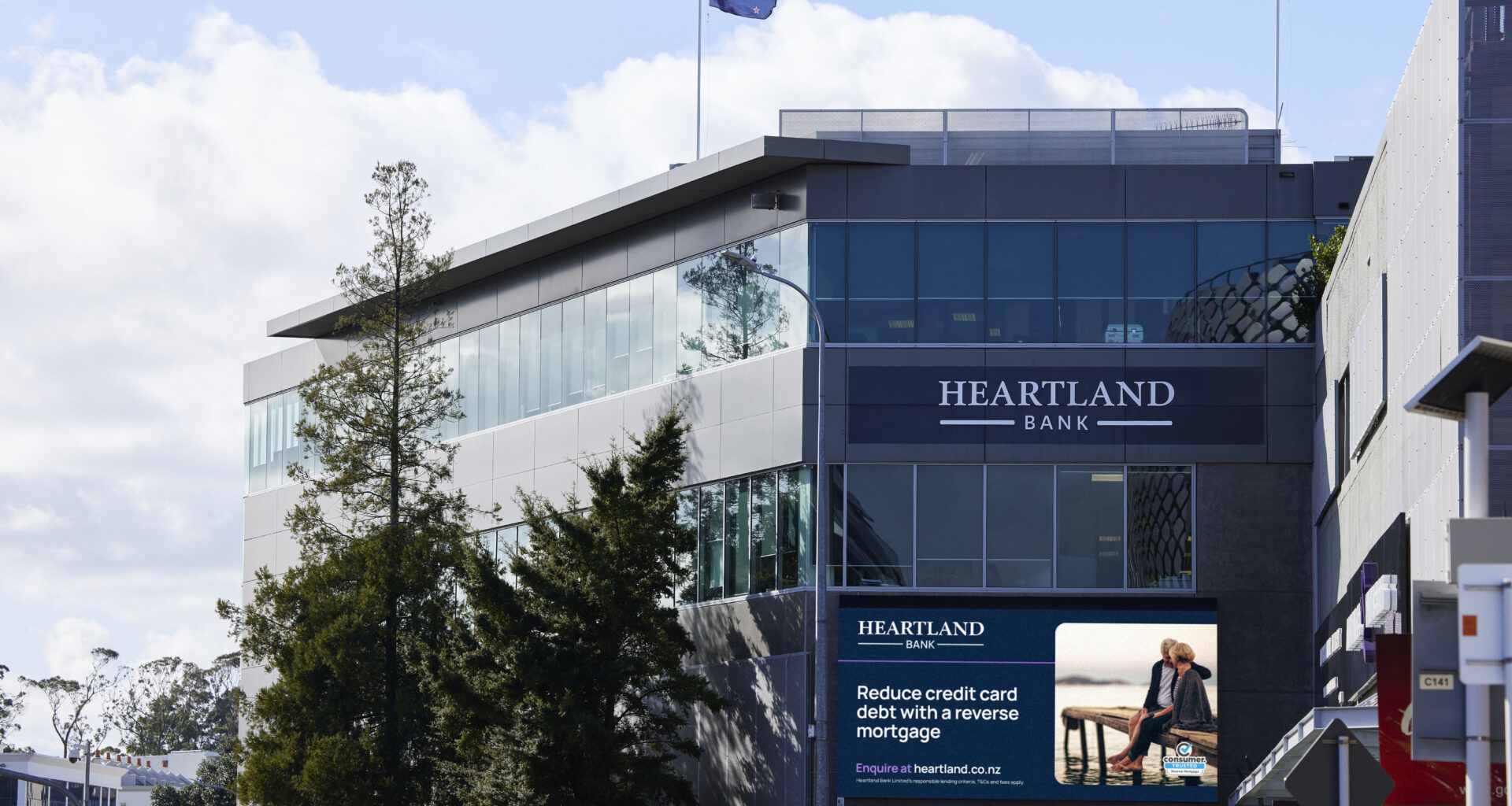
When Heartland Group reports its annual financial results on Thursday, attention will focus squarely on the growth of its reverse mortgage loan books in New Zealand and Australia.
Updating the market in April, the bank forecast normalised annual net profit of at least $45 million.
That’s a far cry from the $110.2 million it posted in the June 2023 year, before poor returns from its non-reverse mortgage lending began to drag on profitability.
Former CFO Andrew Dixson, who took over from Jeff Greenslade as CEO in September 2024, has set about extricating the bank from poor-performing legacy business surviving from the 2011 weld-together of CBS Canterbury, Southern Cross Building Society, MARAC Finance, and PGG Wrightson Finance.
Not all of it needs jettisoning.
Livestock finance has been a recent high-performer in New Zealand and Australia, with minimal impairment issues.
Within the $689 million NZ Rural portfolio, livestock loans reached $189 million at 31 March. And Australian livestock grew strongly, to A$285 million (NZ$313 million).


But motor finance is being extensively reconditioned, and some more recent ventures into business and mortgage lending misfired.
In motors, where Heartland had $1.592 billion of loans at 31 March, the bank has been tightening up on collections and recoveries and attempting to transition to higher-quality lending.
The Open for Business online lending platform launched in 2016 is closed to applications and running down, although Heartland remains a business lender.
Also running down is the Online Home Loans Product, whose launch coincided with the first Covid lockdown of March 2020.
That leaves reverse mortgages, the jewel in Heartland’s crown.
In the April update, Heartland reported a group-level third-quarter net interest margin (NIM), the difference between the interest inflows from its lending and the interest payments it makes to depositors and other lenders, of 3.69%.
At a country level NIM was 3.92% in New Zealand and 3.31% in Australia.
Reverse mortgages (RMs), according to Forsyth Barr analyst Andrew Harvey-Green, have consistently yielded returns above Heartland’s cost of equity.
Harvey-Green says RMs currently (31 March) comprise around a third of Heartland’s net assets. Securing a re-rating by investors will require two things.
Firstly, the bank will need to allocate more capital to reverse mortgages, and ensure they remain as rewarding as they have done to date.
Second, Heartland will have to squeeze improved performance from its other lending, a feat that might prove challenging in the current subdued NZ economy.
Growing the RM book will be challenging too as early tailwinds subside on both sides of the Tasman.
In New Zealand, Heartland has a market share of over 90%. The only other player of even modest scale is SBS Bank, which had a $96 million RM book at 31 March, compared to Heartland’s (April) $1.192 billion.
But that dominant market position represents the lower-hanging fruit. It will have to work hard now to grow the market, including getting a new generation of asset-rich, cash-poor retirees comfortable with the product, Harvey-Green says.
In Australia, which the bank entered in 2014, Heartland’s RM book has grown to A$1.884 billion (NZ$2.072 billion). But a raft of challengers have entered the market.
Household Capital has issued A$590 million of RM loans since 2019, Gateway Bank’s book grew last year to A$260 million, and newcomer Inviva reached A$150 million of loans early this year.
In addition the Australian Government’s relatively cheap Home Equity Access Scheme has grown rapidly following a 2022 expansion, albeit with eligibility restricted to smaller loans.
Heartland is addressing the more competitive Australian environment by shifting its early reliance on wholesale funding to cheaper retail deposit funding, and said in April it expected to be 80% retail-funded by June 2025, “supporting NIM expansion.”
Forsyth Barr’s Harvey-Green is forecasting normalised (underlying) net profit of $46.2 million for Heartland’s June-year, growing to $83.3 million in its 2026 financial year and $105.7 million in 2027.
*This article was first published in our email for paying subscribers early on Monday morning. See here for more details and how to subscribe.