
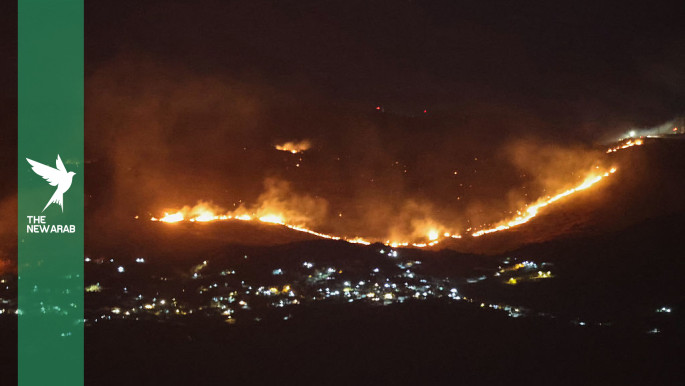
“During the previous war, around 8,500 hectares (85 square kilometres) of land was burnt,” Abdallah said, while this year, “the Israelis have burnt around 7,500 hectares”, including 350 hectares after the June deal. [Getty]
Lebanese officials and residents report that the Israeli military is systematically sparking blazes that have burnt swathes of forest and farmland in the country’s south as part of its policy of “ecocide”.
In the village of Shaqra, Haidar Qoteish, 36, says he has watched fires devour fields and orchards in his hometown of Hula, just five kilometres (three miles) away but under Israeli military control.
“They’ve burnt everything. You can see the fields are all black,” the father of four told AFP by telephone.
“Those whose land they didn’t burn, they’ve bulldozed,” he said. “It’s a great loss, and there’s nothing we can do.”
Lebanon’s governmental National Council for Scientific Research (CNRS) says Israeli military activity has caused 160 square kilometres of land, half of it agricultural, to go up in flames since hostilities between Israel and Hezbollah began in October 2023.
‘Scorched earth’ policy
Despite an alleged ceasfire since June, Israel continues to bomb the south and has been demolishing border villages.
Lebanon’s Prime Minister Nawaf Salam said Israel is pursuing a “scorched-earth policy” in the south.
Hussein Fakih, the head of the civil defence agency for the Nabatieh region, said that since July his teams have observed fires both inside and adjacent to areas where Israeli troops are stationed.
He told AFP the blazes had been sparked by Israeli “bombs and drones” and sometimes incendiary phosphorous shells and cluster munitions.
In Kfarshuba, which abuts Israel’s “security zone”, mayor Qassem al-Qadri said an Israeli attack this month sparked a fire that spread across a broad area of “mostly forest”.
He said residents desperately tried to fight the blaze themselves while waiting for the Israeli army to grant firefighters access to the area, in accordance with a ceasefire monitoring mechanism.
They only got the green light “the following day when the fire had burnt everything”, said the civil defence’s Fakih.
Kfarshuba residents with property close to Israeli positions are afraid to take fire prevention measures like clearing undergrowth, the mayor said.
“They talk about the ‘security zone’ but… we don’t know where its (exact) boundaries are,” Qadri added. “We feel like the whole area is under Israeli control.”
‘Ecocide’
Environment Minister Tamara Elzein has condemned what she called “ecocide” in the south, stressing Israel’s army is “deliberately” burning swathes of Lebanese land.
CNRS director Chadi Abdallah told AFP “fires were limited to the border strip” during the 2023-2024 hostilities, but have broadened since the conflict reignited this year.
He said the Israeli army is “systematically burning land” and is “trying to create a buffer zone devoid of homes, people and the natural environment”.
“During the previous war, around 8,500 hectares (85 square kilometres) of land was burnt,” Abdallah said, while this year, “the Israelis have burnt around 7,500 hectares”, including 350 hectares after the June deal.
CNRS satellite imagery showed formerly green areas that have now disappeared due to fires, as well as Israel’s bulldozing and uprooting of vegetation.
Lebanon’s state-run National News Agency this month said Israeli forces had uprooted 600 olive trees in one southern village alone.
Lebanese environmental group Green Southerners says it has recorded widespread damage to forest, woods and farmland since 2023.
This month, it warned that “major nature reserves in southern Lebanon have also been subjected to extensive and repeated destruction”.
In Shaqra, Qoteish lamented the environmental losses.
“Demolished homes maybe can be rebuilt in a year, but trees don’t grow back” so quickly, he said.