
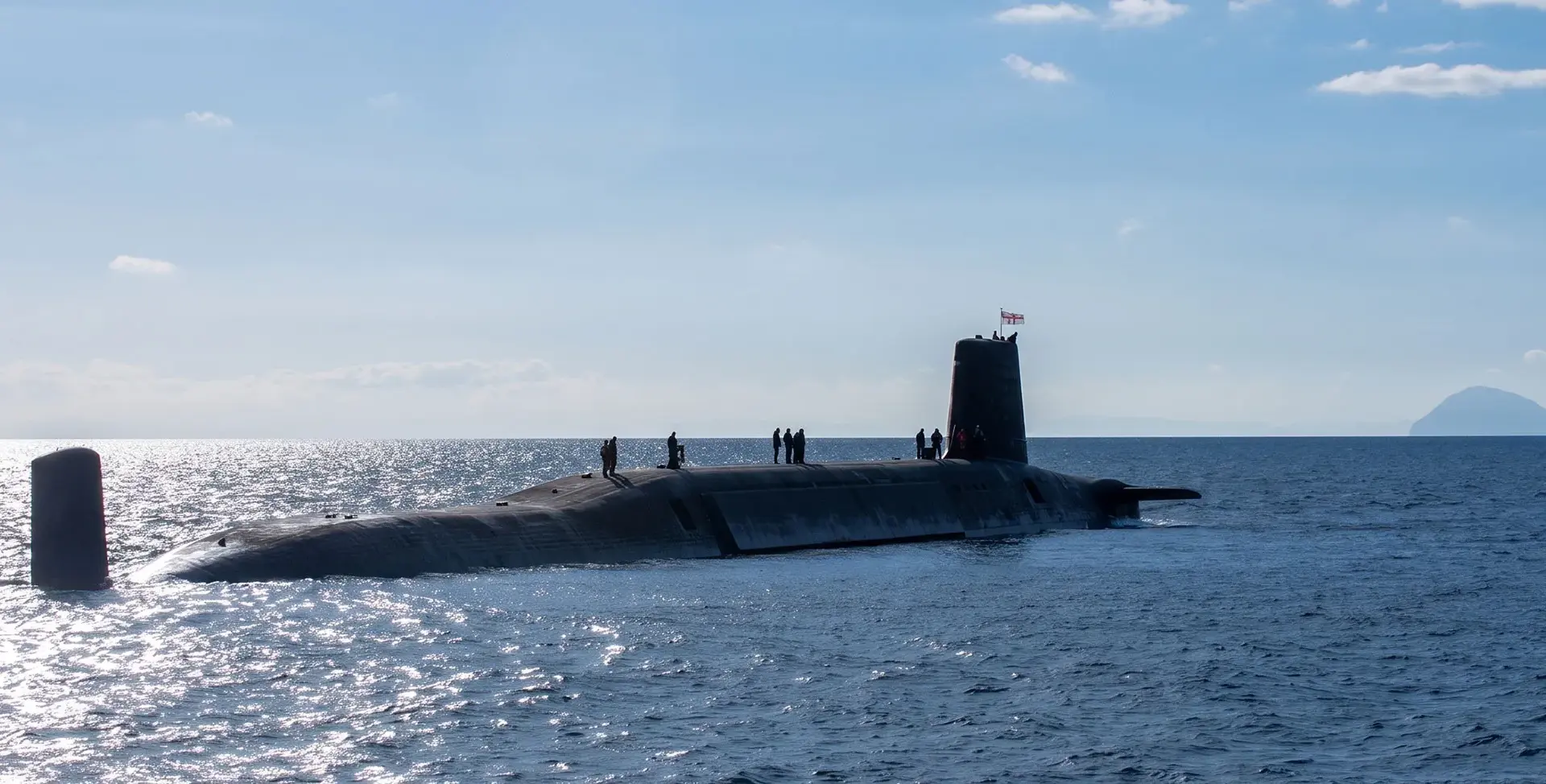
Reports in the Telegraph that Germany is considering financial and military support for Britain’s nuclear weapons are part of a widening debate over European defence. Berlin could help protect the bases and reinforce the conventional forces around them, but access to the deterrent itself would remain tightly controlled by London and constrained by Washington.
Under the British umbrella
The UK deterrent carried by the Royal Navy’s submarines has been assigned to the defence of NATO since the Nassau Agreement of 1962, and British declaratory policy has long stated that nuclear weapons would be considered only in extreme circumstances of self-defence, including the defence of NATO allies. Under existing arrangements that, admittedly, have never been stress-tested in a real conflict, a nuclear attack on Germany would be an attack on a NATO member and would trigger Article 5 consultations. It would not, however, create an automatic British obligation to launch nuclear weapons. That enormous decision would remain with the Prime Minister. The UK is the only European ally to commit its strategic deterrent to the defence of the Alliance, so Germany is covered whether or not it contributes financially.
Berlin is hedging. France and the UK took their nuclear cooperation to a new level with the Northwood Declaration of July 2025, which put coordination of both nations’ forces on the table for the first time. But French doctrine is more self-interested and remains centred on national survival; France stays outside NATO’s nuclear planning, and Macron leaves office next year with successors who may be even be less enthusiastic about sharing. Britain, by contrast, assigns its deterrent to NATO, making it a more natural anchor for allies who want assurance inside the alliance rather than be led by Paris.
German money could still buy credibility. Extended deterrence has always faced the question posed by Charles de Gaulle in the 1960s: would Washington trade New York for Paris? Moscow could ask whether London would trade Birmingham for Berlin. A Germany with a financial and operational stake in the deterrent, a greater role in consultation and forces protecting the bases would make the promise more credible, both to the Kremlin and to a German public that has been told for decades that its past meant it should never aspire to nuclear ownership.
Since the withdrawal of the WE.177 free-fall nuclear bomb in 1998, Trident has been Britain’s only nuclear weapon system. It can theoretically be used in a sub-strategic role, but until the recent change of policy, has no dedicated, sovereign weapon designed specifically for that rung of the escalation ladder. The DIP confirmed the purchase of 12 F-35A aircraft supposedly for the UK’s eventual participation in NATO’s Dual Capable Aircraft nuclear mission. Attaining this as an operational capability is some way off but would give the RAF a role in delivering US nuclear weapons under NATO arrangements. The situation was further confused in July when AVM Jim Beck, the RAF’s Director Capability and Programmes, said: “We did not buy those aircraft for their dual capability, we bought them for our conversion unit. At the same time, we stated we would get back into the [nuclear] role supporting NATO. The two are separate functions.”
A Russian limited nuclear strike would leave a British prime minister choosing between using Trident in a sub-strategic role, escalating to a strategic response or declining to respond with nuclear weapons. Germany, which hosts American B61 bombs at Büchel under NATO nuclear sharing, understands the logic of a graduated response.
 The UK is purchasing 12 F-35A jets, supposedly to be ‘double-hatted’ for the F-35 Operational Conversion Unit (Pilot training) and the Dual Capable Aircraft nuclear mission.Independent while dependent
The British deterrent is operationally independent, but technically and legally entangled with the United States. The 1958 UK-US Mutual Defence Agreement governs the exchange of nuclear materials, information, technology and submarine reactor technology. Its provisions were placed on an enduring basis in 2024. The 1963 Polaris Sales Agreement, amended in 1982 to cover Trident, provides the missiles. They are drawn from a US-managed pool maintained at Kings Bay in Georgia rather than owned outright by the UK.
The Astraea replacement warhead is being developed alongside the American W93 programme and is expected to use a common aeroshell design. The PWR3 reactor for the Dreadnought class also draws on US design work. The agreements give Britain substantial access, but only within a tightly controlled bilateral framework. Information supplied by the United States is protected under the Atomic Energy Act and can only be shared under formal agreements for cooperation. Onward transfer is prohibited. German engineers, officials or companies could not simply be given access to the warhead, missile, reactor compartment or fire-control system. Any such involvement would require explicit American approval. No third party has been granted comparable access to the UK-US strategic nuclear system.
Money and infrastructure are different matters. In principle, Berlin could contribute to the redevelopment of Faslane and Coulport, the Barrow expansion, non-nuclear sections of submarine construction or the conventional forces that protect the sites. Such arrangements would still raise complex political, legal and security questions, and Washington would expect to be consulted.
The funding question
The financial argument is the strongest part of the case. Germany now has access to a much larger defence budget than in the past. Its regular defence budget for 2026 is €82.7Bn (£70.8Bn), with a further €25.5Bn (£21.8Bn) from the Bundeswehr special fund, giving total direct allocations of €108.2Bn (£92.6Bn). Berlin has also cited a broader total of around €124Bn (£106Bn), although comparisons with the UK depend on the accounting basis used. The UK spent £60.2Bn (€70.3Bn) on defence in 2024-25 and is expected to reach around £79Bn (€92.3Bn) in 2029-30.
The pressure of nuclear expenditure is increasingly impacting the rest of UK defence. The DIP says Defence Nuclear Enterprise (DNE) expenditure has risen substantially and will account for between 20-25% of the defence budget in the coming years. More than £63Bn is allocated over four years to the defence nuclear programme, including Dreadnought, SSN-AUKUS, the replacement warhead and nuclear infrastructure. A further £8.4Bn for Dreadnought Delivery Phase 4 was announced in July. The pressure on the conventional fleet is obvious. Escort numbers are at a historic low, Type 26 deliveries stretch into the 2030s, Astute SSN availability has been very poor and weapons stocks and personnel remain short across the fleet. DNE also competes directly for money, industrial capacity and skilled people needed elsewhere in the RN. While some argue we should abandon the deterrent on cost grounds, this would be a strategic disaster for the UK and for Europe.
A German contribution that freed even a fraction of the nuclear bill would allow savings to flow back into conventional forces. Berlin would want visible returns for such a major political decision. Germany’s own record also suggests caution. Berlin has cancelled the troubled F126 frigate programme after major delays and cost growth, replacing it with a plan to acquire up to eight MEKO A-200 frigates. Its rearmament is heavy on ambition, but delivery matters more than budget announcements.
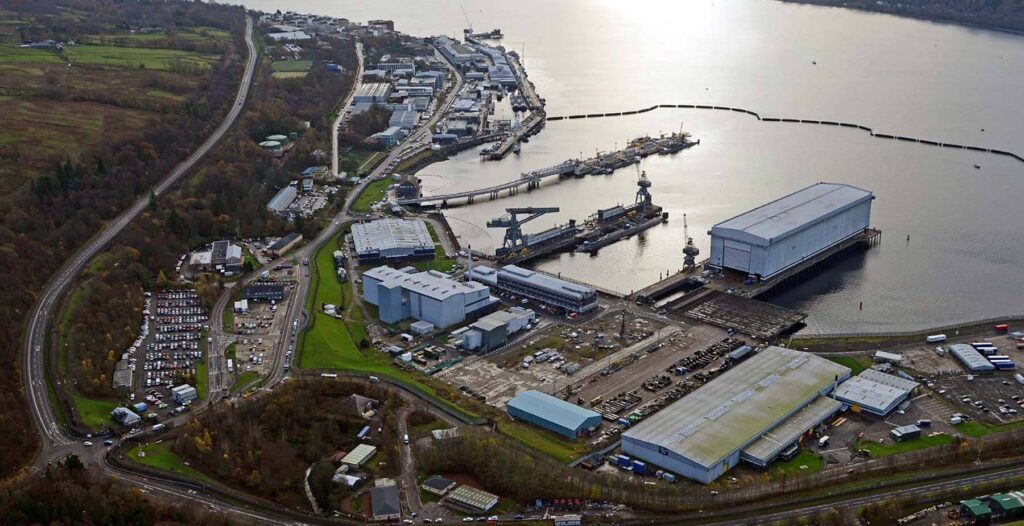 Like most UK defence installations, Faslane naval base and the Coulport armaments depot currently have no air defence against missile or drone attacks.Protecting the bases
The most tangible element of the reported discussions is conventional protection for the bases. Faslane, Coulport and Barrow do not have permanent, dedicated ground-based air defence. The Army’s Sky Sabre force is being doubled, with additional systems due to enter service in 2027. Even after that increase, Sky Sabre will remain an Army system that must compete for trained personnel and deployments with other defence tasks.
The appearance of the hypersonic conventional/nuclear missile-equipped frigate, RFS Admiral Kasatonov, off Fehmarn island in Northern Germany this month, reportedly with its transponder switched off, was a reminder of the threat posed by Russian warships operating close to European coastlines. A vessel carrying long-range cruise or hypersonic missiles can present a serious problem for bases that are not permanently protected by layered air and missile defence.
German Patriot batteries around the Gare Loch would be a neat reversal of history. For much of the Cold War, the British Army of the Rhine and RAF Germany stood guard on German soil against the Soviet Union. The last British formations left Germany in 2020. Now a Bundeswehr brigade is deploying to Lithuania, and German P-8 Poseidon maritime patrol aircraft operate from Lossiemouth. A German air defence unit protecting the British deterrent would complete the circle and is perhaps the most realistic and likely initial contribution. Foreign troops defending Faslane may prove easier to sell to the public in Scotland than the submarines they protect.
The naval contribution is less visible but potentially more useful. Germany plans to acquire up to eight MEKO A-200 frigates, primarily for anti-submarine warfare (ASW), and is acquiring U212CD submarines with Norway. Although their primary focus is the Baltic, the Trinity House Agreement already provides a framework for closer naval cooperation in the North Atlantic. German vessels operating in the Greenland-Iceland-UK gap and the Clyde approaches could contribute significantly to the security of the deterrent and are a role for which the Bundesmarine is building relevant equipment and expertise. European states used to look to the UK as the reliable leader on maritime security in the region, but the criminal neglect of the Royal Navy by successive governments has eroded that trust. The RN is now struggling to protect even its own nuclear deterrent submarines, something that will not have escaped the notice of the Germans, who are reassured by nuclear forces independent of the increasingly unreliable United States.
What the RN gains
The potential gains are clear. Anglo-German cooperation could spread a burden the UK is struggling to carry, improve protection for the nuclear bases, add ASW capacity in waters where the RN is thin and reduce the pressure on countries such as Poland and those in the Nordic region to consider acquiring nuclear weapons of their own.
The risks are equally clear. A paying partner will eventually want a hearing on how the money is used and possibly on doctrine. Washington holds a veto over anything that touches protected technology. German domestic politics may not survive the first serious debate about what a deterrent is for, and Britain could end up with a new dependency layered on top of its existing reliance on the United States. The most realistic action should probably be based on frameworks that already exist. Patriot batteries at Faslane, German P-8 operations and frigates in the North Atlantic can be discussed within NATO and the Anglo-German Trinity House defence arrangements.