
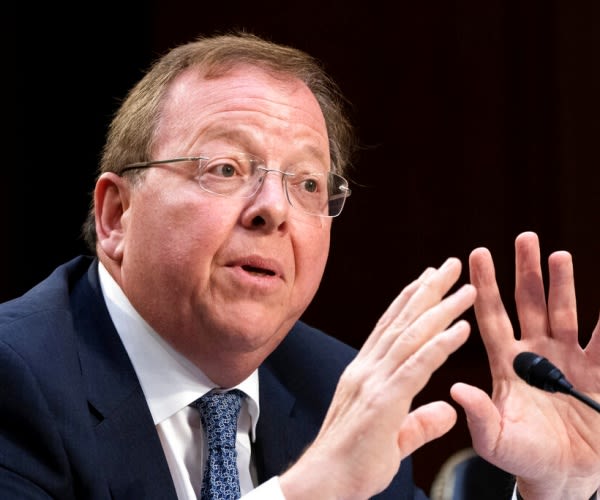

Robert Pape (Jacquelyn Martin/AP)
University of Chicago political scientist Robert Pape is warning that the Trump administration’s new maximum-pressure sanctions campaign against Iran could backfire dramatically — hardening Tehran, provoking attacks against U.S. partners and ultimately pulling Washington into a much larger military conflict.
In a wide-ranging interview streamed Monday on podcaster Mario Nawfal’s YouTube show, Pape argued that economic sanctions have repeatedly been presented as an alternative to war but have often become a pathway to greater military escalation.
The interview was titled “Trump’s Sanctions ‘The Ultimate Escalation Trap,’ War Now Imminent.”
“Sanctions are just another escalation trap,” Pape told Nawfal. “There are no two bigger escalation traps than bombing regimes and economic blockades.”
Pape said the sanctions could succeed in inflicting severe economic pain on Iran but still fail at their larger objective.
“They are likely to be tactically successful and strategically fail,” he said, predicting the pressure would not topple Iran’s government but instead “harden the regime” and increase pressure for further U.S. escalation.
Pape identified what he called several “fatal flaws” in Treasury Secretary Scott Bessent’s sanctions strategy.
Most important, he argued, is that Washington has effectively put regime change back on the table, turning the conflict into what Iranian leaders and regime supporters will view as an existential struggle.
That, Pape said, makes a negotiated compromise less likely.
“This is now … unconditional surrender demands,” Pape said.
Pape also disputed the premise that enough economic punishment will break Iran’s military or political leadership. He pointed to Germany during World War I, Japan before Pearl Harbor, Saddam Hussein’s Iraq and more recent Western sanctions against Russia as examples of countries absorbing enormous economic punishment without capitulating.
His most ominous comparison was Japan in 1941.
Pape argued that U.S. oil sanctions created a shrinking window for Tokyo and helped persuade Japanese leaders to gamble on attacking Pearl Harbor despite understanding the enormous risks of war with the United States.
“The sanctions created a window,” Pape said. Faced with what its leaders believed would eventually mean political and economic strangulation, Japan chose what Pape described as a military “Hail Mary.”
“The tougher the sanctions, the more they are going to topple the regime in Iran, the more likely the lashback,” he warned.
Iran, Pape predicts, will also adapt economically. Tehran can increasingly move oil and other goods through its extensive land connections with Pakistan, Turkey, and other neighbors.
He noted that Iran has roughly 3,600 miles of land borders, making a truly airtight economic blockade difficult without military enforcement.
That is where Pape sees the greatest danger.
If sanctions prove ineffective, Washington could face demands to strike railways, bridges, transportation corridors, and other infrastructure moving goods into and out of Iran. What begins as financial pressure could gradually require air strikes and eventually ground forces to enforce.
“This is the road to ground escalation,” Pape said.
He also warned that Iran would retaliate against countries helping Washington enforce the blockade, singling out the United Arab Emirates as particularly vulnerable.
Pape said Tehran’s new military leadership has already threatened Gulf governments that materially cooperate with the United States.
“It’s going to be the UAE. It’s going to be Dubai. It’s going to [be] Abu Dhabi,” Pape warned, arguing that Iran could target economic interests there in response to attacks on its own civilian economy.
Pape’s comments come after Bessent last week unveiled the administration’s “Economic D-Day” sanctions plan targeting Iran and its trading partners, which will also face U.S. enforcement actions.
China has been Iran’s largest oil trading partner and Beijing was quick to hit back at the U.S. plan.
China’s Foreign Ministry spokesman said China strongly opposed America’s “illegal unilateral sanctions” and warned Beijing would take “all necessary measures” to protect its right to trade.
On Thursday, Russia announced it would work with Iran to address the sanctions, Russian Foreign Ministry spokeswoman Maria Zakharova said.
Zakharova told reporters in Moscow that Moscow “rejects the use of unilateral and coercive measures that it considers illegal and contrary to the UN Charter.”
Pape is a professor of political science at the University of Chicago and founding director of the Chicago Project on Security and Threats.
His research has focused extensively on air power, economic coercion, terrorism and political violence. His books include Bombing to Win: Air Power and Coercion in War and Dying to Win: The Strategic Logic of Suicide Terrorism.
His bottom line on Iran is stark: economic pressure may hurt Tehran badly, but pain does not necessarily produce surrender.
Instead, Pape argues, Iran is increasingly fighting what it sees as a “life or death battle” — and the greater the pressure becomes, the greater the incentive for Tehran to strike back, triggering another round of American escalation.
© 2026 Newsmax. All rights reserved.