
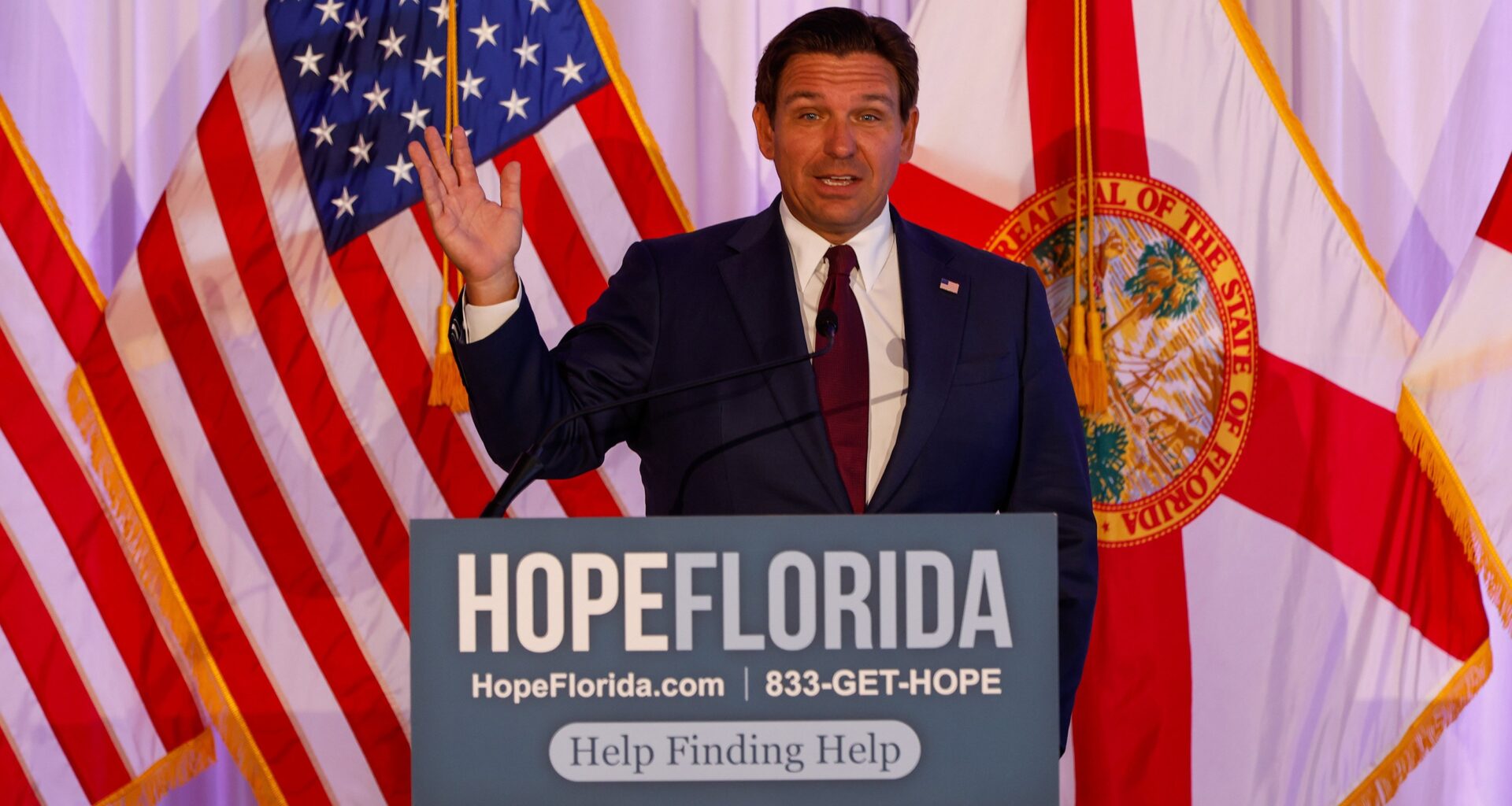
TALLAHASSEE — A scathing grand jury report on the Hope Florida scandal found that top members of the DeSantis administration took part in a “sophisticated scheme” to divert $10 million of a Medicaid settlement intended for poor, sick children to “political purposes” instead.
The leaked report, obtained by CBS News Miami, said Attorney General James Uthmeier, who at the time was chief of staff for Gov. Ron DeSantis, was in a “position of authority” over the people involved in the settlement agreement.
That agreement wrongly sent the $10 million, which should have been returned to the state budget, into GOP-backed political action committees with the Hope Florida Foundation — a charity First Lady Casey DeSantis championed — serving as the conduit, the report found.
U.S. Sen. Ashley Moody, then Florida’s attorney general, knew about the settlement negotiations and authorized her chief deputy to sign the settlement agreement, the report added.
Though the report also castigated several DeSantis staffers and Hope Florida officials for failing to conduct “due diligence” before rushing to disburse the $10 million, it said there was insufficient evidence to charge anyone with a crime because no one would “take responsibility” for key decisions.
“Nobody will take responsibility for deciding the $10 million of taxpayer money would go to Hope Florida,” the report said, calling that decision “the original misappropriation.”
“We can plainly see that taxpayer money was misused for political purposes and we would like to see changes made to prevent this from happening again,” the report said.
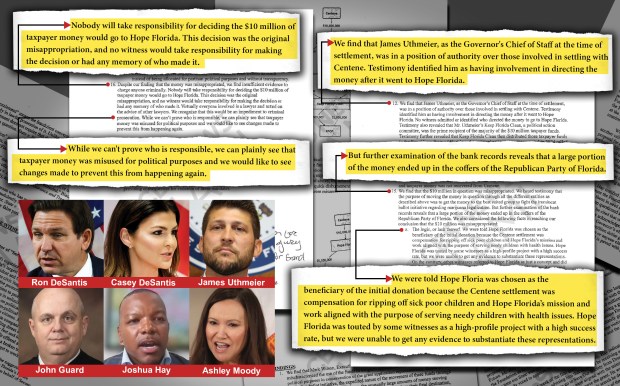 The Hope Florida scandal involved many key staff members in Gov. Ron DeSantis’ administration, a grand jury report said, finding that $10 million from a Medicaid settlement, which should have been returned to the state budget, was wrongly diverted into GOP-backed political action committees with the Hope Florida Foundation — which First Lady Casey DeSantis championed — serving as the conduit. The report found that: Attorney General James Uthmeier, then the governor’s chief of staff, was “in a position of authority” over the settlement money; John Guard, now an appeals court judge, but then Deputy Attorney General had “reservations” about the settlement deal but signed it “without conducting his due diligence;” Joshua Hay, then chairman of the Hope Florida Foundation, acted “without due diligence;” and Ashley Moody, now one of Florida’s U.S. Senators, was then Florida’s attorney general and authorized her deputy to sign the settlement. (Photo illustration: Rich Pope/Orlando Sentinel; Photos: Orlando Sentinel file; Report: CBS News Miami)
The report was the subject of an intense, behind-the-scenes court battle over its release that dragged on for seven months. CBS News Miami first reported on its contents this week. Its release sparked outrage among state Democratic lawmakers, who demanded that both Uthmeier and Moody resign. David Jolly, the Democratic candidate for governor, said he wants to reopen the Hope Florida investigtion if elected, and called on his Republican rival, Byron Donalds to do the same.
Both Uthmeier and Moody are running in the November elections to hang onto the seats that DeSantis appointed them to last year. Both denied wrongdoing, with Uthmeier’s office telling CBS News Miami the release of the grand jury report the only crime that had been committed related to Hope Florida.
DeSantis, in a news conference Thursday, defended his administration’s actions. “The settlement agreement … was legally sound, appropriate and advanced the interests of the state,” he said.
But the grand jury said the $10 million should not have been peeled off the settlement with Centene Corporation, which had overcharged the state for prescription medications. Instead of going back to health care for low-income children, the money was used for a DeSantis-backed effort to fight a proposed 2024 state constitutional amendment to legalize marijuana and to fund the Republican Party of Florida, it said.
Democrats said it was clear top DeSantis officials orchestrated the deal.
“For months, Ashley Moody has hidden from the Florida press, dodged the voters and refused to answer for her role in the Hope Florida scandal,” said Angie Nixon, a Democratic state representative from Jacksonville challenging Moody for the U.S. Senate. “Today, the grand jury report confirmed what we already knew; that she knew exactly what was happening.”
In a social media post Thursday, Moody denied any involvement in negotiating the settlement agreement or deciding how the money would be spent, calling such claims “disengenous.”
But grand jury testimony showed that the people at the negotiating table were in constant contact with her deputy chief attorney general and other lawyers.
The grand jury report said the entire settlement agreement was a taxpayer reimbursement. The money was part of a larger $67 million settlement with the Centene Corporation, a Medicaid vendor, and the decision to “donate” the $10 million of that to Hope Florida was intended to circumvent Florida law.
Uthmeier directed most of the $10 million to two political committees fighting passage of the marijuana amendment. Those committees then donated to Keep Florida Clean, a committee chaired by Uthmeier.
“Testimony identified (Uthmeier) as having involvement in directing the money after it went to Hope Florida,” the report said. “Testimony also revealed that Mr. Uthmeier’s Keep Florida Clean, a political action committee, was the prime recipient of the majority of the $10 million taxpayer funds.”
The report also found that Moody authorized her chief deputy at the time, John Guard, to sign the settlement agreement. Guard signed the settlement agreement, despite his reservations about the $10 million going to Hope Florida, and “without conducting his due diligence to ensure the proper appropriation of taxpayer funds,” the report said.
In January, DeSantis appointed Guard to serve as a judge on the Second Circuit Court of Appeal in January.
Jason Weida, who was head of the Agency for Health Care Administration at the time and is now DeSantis’ chief of staff, said the $10 million was a “bonus” on top of the settlement agreement with Centene. But the grand jury rejected that reasoning. It said that was not a credible argument because it conflicts with Centene’s original settlement offer that $10.8 million was to reimburse the state for any additional future damage claims. And it noted Centene’s lawyers had reservations about stripping $10 million off the top of the settlement agreement to give to Hope Florida.
“Hence, this money was part of the damages Centene owed to Florida’s taxpayers,” the grand jury said.
The Hope Florida board, which got the $10 million, met in October 2024 and approved splitting the money evenly between two committees, Save Our Society From Drugs and Secure Florida’s Future. The grand jury found the chairs of both those organizations “mischaracterized the use of the funds” in their grant applications for that money.
Joshua Hay, who was the chairman of the board of Hope Florida Foundation at the time, acted without “due diligence” by receiving such a large, unique donation and using it all to fulfill two grant requests “well above Hope Florida’s normal grant amounts previously seen,” the report said.
His testimony also conflicted with that of Jeff Aaron, the charity’s attorney. Hay said that Aaron was the person who told him about the $10 million donation coming its way, but Aaron said he didn’t know about the $10 million donation until Rep. Alex Andrade, a Panhandle Republican, began his legislative investigation last spring.
The grand jury was convened in October 2025 by Leon County State Attorney Jack Campbell to investigate the circumstances surrounding the distribution of the $10 million.
The investigation followed months of news reports about the scheme, after Andrade held committee hearings questioning state officials and Hope Florida board members about the transfer. The grand jury concluded its work in January, and its report was sealed.
Neither DeSantis, Uthmeier or Moody were called to testify before the grand jury.
The grand jury also questioned the work of Hope Florida, which the DeSantis’ touted as a way to get Floridians off welfare.
Some witnesses told the grand jury, “Hope Florida’s mission and work aligned with the purpose of serving needy children with health issues” and so it was a valid recipient of the $10 million.
But the grand jury said it could not obtain any evidence to substantiate testimony that Hope Florida was a high-profile project with a high success rate.
“On the contrary, other witnesses referred to Hope Florida as just a concept and did not have a clear understanding of what it did, where it existed, or how it operated,” the report said. “So, we fail to see the nexus between Hope Florida and the Centene settlement, and even if there was a nexus, it was rendered moot by the fact that the money only stayed in Hope Florida’s account for a couple days.”
The grand jury report concludes with two recommendations — that the Legislature pass a law to prevent something like this from occurring again, and pass “clear laws setting requirements” for how nonprofits like the Hope Florida Foundation can use taxpayer funds, making sure those funds are monitored and providing penalties for violating any new laws.