
Sign up for the Slatest to get the most insightful analysis, criticism, and advice out there, delivered to your inbox daily.
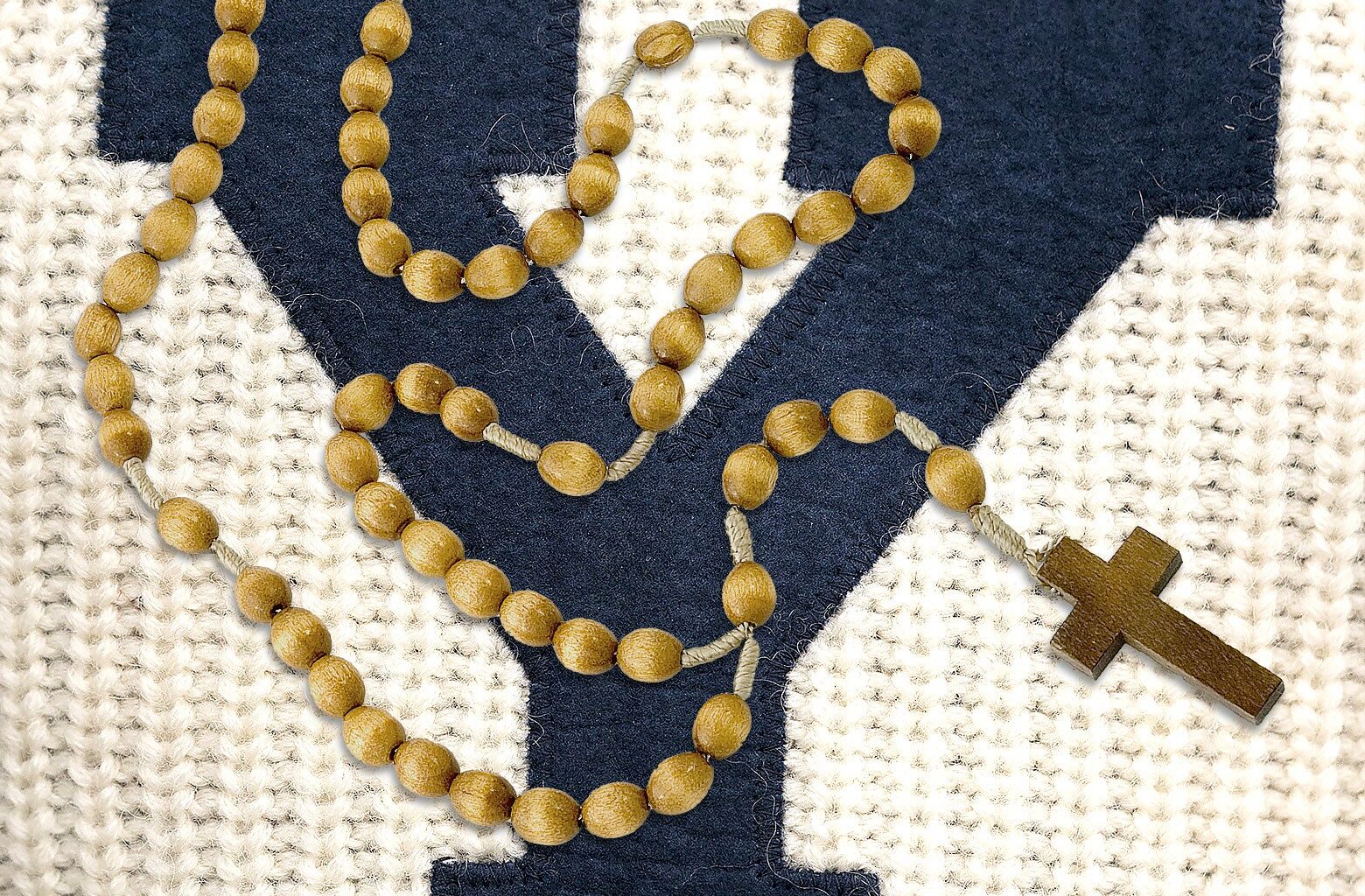
Around the United States, as you’ve probably heard, Gen Z Catholics are heading to the pews in eye-popping numbers. They meet up in pizzerias and follow one another on social media. They flock to Catholic student organizations, which are booming. And at Yale University, where I teach Latin American and global history, they attend classes and public lectures to learn about their faith.
The trend has surprised many in my department. Last spring, the most popular history course at Yale was The Catholic Intellectual Tradition, a survey of Catholic thinking and writing from the first century to the present. It beat out such popular, evergreen classes as The Birth of Europe and The Roman Empire. I was asked to assist with this 85-student course as a teaching fellow. Each week, after scrolling past calls to defund the humanities and to automate the many jobs that make a liberal arts education possible, I found myself surrounded by eager students ready to engage with fourth-century Christology, medieval mysticism, World War II–era debates over “just war” theory, and much more.
I, too, was surprised by these developments. I was an undergraduate at Yale from 2014 to 2018. My freshman year, only 13 people took The Catholic Intellectual Tradition. Instead, my peers and I spent those formative years reading postcolonial theory, taking classes on gender and ethnic studies, and railing against the Western, or “Eurocentric,” canon. When I entered graduate school, my research on Latin American anti-poverty debates alerted me to Catholic intellectuals’ rich tradition of studying poverty, violence, suffering, and disease. Even so, I struggled to see how I could make those texts relevant to my students’ lives.
Faculty at leading universities have, in recent years, avoided religious history on the premise that such topics as the Reformation and Puritanism are unexciting and stale. Hiring for scholars of religious life has also been minimal in the past decade. By and large, however, scholars at the nation’s top schools have ceded important cultural ground to unquestioningly patriotic religious education movements, such as the ones now funneling students from K–12 schools to a growing number of “trad” Catholic colleges and beyond. That’s depriving many bright young minds of the opportunity to encounter faith as an object of serious academic inquiry. Universities need to do more to connect with religious and, given recent trends, Catholic students, exposing them to the complexity and diversity of Catholic thought. Such schooling would help students see their faith as a living and relevant part of the world, rather than as a siloed-off identity or ideology.
Today the U.S.-born pope roots for the White Sox, defends migrants, and speaks about artificial intelligence. Meanwhile, leading American politicians and commentators debate the applicability of just war theory to the war in Iran. As it turned out, my students last spring had no trouble seeing how readings from Catholic history related to current events like the Trump administration’s attacks on sanctuary cities and the U.S. bombing of boats in the Caribbean.

Nick Ripatrazone
I’ve Taught High School English for 22 Years. Here’s What the Debate Over Standardized Testing Is Missing.
Read More
To be sure, an 85-person lecture at an Ivy League university does not signal lasting student demand for teaching on a given topic. But at a moment when “trad” Catholic institutions like Rosary College and Wyoming Catholic College are growing despite funding declines and turbulence across the education sector, professors and administrators should take heed. The nation’s universities must step up to the task of educating tolerant and broad-minded Catholic leaders. Failing to do so risks alienating some of the students who most stand to benefit from engaging with the liberal arts.
At Yale, I know exactly what that should look like. Courses on Catholic history should engage women’s voices. My students and I read the 12th-century anchorite Julian of Norwich, a saint in the Anglican faith and the first known woman to write a book in the English language. We also read the journalist and activist Dorothy Day, whose blistering critiques of inequality resonate with students nearly a century after her conversion to Catholicism in 1927. Such texts are a reminder that women have long been among the most astute interpreters of religious and social life.
This Content is Available for Slate Plus members only
I Teach at Yale. There Are Gen Z Catholics All Around Me. I Know What Must Be Done.
This Content is Available for Slate Plus members only
Donald Trump’s 19-Year-Old Granddaughter Did What Grandpa Could Not
Courses on Catholicism should also probe the history of what my department used to call, until recently, Rest of World. From the 1500s to the present, Catholicism has profoundly shaped the histories of Africa, Europe, and Latin America. Today Catholicism and evangelical devotion are exploding in Africa, and in the United States, the majority of Gen Z Catholics are Latinx. Finally, teaching about Catholicism should explore the intersection of Catholic and queer history, a field that the late Yale historian John Boswell pioneered in the 1980s.
Catholicism has a lengthy and complex past, one that cannot be flattened into sound bites or stripped of its many paradoxes. How else could the Christian God be one and three? How else could Julian of Norwich say that sin is both nonexistent and necessary? As Boswell repeatedly showed, the Catholic Church long treated queer figures with tolerance and respect. Wrestling with this and other seeming paradoxes can only strengthen students’ moral imaginations.
My grandfather, a lapsed seminarian, loves to quote a line from Augustine of Hippo: “Tolle, lege” (“Take this and read”). I used to hear that as an imperative, a command to read the “classics” of Western civilization. Now I hear the phrase’s gentler side, which encourages curiosity and openness. The Gen Z Catholic boom has set many cassocked hearts ablaze. Catholics across the country are eager to welcome young believers. May the universities—and their scholars’ zeal for exploring rich and complicated pasts—be there, too.