
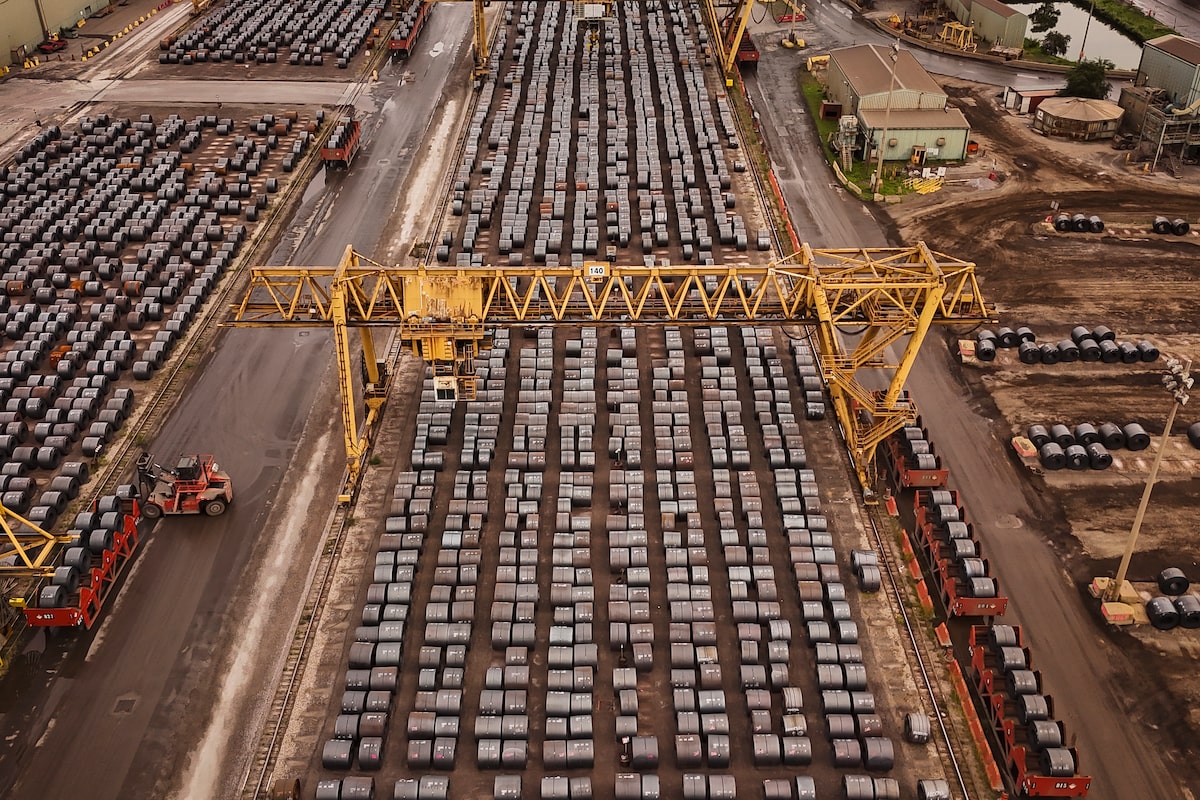
StatCan reported back in May that real GDP declined slightly in the first quarter, fueling debates over whether a recession had hit the economy.Nick Iwanyshyn/The Canadian Press
Canada’s economy rebounded sharply in the second quarter after six months of virtually no growth, aided by strong jump in exports and solid domestic demand, data showed on Friday.
The economy grew at an annualized rate of 3.3 per cent in the second quarter, following an upwardly revised 0.3 per cent in the first quarter, Statistics Canada said.
With the first quarter revision, which was previously a slight contraction, Canada was not in a technical recession, which is usually two consecutive quarters of contraction.
Healthy domestic demand, led by consumer spending and business investments, signals the economy is slowly brushing off the impacts of more than 18 months of U.S. tariffs that upended North American supply chains and increased costs.
A strong domestic consumption and expenditure pattern also puts Canada on a firm footing to withstand a new 50 per cent U.S. tariffs that President Donald Trump imposed this week. Canada retaliated with its own countermeasures.
On a quarterly basis, the GDP grew at 0.8 per cent for the quarter ending June, from an upwardly revised 0.1 per cent in the previous quarter.
The second quarter annualized growth was higher than the Bank of Canada’s forecast of 2.5 per cent growth it projected in July.
Higher exports were one of the main contributing factors for the second quarter growth with outbound shipments growing 3.6 per cent, its fastest pace in over three years, Statscan said.
Final domestic demand, the sum total of all consumption and capital spending and a crucial metric to assess domestic health, rebounded to one per cent in the second quarter, from a minor contraction in Q1.
This number has been largely muted for the last several quarters as consumers and businesses stayed cautious as Canada navigated a trade war.
Investors and economists also closely watch the GDP numbers to judge whether the economy is being held up by important levers such as consumer spending and private investment or being propped up by government support.
The household final consumption expenditure, the main indicator of consumer spending, rose 0.8 per cent, its highest level in three quarters, highlighting strong household spending trend.
Business investment, or business gross fixed capital formation, sprung to a solid 2.3 per cent growth in the second quarter from a contraction of 1.3 per cent. This is the first time in the last year and a half that businesses investment has expanded.
The growth was led by both residential structures and non-residential structures, machinery and equipment categories, Statscan said.
However, the general gross fixed capital formation, essentially government expenditure for creating assets, continued to decline with the second quarter contraction at 2.9 per cent, after shrinking 2.6 per cent in the previous quarter.
On a month-month basis, the GDP for June grew at 0.3 per cent against a forecast of 0.2 per cent and an advanced indicator showed that the economy was largely flat in July, the statistics agency said.