
The unusual visit by CIA Director John Ratcliffe to Moscow this week has raised concern among U.S. allies in the West over a possible renewed rapprochement between U.S. President Donald Trump and Russian President Vladimir Putin.
Trump strongly denied a Wall Street Journal report claiming that Ratcliffe had warned his Russian interlocutors against an attack on NATO. Politico reported that Ratcliffe instead urged Russian officials to reduce Moscow’s military and economic support for Iran.
(Photo: AP Photo/Julia Demaree Nikhinson, shutterstock)
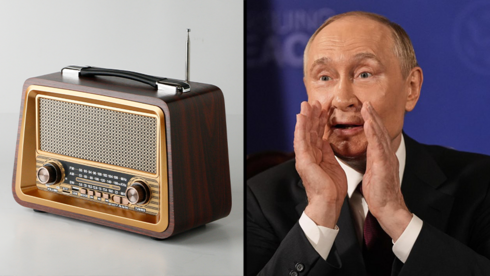
It is still too early to know whether Ratcliffe’s visit had any effect on Russian policy. But one development that added to the sense of mystery surrounding the trip was the unusual activity of UVB-76, the enigmatic shortwave station often nicknamed “Doomsday Radio.” The station began operating in the Soviet Union in the 1970s on a frequency of 4,625 kilohertz. Its official purpose has never been publicly disclosed.
Over the years, theories have suggested that it serves as a military communications channel for transmitting messages to Russian units, or as a means of communicating with Russian intelligence operatives around the world.
The station usually broadcasts a short, monotonous buzzing sound. Occasionally, the buzz is interrupted by spoken Russian words, numbers or combinations of letters. Western media have reported for years that intelligence services in several countries closely monitor its transmissions.
According to The Moscow Times, the station’s buzzing was interrupted at least 25 times on Thursday, roughly a day after Ratcliffe’s visit to Moscow. The broadcasts included numbers, words and letter combinations. Among the words reportedly heard were “waitress,” “spray” and “existence.”
The last time the mysterious station was reportedly this active was on Feb. 12, 2025, the day Trump and Putin spoke for the first time since Trump returned to the White House for his second term. Even Kremlin-linked media outlets reported on this week’s unusual burst of activity.
As far as is known, Ratcliffe met during his Moscow visit with his Russian counterpart, Foreign Intelligence Service chief Sergei Naryshkin. Kremlin spokesman Dmitry Peskov said Putin did not meet with the visiting CIA director. Russian Foreign Minister Sergei Lavrov addressed the visit Friday, saying the discreet nature of contacts between intelligence agencies should not come as a surprise.
“The non-public nature of interaction between intelligence agencies, which traditionally work ‘quietly,’ should not be surprising,” Lavrov said. “There are rules according to which intelligence agencies interact, and there is nothing surprising about that. They conduct this work quietly. We diplomats also work largely quietly. But by tradition, we are obliged to say something.”
The coded messages as broadcast after Ratcliffe’s visit


After Ratcliffe’s visit, Moscow also stepped up its rhetoric toward Britain. Russian Foreign Ministry spokeswoman Maria Zakharova warned Thursday that Russia could strike British military targets because of London’s military support for Ukraine.
“Any British military facility and equipment in Ukraine and beyond may become a target for retaliatory strikes over Ukrainian attacks using British weapons on Russian territory,” Zakharova said. “Those guilty of war crimes, including against our civilian population, will be punished and held accountable for their actions.”
Lavrov joined the criticism of Britain on Friday. “Britain plays the most negative role in the conflict in Ukraine, both in relation to Russia and to Western countries,” he said. “It has been this way for centuries. Britain has always had partners for the journey, not allies. The United States is no exception. They have always looked down on everyone to some extent.
“All the conflicts that erupted in our region were imported from outside. It always came from the British and the Europeans. Always from Europe.”
The recent developments, including Ratcliffe’s Moscow visit, have also stirred concern in Western Europe, particularly in the Baltic states bordering Russia. Lithuania, Latvia and Estonia each maintain relatively small militaries and have long viewed Russia as their primary security threat.
Their concern has intensified amid doubts over NATO’s future effectiveness and amid Trump’s repeated criticism of the alliance. Although Russia remains deeply engaged in its war in Ukraine, it still represents a significant military threat to the Baltic region.
Latvian President Edgars Rinkevics sought to reassure the public, writing on X that the country’s assessment of the immediate military threat had not changed. “As for the current situation, the level of military threat and its assessment have not changed,” he wrote. “At present, the risk of a direct Russian invasion remains low. What is possible are various acts of sabotage, cyberattacks and hybrid operations.”
Rinkevics said Latvia’s Interior Ministry, armed forces and NATO allies were taking steps to prevent such actions. “We greatly appreciate NATO’s political, diplomatic and military efforts, including those of the United States, aimed at strengthening regional security,” he said.