
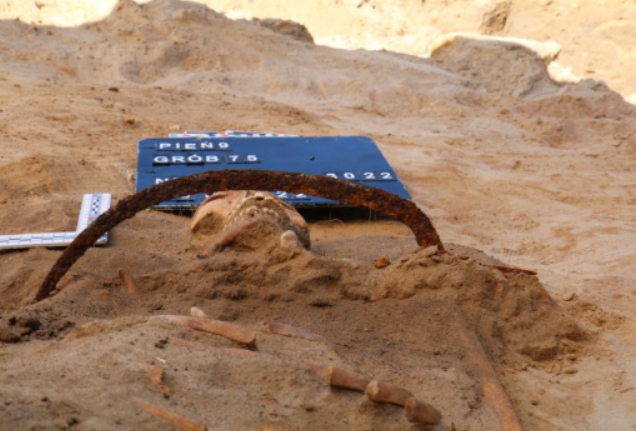
A 17th-century woman buried with a sickle at her throat and a padlock on her toe is beginning to tell her story—and it’s not a simple vampire tale. New research on “Zosia,” unearthed in 2022 near the village of Pien in northern Poland, uses DNA, isotope testing, and textile analysis to probe who she was and why locals feared the young woman enough to “secure” her grave twice, CNN reports. The sickle, added after burial but before full decomposition, was positioned to sever her neck if she rose, while a triangular padlock had been clasped to her big toe, though it was found unlocked.
Researchers also found traces of a copper-and-gold object placed in her mouth or nose, likely another anti-demonic measure. The grave sits in a 17th-century cemetery used for about four generations and filled with what archaeologists call “deviant” burials: bodies face down, stones around skulls, more sickles and padlocks. While the word “vampire” wasn’t widely in use at the time, such burials have become known as vampire burials, CNN notes. Researchers believe it was a Protestant burial ground due to the lack of crosses and other items typically buried with Catholics at the time. Isotope data suggests Zosia probably grew up locally, and mitochondrial DNA hints at possible Scandinavian maternal roots, though experts say that’s far from definitive.
What does seem clear: she came from money. Silk fabric near her skull carried pure gold and silver threads—richer than royal garments of the era. Researchers hope to determine her cause of death with further analysis of DNA samples. The team has yet to determine exactly why she was considered so dangerous after death. Zosia’s grave and others in the Pien cemetery “vividly illustrate superstitions, including the tendency to blame the deceased for misfortunes and the fear of the unknown in the 17th-century Polish-Lithuanian Commonwealth,” researchers wrote in a study published in the Journal of Archaeological Science.