
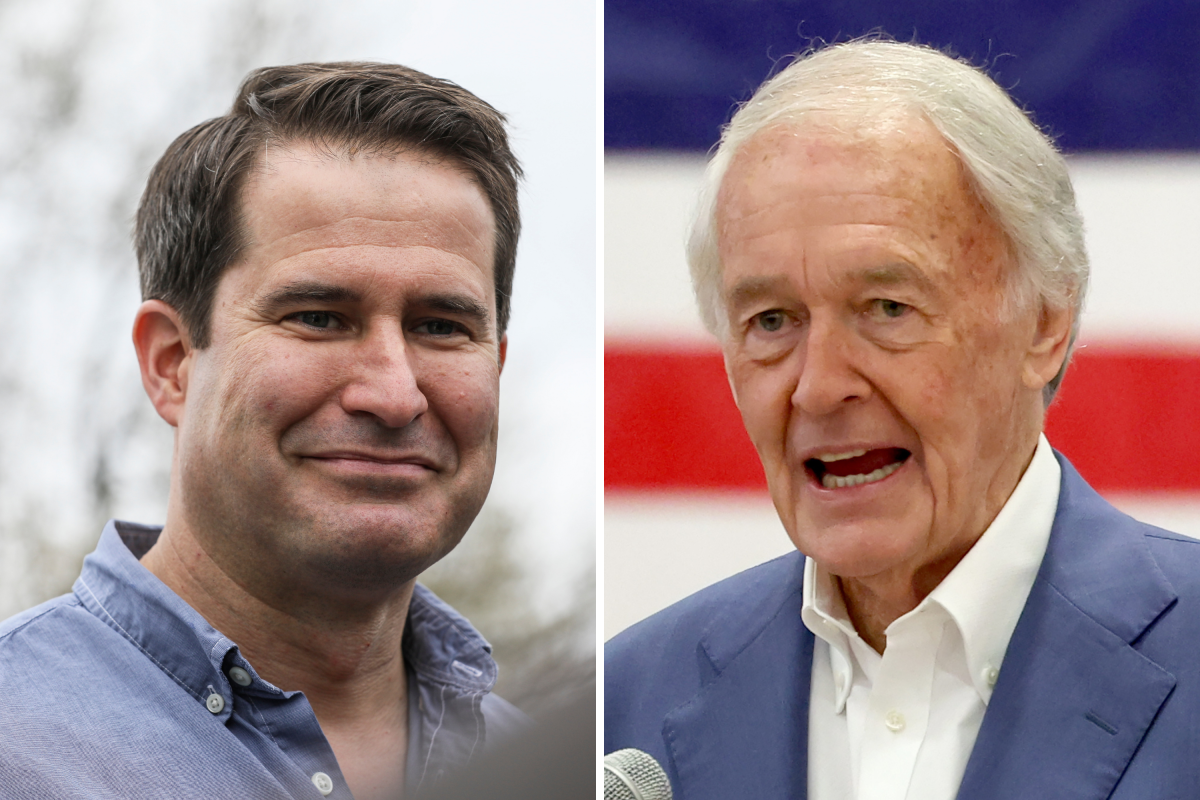
Senator Ed Markey holds a substantial polling lead over Representative Seth Moulton ahead of the Democratic primary in the Massachusetts Senate race, defying a trend of generational change that has defined this year’s primaries.
Moulton, 47, has cast himself as part of a new generation of Democratic leaders in his bid against Markey, an 80-year-old who first entered Congress in 1976. Moulton has sought to make the case for new leadership in the Senate against a longtime incumbent, as many Democrats have expressed frustration with their party’s aging representation in Washington.
The primary challenge by Moulton comes as an anti-incumbent wave has swept through this year’s Democratic primaries, and several longtime incumbents have lost to political newcomers. In addition to age, many incumbents have also lost to more progressive challengers or democratic socialists.
Read More on Politics
But Massachusetts has different ideological dynamics at play.
Markey has positioned himself as one of the most progressive senators, touting his support for Medicare for All and the Green New Deal, while Moulton is viewed as more moderate. Moulton, who represents a district based around the North Shore, has criticized his party’s position on transgender rights and has declined to support Medicare for All.
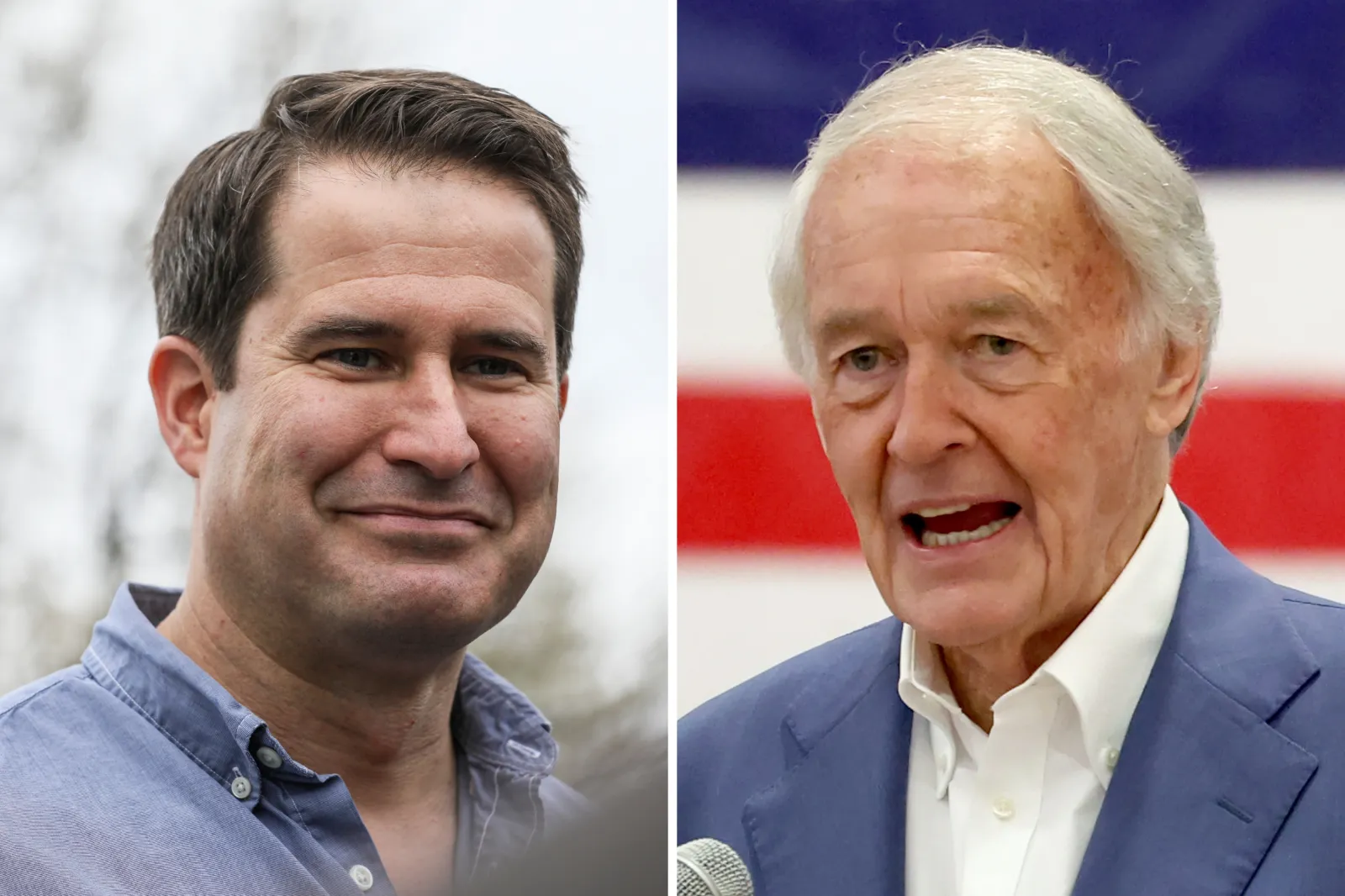
The primary will gauge whether Democrats in a solidly liberal state are willing to ditch a longtime senator whose age has drawn scrutiny, even if the younger candidate is not as progressive.
Suffolk University Political Research Center Director David Paleologos told Newsweek he believes Markey has a substantial advantage heading into the primary.
“When we released our final poll three weeks ago, I stated that this race was never close in the polling and that Markey had locked up the demographics he needed to win. I stand by that statement today,” Paleologos said.
Newsweek reached out to the Markey campaign via press contact form and the Moulton campaign via email for comment.
Ed Markey vs. Seth Moulton: What the Polls Show
The latest polling shows Markey with a comfortable lead over Moulton.
Markey led the latest Emerson College poll by 31 points, 60 percent to 33 percent. It surveyed 550 likely voters from August 28 to 29, 2026 and had a margin of error of plus or minus 4.1 percentage points.
It marks a surge in Markey’s support compared to May, when he led an Emerson poll by only 5 points, 37 percent to 32 percent, suggesting previously undecided voters have backed the incumbent. Only 7 percent of voters were undecided in the new poll, down from 29 percent in May.
A poll from the University of Massachusetts Amherst similarly showed Markey leading Moulton. It showed Markey with support from 60 percent of respondents compared to Moulton’s 32 percent. It surveyed 445 self-identified Democratic primary voters from August 5 to 12, 2026, and had a margin of error of plus or minus 5.8 percentage points among Democratic voters.
Among Democrats, 82 percent of respondents approved of the incumbent Democratic senator’s job performance.
A poll from Suffolk University and The Boston Globe showed Markey up nearly 15 points, 52.2 percent to 37.6 percent. It surveyed 500 Massachusetts residents from August 13 to 16, 2026.
Paleologos told Newsweek that Markey’s big win among key demographics, including women, registered Democrats, progressive voters, Suffolk County residents and those who have already voted, has helped him build a polling lead.
Markey is a “popular incumbent” who has “already surmounted a primary challenge from a highly touted young centrist Democrat six years ago,” Joshua J. Dyck, professor and chair of political science and director of the Center for Public Opinion at the University of Massachusetts Lowell, told Newsweek.
“Moulton is trying to raise his political profile in this race, but the fact remains that Markey has certified support from the progressive wing of the Democratic party, and that is what wins in a primary in Massachusetts, and that is what is winning in this particular political moment,” he said.
Moulton “has not been able to credibly capture the populist moment we are in because he is, at his core, a normal moderate Democrat,” he said. Moulton’s focus on Trump’s policies on immigration is a “necessary, but not sufficient condition” for earning support in a Democratic primary, he said.
Markey is also favored in prediction markets; Kalshi gave him a 98.7 percent chance of winning on Monday, while his likelihood of victory stood at 99 percent on Polymarket.
Prediction markets allow traders to buy and sell contracts tied to political outcomes and current events, aggregating real‑money wagers into probability estimates. Prices fluctuate as traders react to polling, fundraising, candidate developments and broader political trends. They measure trader sentiment in the moment but do not always predict the future accurately.
Why Ed Markey Could Defy Generational Challenge
While calls for generational change have become a major issue in the midterms, policy and ideology remain an important factor for primary voters. Markey’s progressive bona fides may be helping him build support among the more liberal wing of the Democratic primary.
Paleologos said Moulton “needed to triangulate” the arguments around age, that Markey wouldn’t be able to lead the progressive agenda if reelected and his arguments around his own vision as a senator.
“He was only able to do the first, and the political tripod doesn’t stand on one leg,” he said.
UMass political scientists Tatishe Nteta, Jesse Rhodes, Jesse Usher Barrett, and Sydney Brake wrote in a Substack post breaking down their latest poll on Monday that Markey’s popularity, progressive bona fides and support for transgender rights have bolstered his campaign.
“The average Democratic primary voter is even further to the left than the average Massachusetts voter, and these voters prefer a progressive candidate,” they wrote. “This is good news for Markey, whom likely Democratic primary voters view as the more progressive candidate.”
Moulton, who garnered national attention for his 2020 presidential run, has also faced scrutiny from some Democrats over his past remarks about transgender athletes, an issue that has divided the party. In an interview with The New York Times last year, Moulton said, “I have two little girls. I don’t want them getting run over on a playing field by a male or formerly male athlete.”
Markey is no stranger to facing a competitive primary.
In 2020, then-Representative Joe Kennedy III challenged Markey, making similar arguments around the need for generational change. But Markey won that race by nearly 10 points. He did so by unifying more progressive voters in the solidly blue state.
He also won support among younger Democrats, who helped build his social media presence on the “Markeyverse,” a network of meme accounts that supported his reelection.
Notably, Markey is not the only older progressive leader. In neighboring Vermont, 84-year-old Senator Bernie Sanders, an independent who caucuses with Democrats, is one of the country’s most prominent progressives and won reelection in 2024.
Still, age has become a sore spot for the Democratic Party, particularly after former President Joe Biden had a disastrous debate against President Donald Trump in 2024. The debate, which came after Biden opted to run for a second term despite age concerns voiced both outside and within the party, was seen as a major turning point in Trump’s reelection that culminated in Biden’s exit from the race.
When Is the Massachusetts Primary Election?
The Massachusetts primary election is set for September 1, 2026. Polls will be open from 7 a.m. to 8 p.m., according to the Secretary of the Commonwealth of Massachusetts’ office.
Who Is Republican John Deaton? Can He Flip Massachusetts?
John Deaton, an attorney, is viewed as the presumptive Republican nominee in the Senate race. He was the party’s nominee in the 2024 race against Democratic Senator Elizabeth Warren, losing by nearly 20 points.
The general election is not expected to be competitive, as Massachusetts has long been viewed as one of the bluest states in the country.
Former Vice President Kamala Harris won Massachusetts in 2024 by 25 points over Trump. In 2020, it backed Biden by more than 33 points.
Boston is a Democratic powerhouse that often elects some of the country’s most progressive lawmakers, and the rest of the state, including more rural areas out west, is also quite blue. Trump did not win a single county in the state in any of his three presidential runs.
A poll from UMass Amherst showed both Markey and Moulton ahead of Deaton. Markey led by 21 points, 51 percent to 30 percent, while Moulton led by 24 points, 49 percent to 25 percent.
Paleologos said he doesn’t believe the race will become competitive “because Donald Trump will still be the president for two more years.”
“Even if Markey has a senior moment in a bad debate, he’d still probably win,” he said.
Dyck said there is “no chance” of the race becoming competitive.
“The President’s approval rating is awful right now. Everything favors a Democratic surge in November and so that only makes this very safe Democratic seat safer,” he said.
Contact Newsweek editors on this story: Jason Lemon and Sam Wilson.