
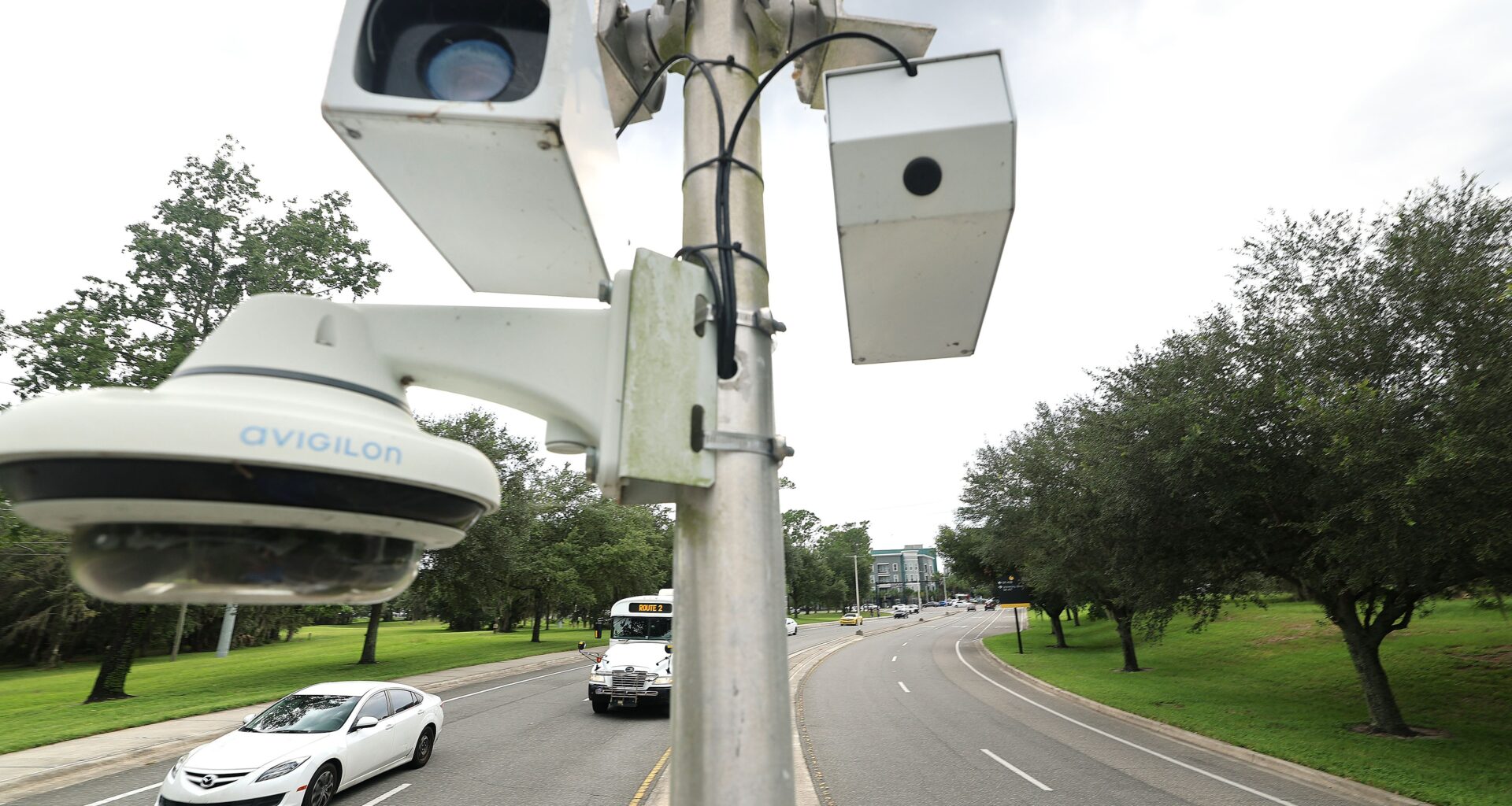
Florida ordered Flock cameras and similar license-plate readers off state roads late Monday and by Tuesday law enforcement agencies in Osceola, Lake and Seminole counties had begun dismantling networks of the high-tech devices in their jurisdictions.
The cameras, most often manufactured by Flock Safety but also by numerous other companies, had become ubiquitous on Florida streets and, officials have argued, one of law enforcement’s most valuable tools.
But citing instances of misuse and fears of creating a surveillance state, the administration of Gov. Ron DeSantis on Monday kicked off the “De-Flocking” of Florida.
“The recent exponential increase in deployments along our roadways, coupled with concerning reports of misuse, data privacy concerns and surveillance schemes merit immediate action to preserve Floridians’ sovereignty and quality of life,” the Monday memo from the Florida Department of Transportation states.
By Tuesday evening, Lake County Commissioners voted to remove license plate readers from their streets, and sheriffs in Seminole and Volusia counties said they’d pause their use, too. In Seminole, officials in Altamonte Springs, Casselberry, Lake Mary, Oviedo, Sanford, Winter Springs, and in Lake, those in Clermont and Groveland agreed to stop using them as well. In Osceola, the sheriff’s office and St. Cloud’s police department both said they’d pause using them.
The Orange County Sheriff’s Office, the region’s largest law enforcement agency, intends to comply with FDOT’s order while continuing to use the devices where permitted, a spokesperson said in a Tuesday statement.
“Sheriff Mina remains committed to protecting the community while respecting the privacy and rights of those we serve. Where permitted by law, LPR technology will continue to be used as an investigative resource to help solve crimes, locate vulnerable people, and keep Orange County safe,” the statement reads.
Osceola County Sheriff Chris Blackmon announced Tuesday his office would suspend using them as well — making it the lone agency in Orange and Osceola to do so.
The controversial cameras photograph every vehicle that passes by, recording details like license plate numbers, make, model, color and even bumper stickers and markings like dents and scratches on cars. Thousands have been posted on streets across the state — and tens of thousands more nationally — and law enforcement agencies say the cameras are critical tools to solving crimes quickly.
Mina said recently that his agency has 160 cameras at a cost of $158,000 annually.
“If somehow this were to go away, it’s a big win for the criminals,” Mina said. “It’d be a huge detriment to law enforcement if we lose it.”
He and others said the cameras powered by AI technology and sometimes called LPRs have led to the solving of murders and other serious crimes, helping to find the man later convicted of trying to assassinate President Donald Trump at a Palm Beach golf club and the man later convicted of killing 13-year-old Madeline Soto, whose body was found in Osceola.
But there has been an increasing public outcry by residents who fear law-abiding people are being wrongly tracked.
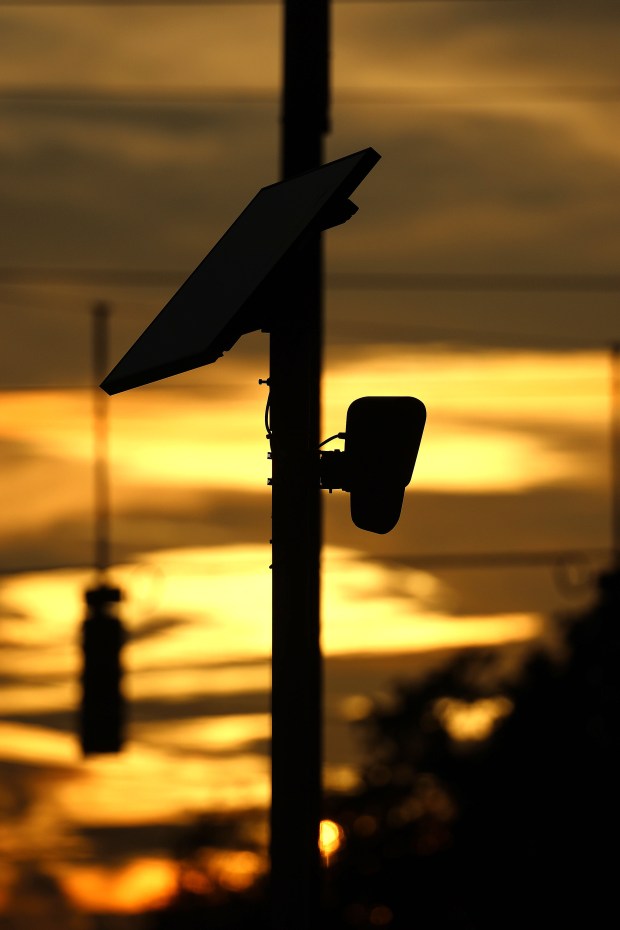 An automated data-gathering camera is pointed toward traffic on U.S. Highway 27 in Leesburg on Tuesday, August 25, 2026. (Stephen M. Dowell/Orlando Sentinel)
At a meeting Monday evening, Oviedo resident Tara Hill was part of a crowd that urged the city to get rid of them. She called the Flock cameras an “automated mass surveillance” system, adding that they end up “treating all free citizens as potential suspects.”
Former Oviedo Police Chief Jeffrey Chudnow spoke in favor of the cameras, however, as a valuable law enforcement tool when searching for a murder suspect or missing person.
“If you have a child that’s been kidnapped, how fast do you want the police to respond?” he said.
The city decided to end its contract with Flock about seven months after installing the cameras —and quit its 5-year-lease on the devices.
Lake County Commissioner Kirby Smith said Tuesday he voted to allow the cameras two years ago, and at the time, was comfortable with a slate of safeguards in place on their usage.
“However, technology has changed at such a fast pace that we cannot keep up with it,” he said.
He joined other commissioners in voting to get rid of them after a tense meeting, in which commissioners were heckled as they considered whether to hold a later public hearing to consider the matter, allowing time for Sheriff Peyton Grinnell to brief them.
Furor had been mounting against license plate readers for quite some time, but last week, DeSantis lit the fuse in Florida, declaring their use as “out of control.”
“I’m all about having law enforcement have tools to be able to hold criminals accountable,” the governor said. “But I don’t want to have this become a surveillance state.”
Soon after DeSantis’ transportation department issued its order this week, several sheriffs across the state said they would take down all of their cameras in the wake of the state memo. Volusia County Sheriff Mike Chitwood said the governor’s comments and FDOT memo show that they “LPRs are no longer workable in Florida.”
“Recently, they have come under intense criticism. Some of that criticism is based on legitimate concerns about privacy, technology, and data sharing,” Chitwood said in a statement on Facebook announcing their removal. “In my opinion, a lot of the criticism has been based on half-truths, outright lies, and bad actors who have destroyed a valuable tool for the rest of us.”
Chitwood also said he hoped Florida lawmakers would create rules that allow them to be used in the future.
“Make no mistake, there will be an impact on crime and public safety,” Chitwood continued. “I’m sure there are criminals who will be celebrating this post along with the critics. I still hold out hope that our lawmakers can reach a consensus on LPR guardrails, regulations and accountability measures that protect individual rights while preserving a resource that solves crime and saves lives.”
The FDOT order applies to only state roads — but those are also some of the busiest roads in Central Florida, including Semoran Boulevard, Colonial Drive, Orange Blossom Trail, Conway Road and Alafaya Trail in Orange County. Cameras are posted on parts of all of those streets, according to the open-source map DeFlock.
And with local jurisdictions now pulling them from their streets, too, coverage could soon be spotty in many parts of Florida.
Despite his current opposition, DeSantis has also recently approved money for local agencies to purchase hundreds of Flock and similar cameras in his role on the State Board of Immigration Enforcement.
Over the past year, the board funded nearly $6.5 million worth of the high-tech license-plate readers for state law enforcement agencies, including sheriff’s offices in Orange and Osceola counties. The money will go to at least 547 cameras that can be affixed to poles and vehicles or to trailers that can be parked on roads and capture who drives by.
DeSantis’ office didn’t respond on whether it intends to take action against those devices as well or how the change might impact its work to crack down on illegal immigration.