
Russia has secretly helped Iran develop supersonic cruise missiles that could menace American warships in the Middle East.
Experts said the transfer of military technology to Tehran would have had to be authorised by the top levels of the Kremlin, according to The Financial Times.
The programme, codenamed C340L, began in 2023 and has continued throughout the US’s war against Iran, raising the possibility that American aircraft carriers and other warships could be targeted.
It is intended to help Iran develop a ramjet propulsion system, an engine which allows a cruise missile to fly faster than the speed of sound.

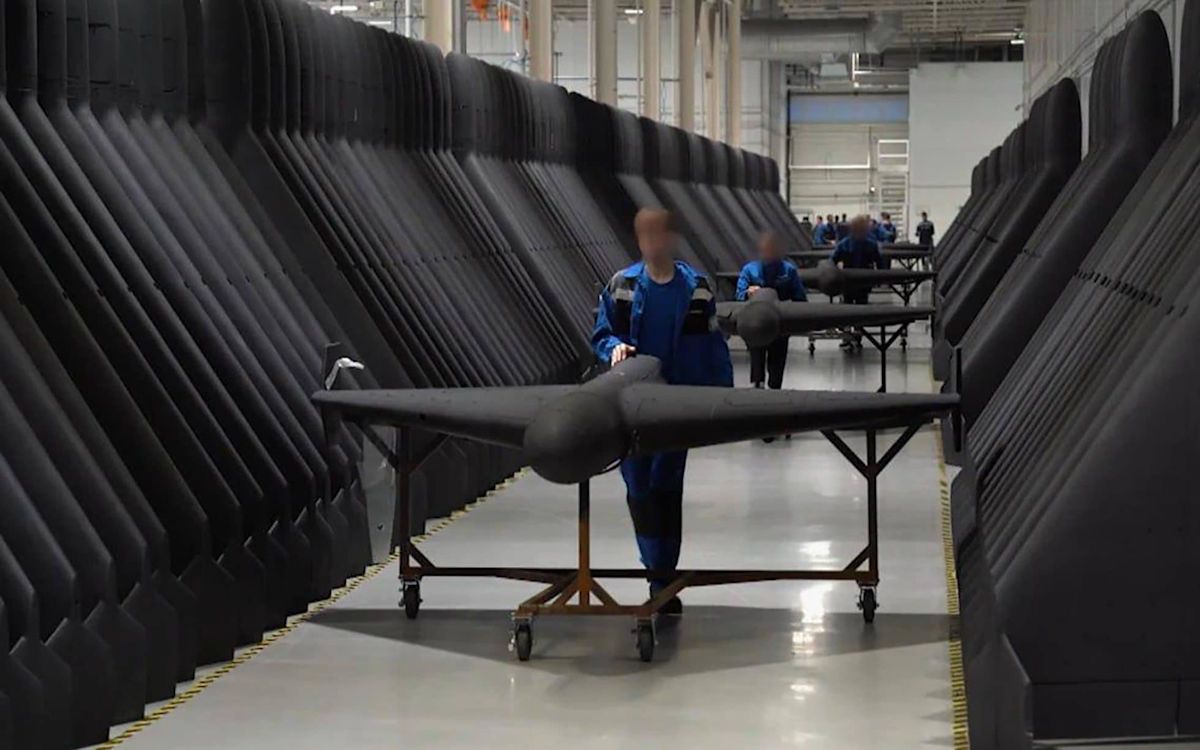
A production line of Russian-built versions of the Iranian-designed Shahed drones in Alabuga
“For the Iranians, this would give them a qualitatively new strategic weapon system that could threaten US navy vessels,” said Jim Lamson, a former CIA military analyst.
Supersonic cruise missiles are extremely difficult to intercept because they fly at a low altitude, “hugging” the landscape to hide from radar, at speeds of up to 2,200mph.
Although Iran has built and tested the ramjet propulsion system, there is no evidence that it has been deployed in the field.

Putin’s assistance is the latest sign of an increasingly close alliance between Russia and Iran – Getty
“This is the transfer of a highly strategically sensitive military technology from Russia that the Iranians have wanted to acquire for decades,” said Fabian Hinz, an Iranian missile expert.
“A programme like this would require political clearance from the very top in Russia.”
The Iranian regime has supplied Moscow with its “kamikaze” Shahed drones for its nightly bombardments of Ukrainian cities, while Russia has reportedly provided intelligence that allows Tehran to strike American bases in the Middle East.

Their cooperation “shows Russia is trying to broaden the Ukraine war and draw the US into different theatres”, said Nicole Grajewski, a professor at Sciences Po University in Paris.
“Russia doesn’t care as much about the red lines in the region,” she added.
The programme was reportedly arranged by Rosoboronexport, Russia’s state arms exporter, which co-ordinated the project with NPO Mashinostroyenia, a Russian rocket company which the US has sanctioned since 2014.
NPO Mashinostroyenia received a cache of Iranian technical material on the ramjet propulsion system by 2025.
Russian engineers analysed data from an Iranian test flight and sent a detailed list of questions about how it performed.
The programme is said to have drawn on the expertise of NPO Mashinostroyenia’s most senior missile engineers, some of whom travelled to Iran before a contract signing in 2023.

Motorists drive past a billboard pledging revenge against Donald Trump along Jomhouri Street in central Tehran – AFP via Getty Images
Vladimir Putin, the Russian president, on Tuesday told his Iranian counterpart, Masoud Pezeshkian, that Moscow was “trying to give you the help you need in this difficult period” and “supplying you with the goods you need” during the war.
Exchanges between the US and Iran have intensified since the weekend, after a lull in fighting of more than a month.
The US targeted two Iranian rocket launchers on Larak Island in the Strait of Hormuz on Sunday, followed by further attacks on Tuesday. Iran has fired drones and missiles at American targets in response.