

Thousands of English-speaking Quebecers may have difficulty finding out how and where to vote as election guides and notices are being mailed only in French for the first time in a provincial campaign.
Voters seeking English versions will instead be directed to the Élections Québec website, either directly or through a QR code printed on the French documents, potentially posing difficulties for those who either do not own the technology or need help using it. Around one in five Quebecers 75 and older do not own a smartphone, computer or tablet, according to a recent study.
Élections Québec said Tuesday that the Coalition Avenir Québec government’s sweeping language law changes in Bill 96 require voting guides and reminder cards to be mailed only in French. It’s part of the CAQ government’s eight-year drive to enforce French in daily life in Quebec — on signs, in workplaces, at universities, and even attempted in health care at one point. The latter sparked fury before being walked back.
“This is extremely concerning,” Eva Ludvig, president of TALQ, a coalition of English-speaking community groups, told The Gazette. “It’s a very slippery slope for democracy.
“Élections Québec is an independent and neutral institution. Its mandate is to ensure citizens have the information they need to participate fully and to ensure fairness, not to interpret language legislation.”
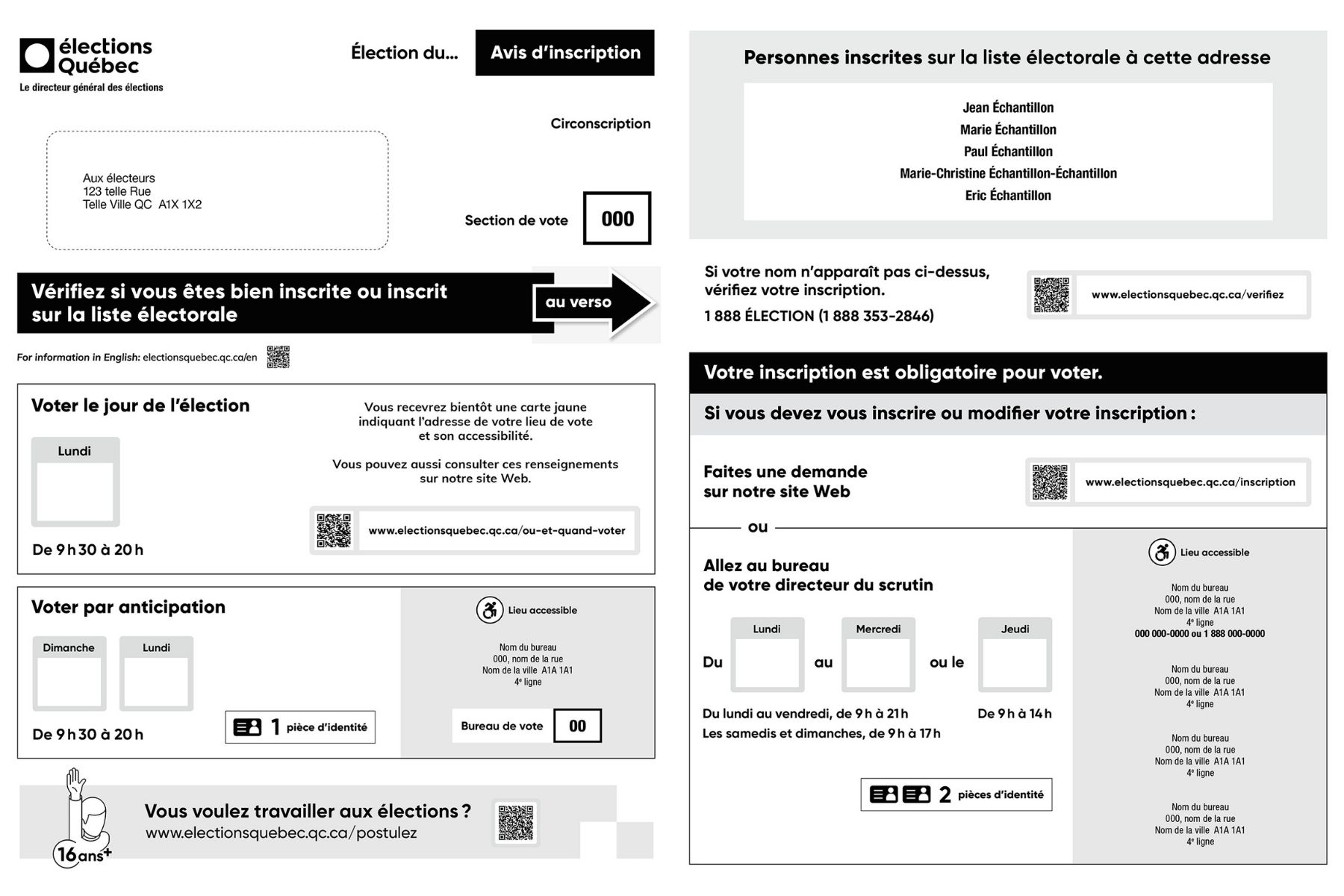 Example of registration notice voters will receive before this October’s Quebec election. Élections Québec
Ludvig added that TALQ is writing to Élections Québec to ask it to reverse the decision.
Élections Québec asked the CAQ government for an exemption in Bill 96 to get English information sent, according to Julie St-Arnaud-Drolet, a spokesperson for the agency, but the government did not oblige.
There are exceptions, according to Élections Québec. Indigenous voters and people formally declared eligible for English-language education and issued a certificate of eligibility by Quebec’s Education Ministry may contact the agency for information and other services in English. Other anglophone and allophone voters will be directed online.
It is unclear how many voters already hold an eligibility certificate and how many others would qualify, and whether they could obtain one before the election mailouts begin. Temporary authorizations granted to the children of foreign students or temporary foreign workers do not count, according to the Quebec government’s website.
Eric Maldoff, a lawyer and former president of the anglophone-rights group Alliance Quebec, said: “The system (for eligibility certificates) was geared for people who are trying to enrol their kids in school. Not for people who are 70 years old, or 80 years old, or 50 years old, or 40 years old to track down certificates at this pace.”
He called the policy “an attempt to create an obstruction to the equal right to vote” and demanded that Premier Christine Fréchette’s government press Élections Québec to reverse it immediately.
The provincial election guide and registration notices will be sent during the week of Sept. 14, Élections Québec said. A reminder card will follow during the week of Sept. 28, telling registered voters where to cast their ballots and naming the candidates in their riding. Most voters are set to go to the polls on Oct. 5.
A Université Laval study released last week found that 21 per cent of Quebecers 75 and older owned neither a smartphone, computer nor tablet in 2025, while nearly three in five said they needed another person’s help to use digital technology. Among those age 65 to 74, close to half said they needed help.
There were nearly 210,000 Quebec residents 65 and older whose first official language was not French in the 2021 census, according to Statistics Canada.
Older Quebecers are some of the province’s most dependable voters. In 2022, the provincial election turnout reached nearly four in five among those age 65 to 74. It was about 70 per cent among those 75 and older.
“Certainly seniors are the most vulnerable,” Ludvig said, though she added that the problem extends to anyone unable to afford digital devices or internet service and they “risked being left behind” in Quebec’s election.
In June, Fréchette sought to repair the CAQ’s relationship with English-speaking Quebecers after years of disputes over language laws. She promised to bring a “different tone” to the relationship.
“My overarching responsibility to promote and protect French will not change, but tone matters,” she said in English.
Still, the political pressure on Fréchette has intensified against an invigorated Parti Québécois. A new poll published Monday placed the PQ first at 29 per cent, followed by the CAQ at 24 per cent and the Quebec Liberals at 22 per cent.
“Because the PQ remains ahead in the polls, including and especially among francophone voters, the CAQ is focusing on these voters even more than before,” said Daniel Béland, a political science professor at McGill University.
It’s “a situation that many anglophone voters are likely to find problematic,” he added.
What do you think? Will you be affected by this law? Write to me at hnorth@postmedia.com

I’ve been writing for the Montreal Gazette since 2023. My favourite stories are ones that make you think and I’m always looking for new ways to tell them. At McGill, I studied economics and computer science. Now I live in the city’s Plateau, where I wear Doc Martens to try and blend in among the hipsters. Got a story? Email me.
hnorth@postmedia.com
On Quebec Politics
The Gazette’s On Quebec Politics newsletter by Andy Riga breaks down key election issues, from polling shifts to legislative manoeuvring to ideas circulating in francophone commentary that don’t make it into English-language coverage.
To sign up, visit this page and check the box labelled “On Quebec Politics” before providing your email address.