
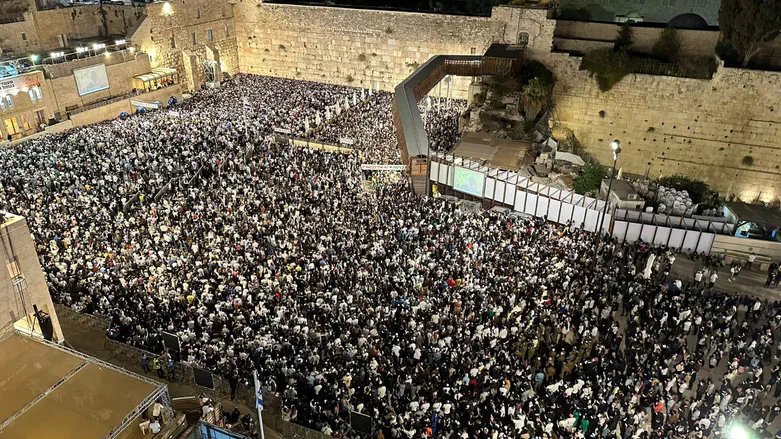
A few years ago, I began reaching out to family members during the month of Elul. I would tell them that I planned to daven for them during this special time of year and ask what, specifically, they would like me to daven for. Part of my goal was to encourage my children to crystallize what they themselves should be davening for during these holy days. But I was also trying to remind myself of the real avodah of this entire Yom Tov season.
There is a certain tension at the heart of Rosh Hashanah, between the severity of the day and its joy. On the one hand, we tremble along with the angels as we contemplate the fragility of life and acknowledge that none of us knows what the coming year holds. At the same time, Chazal (Yerushalmi Rosh Hashanah 1:3), drawing upon the words of Nechemya (8:9-10), encourage us to rejoice, confident that we will be judged favorably.
How can both be true? We know that the coming year will bring pain and loss. There will most certainly be people who suffer. So what exactly are we so confident about?
There is a beautiful parable about two waves making their way toward the shore. One wave is terrified. It sees the beach ahead and knows that within moments it will crash into the sand and cease to exist. The other wave is smiling, humming a tune as it travels through the ocean. “How can you be so calm?” the first wave asks.
The second wave replies, “You are frightened because you think you are a wave, and in a few moments your short life will come to an end. I am calm because I know that I am part of the ocean. And the ocean lives on.”
Throughout the year, I stumble along thinking that I am Josh Joseph – an individual with my own dreams, ambitions, fears, and aspirations. But from Rosh Chodesh Elul through Sukkos, I am reminded that I am part of something so much larger: my family, my community, and ultimately, all of Am Yisrael.
Seen in that truer light, I am not going anywhere.
The Days of Judgment trigger anxiety so long as I see myself as separate from everyone around me. Who will live and who will die? We never know how much time any individual has on this earth. But when I recognize that Hashem is my Father and every Jew is my brother or sister, there is room not only for trembling, but for profound joy. Netzach Yisrael lo yishaker. The Jewish people endure.
This is reflected in the most famous acronym for the month of Elul: Ani l’dodi v’dodi li – I am for my Beloved, and my Beloved is for me. The avodah of Elul is to expand my ani – my very sense of self. As Rav Shimon Shkop writes in his introduction to Sha’arei Yosher, we begin life with a limited sense of self, but as we grow, we are meant to expand it: from ourselves to our families, from our families to our communities, and ultimately to encompass all of the Jewish people.
We are not merely individual waves. We are all part of the same ocean. Which means that when I ask my children what they would like me to daven for, I am thinking far too small. I should be asking my colleagues at the Orthodox Union. I should be asking friends and neighbors. I should be asking Jews in communities different from my own, Jews of different religious persuasions, Jews living in Israel and Jews scattered throughout the world. Because if they are part of my ani, then their tefillos must become my tefillos too.
There is no shortage of challenges facing the Jewish people as we enter a new year: peace within Israel and beyond its borders, security for Jewish communities around the world, greater spiritual accomplishment for Jews of every background, and the basic health, stability, comfort, and wellbeing that all of us need in order to thrive.
If I could truly tap into the energy of Elul, I would understand that their need for safety is my need for safety. Their need for comfort is my need for comfort. Their need for health, meaning, connection, and hope is mine as well.
Last year, when I asked my daughter what she wanted me to daven for, she asked me to daven that she find her shidduch. I am under no illusion that my tefillos were the only factor at play, but a few weeks ago I had the indescribable joy of walking her down the aisle.
This year, I’d like to daven a little bigger. May this be a year in which all our tefillos are answered. A year in which we learn to daven not only for ourselves, but for one another. A year in which our ani expands until another Jew’s hopes become our hopes, another Jew’s pain becomes our pain, and another Jew’s joy becomes our joy. And may all those individual tefillos ultimately merge into the great tefillah that contains them all – the prayer for the day when the Jewish people will finally experience themselves as one:
“Once again there will be heard in the cities of Yehudah and the streets of Yerushalayim the sound of joy and the sound of happiness, the voice of the bridegroom and the voice of the bride… ‘Give thanks to Hashem, Master of Legions, for Hashem is good, for His kindness endures forever’… for I will restore the fortunes of the land as they were at first.” (Yirmiyahu 33:10-11)
Last year, I was blessed to hear the voice of one bride and one groom. May this be the year when we hear that sound throughout Yerushalayim.