
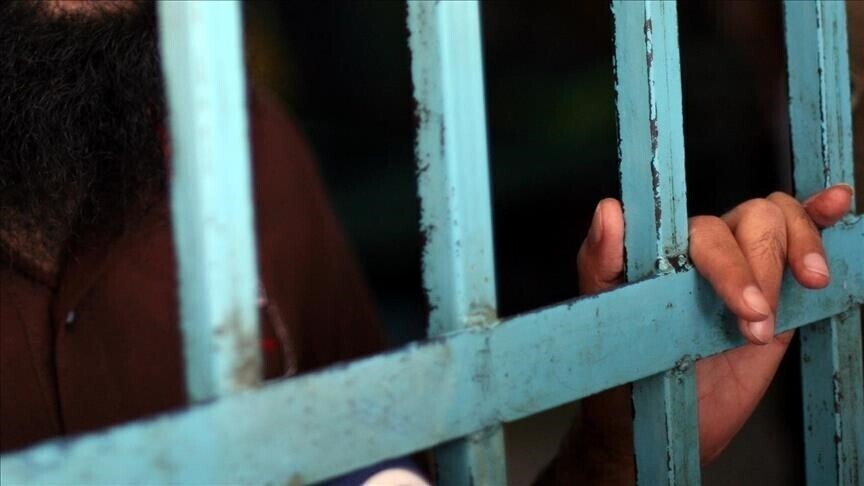
In 2025, Lebanon’s national human rights commission documented arrest of fishermen, shepherds, workers and nurses during civilian activitiesRelease of Razi, others do not negate right to demand accountability, reparations, Lebanese lawyer and deputy tells Anadolu
Israel held Lebanese national Malik Kamal Razi for nearly 11 months without announcing charges before releasing him after an investigation found no evidence linking him or others to any organization.
Israeli official media had described Razi as a “Hezbollah operative” before his release.
Lebanese lawyer and lawmaker Melhem Khalaf told Anadolu that releasing Razi and other Lebanese nationals abducted by Israel over the past two years does not negate their rights to seek investigations, accountability and reparations for any violations they suffered during their detention.
On Thursday, Israel handed Razi over to the Lebanese army through the International Committee of the Red Cross at the Naqoura crossing, marking the first release since the start of US-brokered negotiations between Beirut and Tel Aviv last April.
The release was part of a decision involving five people detained by Israel in Lebanon.
The office of Israeli Prime Minister Benjamin Netanyahu said an investigation showed they “do not belong to any terrorist organization, have not engaged in terrorism, and there is no justification for their continued detention.”
The statement amounts to an acknowledgment that the Israeli army carried out “arbitrary arrests” in Lebanon and provides evidence that such arrests, which Beirut considers “kidnappings,” were conducted before sufficient evidence was available to establish the detainees’ links to any armed activity.
It also highlights the contradiction between Israel’s public broadcaster’s description of Razi as a “Hezbollah operative” without providing any evidence, and Netanyahu’s office’s subsequent announcement that the investigation had not proven the released individuals’ affiliation with any organization.
Disappeared while exercising
Razi, born in 2005, is from Ain Ata in the Rashaya district of eastern Lebanon.
On Oct. 12, 2025, he left on his motorcycle to exercise in a mountainous area near his hometown before contact with him was lost.
His motorcycle was later found, prompting residents and volunteers to search for him.
It subsequently emerged that Israel was holding him. Israel did not announce charges against him or bring him before a court during nearly 11 months of detention.
A Lebanese official source told Anadolu that Israel was expected to hand over four more detainees, including two Syrians, to the Red Cross at the Naqoura crossing at 11 am local time (0800GMT) Friday.
They would then be transferred to the Lebanese army for medical examinations before being handed over to their families.
Fishermen, shepherds, workers
Razi’s case is not an isolated one. Lebanon’s national human rights commission documented, in a legal document issued on Dec. 15, 2025, the arrest and disappearance of Lebanese citizens during civilian activities.
The document was based on information from families, direct testimonies and corroborated data from national and international bodies, amid a lack of official Israeli information about the detainees’ whereabouts and legal status.
Cases included two nurses detained in Aita al-Shaab in November 2024 and two workers detained while traveling to civilian work in Wadi al-Hujeir on Dec. 19, 2024.
The commission also documented two fishermen detained off Naqoura on Feb. 2 and June 4, 2025.
A shepherd was detained while tending his flock in the Mount Hermon area on June 7, 2025, while others were taken from their homes or while returning to their villages after the ceasefire.
The commission said the documented incidents, particularly those occurring after the ceasefire and during civilian activities, indicated “arbitrary detention” in violation of Article 9 of the International Covenant on Civil and Political Rights.
It also pointed to cases that could amount to “enforced disappearance” and the unlawful transfer of detainees into Israel in violation of Article 76 of the Fourth Geneva Convention, in addition to possible violations involving torture and denial of medical care.
In February 2026, independent research and advocacy organization Legal Agenda documented 22 Lebanese people captured or abducted alive, along with 42 whose fate remained unknown.
In May, it raised the number documented as having been taken alive to at least 30 following renewed Israeli operations.
In December 2025, the “Call for Freedom” campaign was launched to advocate for Lebanese prisoners and abductees.
It organized activities with the participation of their families to demand information about their fate and their release.
36 Lebanese prisoners ‘alive in Israeli prisons’
Released prisoner and academic Nabih Awada, a specialist in Israeli affairs, told Anadolu that 36 Lebanese prisoners are “alive in Israeli prisons,” citing the Prisoners’ Representatives Committee and relevant Lebanese authorities.
Israel has declared that it is holding 33, Awada said.
Awada told Anadolu that 21 of them were detained after the ceasefire agreement took effect on Nov. 27, 2024, while attempting to return to their villages, and that six detainees faced trials in Israel.
He noted that between seven and 10 detainees are classified by Israel as members of Hezbollah’s “Radwan Force,” meaning that Tel Aviv does not include the remaining detainees in this classification.
Netanyahu’s office linked the release to searches for the remains of members of the Jewish community who were kidnapped and killed in Lebanon in the mid-1980s, saying that the decision was made “in light” of field searches conducted by both sides.
Lebanese official sources, however, told Anadolu that the release came amid contacts by Lebanese President Joseph Aoun with Washington to pressure Israel to uphold the ceasefire, release the prisoners and withdraw from Lebanese territory.
Lebanese Prime Minister Nawaf Salam pledged, following Razi’s release, to continue pursuing the issue until all detainees are released and the fate of those missing is determined.
The Lebanese state considers civilians detained by Israel inside Lebanese territory to be abductees rather than prisoners of war involved in a prisoner exchange, particularly since Lebanon does not hold Israelis in return.
International law
Lebanese lawyer and MP Melhem Khalaf told Anadolu that when the conditions for prisoner-of-war status are met, a prisoner benefits from the protections provided to prisoners of war under the Third Geneva Convention, while civilian detainees in international armed conflicts are covered by the Fourth Geneva Convention.
Both conventions guarantee humane treatment, protection from torture and ill-treatment, medical care, communication with families and fair-trial safeguards.
Khalaf stressed that the release of a detainee does not extinguish their right to demand an investigation, accountability and reparations for any violations they may have suffered, and that describing a person as a “detainee” or “prisoner” does not legitimize their detention.
Pattern in Gaza
The prolonged detention of individuals without charges or trials is not limited to Lebanon.
Human rights organizations have documented the widespread repetition of this pattern against Palestinians from the Gaza Strip.
Israel uses the “Unlawful Combatants Law” of 2002 to detain individuals for renewable periods without indictments.
According to Amnesty International, the law was initially used to detain two Lebanese citizens before being widely applied to detainees from Gaza.
Release and arrests
Razi’s release coincided with the incursion of an Israeli force into the southern Lebanese town of Halta on Thursday and the abduction of three people, according to the town’s mukhtar and a local source who spoke to Anadolu.
Since March 2, Israeli attacks on Lebanon have killed 4,350 people and injured 12,307 others, while displacing more than 1 million people, according to Lebanese authorities.