
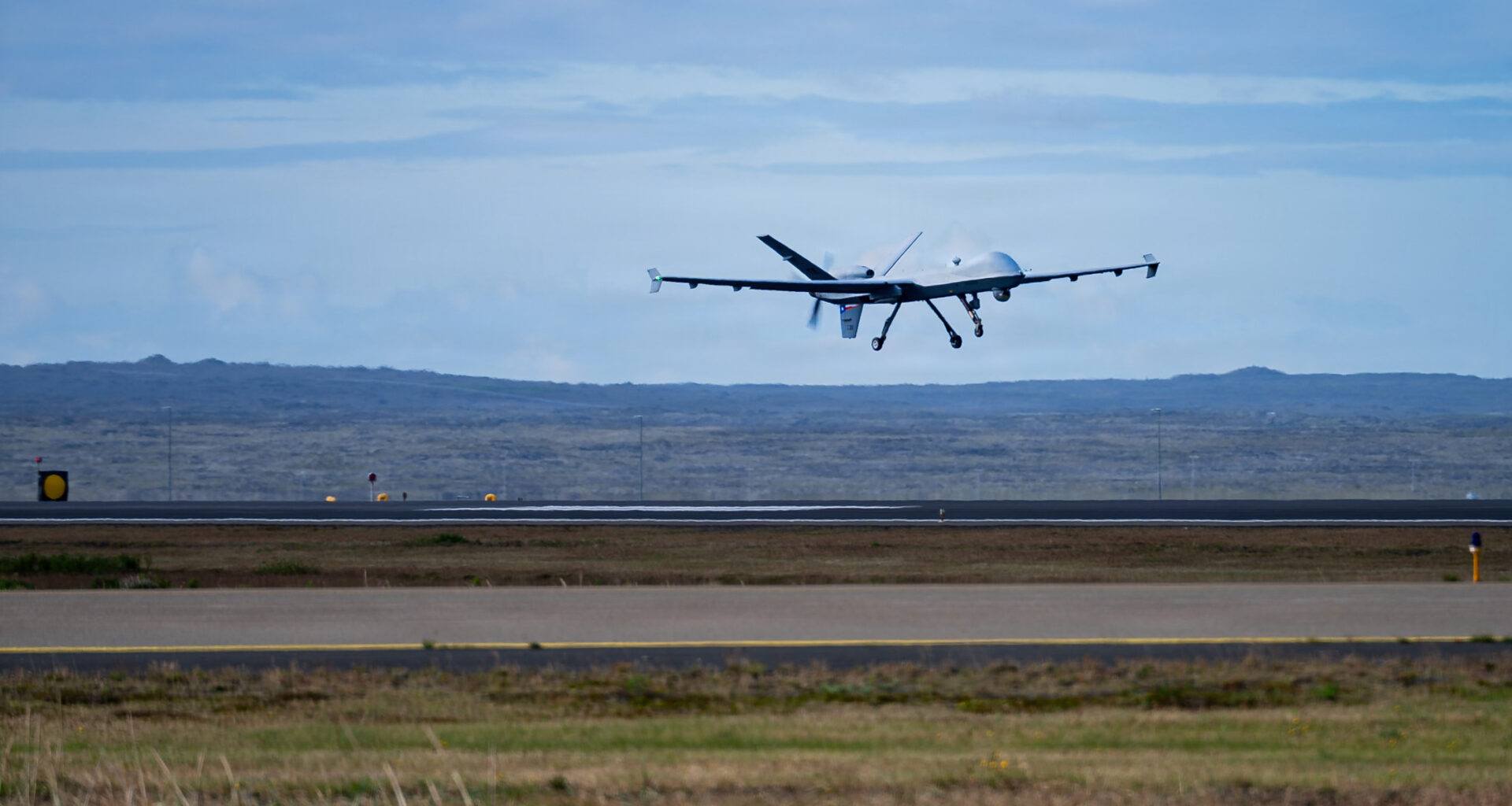
WASHINGTON — Following steep losses of the General Atomics MQ-9A Reaper in recent combat operations against Iran, Air Force officials are accelerating efforts to replace the venerable drone with a new unmanned aircraft at a price of $10 million each.
“As we get to the end of the MQ-9 life, there was some early talk of where do we want to go afterwards, and candidly, as a result of some of the losses that we’ve experienced in combat operations, that discussion sort of got accelerated,” Lt. Gen. Christopher Niemi, the Air Force’s chief modernization officer, said in a briefing with reporters at the Pentagon today.
“So we want to bring this thing forward because of the fact that, although we have plenty of MQ-9As today, we are going through them at a rate that is concerning to us,” he added.
At least 45 Reapers, a quarter of the Pentagon’s inventory, have been lost since the launch of Operation Epic Fury in February, the Washington Post reported in August. The Reaper’s depletion has also left the Pentagon with few good, short-term options to quickly backfill losses.
The considerable exhaustion of the drone, which Air Force officials say can cost up to $50 million a piece depending on its payload, prompted the Pentagon to kickstart a new program in July, dubbed the Mass Modular Aircraft (MMA).
“I can’t buy an MMA today. The reality is, based on the budget and other constraints, that I’m not going to buy a whole lot of MQ-9Bs today either,” Niemi said, referring to an upgraded version of the Reaper known as the SkyGuardian. The MQ-9A ceased production last year.
“There’s a, I think, sort of a misconception that because the MQ-9B is in production, we can walk down there with a big fat check and have 100 of them this year. That’s not reality,” he added.
Air Force officials today laid out their vision for the new MMA drone after inviting bids from industry in July. That notice, posted by the Pentagon’s Defense Innovation Unit, included targets like a one-way range of 8,000 nautical miles (about 9,206 miles), high degrees of modularity and both a producibility and price point that permits the Defense Department to tolerate losses. The goal, DIU said at the time, was to get 20 mission-ready drones by fiscal 2031.
Today, however, officials said they’ve been instructed to move faster and are “looking at options to do that,” Niemi said, without specifying exactly how quickly the new drone could be fielded. But “generally” speaking, according to Maj. Gen. Joseph Kunkel, who serves as DIU’s military deputy, the DIU “intend[s] to get to a prototype within a year, [and] fielded at scale within three years.”
Niemi said the Air Force will probably field “at least 180” of the MMA drones.
Additionally, Niemi noted some ambitious cost targets: The Air Force is aiming to get the cost of its Collaborative Combat Aircraft (CCA) drones to $20 million a piece, and MMA drones “closer to half of that,” he said. (The estimate includes only the cost of the air vehicle, without being fully missionized, according to an Air Force spokesperson.)
Making Trade-offs
While noting that combatant commanders “love” the Reaper for features like long endurance and the ability to execute multiple missions such as reconnaissance and strike, Niemi emphasized that the drone itself isn’t necessarily all that unique.
“What makes the MQ-9 special has nothing to do with the aircraft itself. Like there is no cutting-edge technology for how fast it flies, how high it flies, how far it flies, all that is proven, decades-old technology. So, if you’re focusing on the truck, and you do it in a way where you’re able to make some smart design compromises … we do think you can drive the cost down,” Niemi said.
“You’re going to have to certainly give up something,” Niemi continued. “There’s no doubt if we try and pursue the exact same approach that we had with things like the MQ-9, we’re going to get something that costs about the same as an MQ-9.”
General Atomics spokesman C. Mark Brinkley in a statement to Breaking Defense said the Reaper’s “unique combination of endurance, payload, range, sensors, weapons, connectivity, adaptability and reliability is precisely what enables mission effects that others struggle to replicate.”
The company has “worked with the U.S. Air Force and other customers to hit cost targets for three decades and that won’t change, for any of our programs,” Brinkley added.
General Atomics is competing for the MMA program with a new design the company dubs Wildfire, which Brinkley said “addresses all of the concerns posed by the MMA solicitation. We can deliver years earlier and maintain the same high quality. You can have everything that makes Reaper special, plus more, at a price that doesn’t break the bank.”
Niemi emphasized that at least the initial versions of MMA largely won’t have “cutting-edge” technology. “I think it’s all going to be proven stuff, because that’s how I’m going to drive down the cost so I can get to that goal that I laid out,” he said.
Specifically, the MMA drone “is going to be an aircraft that has a long aspect wing, probably a turboprop, flies a very long way and carries a heavy weight.” The drone will likely be in the “4,000 miles-type class, so it’s going to fly much farther than CCA, but it’s going to fly slower and carry more weight,” Niemi said.
Lt. Gen. Luke Cropsey, the Air Force’s military deputy for acquisitions, said the MMA effort will in many ways mirror the ongoing CCA program. Air Force officials envision aircraft being developed in successive “increments,” for example, while using government reference architectures for hardware and software — enabling them to rapidly add new features instead of having to undergo more extensive block upgrades. Cropsey said the aircraft also needs to be designed so that its production can be scaled up fairly quickly if the moment demands.
Like the CCA program, where Anduril and General Atomics were both picked to produce drones for the effort’s first round, Niemi said officials “want to keep multiple companies in the game” to foster competition. He also said that officials are striving for the MMA drones to have higher levels of automation than the Reaper, with features like one operator being able to simultaneously control several of them.
“What I would like to have is multiple aircraft designs that go into production that can be operated with a common interface that’s more like mouse clicks and keyboard as opposed to stick and throttle, and I can have, whatever an MMA operator ends up looking like, fly all of them. That’s where I would like to go to,” Niemi said.