
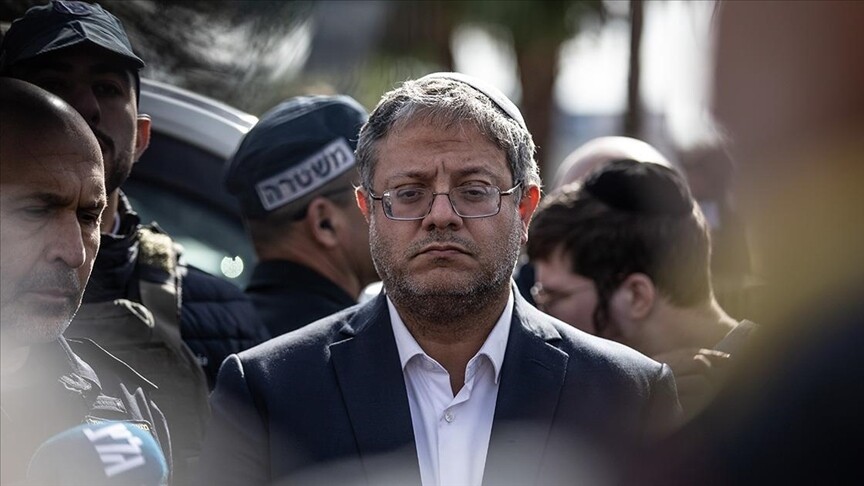
Statements by senior Israeli figures ‘carry serious legal significance’ when assessed alongside conduct on ground, Euro-Med Monitor Chairman Ramy Abdu tells AnadoluThey may be ‘important indicators’ of Israeli intent against Palestinians, lawyer Waseem al-Shanti tells Anadolu
Last month, Israel’s National Security Minister Itamar Ben-Gvir called for killing “30 to 40” Palestinians in Gaza every night, saying some Palestinians “are not worthy of life” and “are not even people.”
Speaking on a podcast hosted by former Israeli captive Rom Braslavski, he described a Palestinian woman who had provided Braslavski with food during his captivity as a “terrorist” who “needs a bullet in the head,” while renewing calls for Palestinians to be driven from Gaza and for Israeli settlements to be established across the enclave.
The remarks are among a series of statements by senior Israeli political and religious figures that legal experts say could carry consequences far beyond inflammatory rhetoric.
Calls to kill or expel Palestinians, deny their existence or strip them of basic rights could serve as evidence of genocidal intent or, in some circumstances, constitute direct and public incitement to genocide, experts told Anadolu.
Such rhetoric has intensified since October 2023, with Israeli officials and influential religious figures making statements that range from denying Palestinian peoplehood and national rights to advocating mass killings and expulsions.
Israel’s Sephardic Chief Rabbi David Yosef recently denied the existence of the Palestinian people and asserted that they have “no rights.”
Last September, he reportedly described Palestinians as “not a people, but a mob,” claiming that they “only do looting and killing.”
Yosef’s statements echo remarks made by far-right Finance Minister Bezalel Smotrich, who said during a speech in France in March 2023 that there was “no such thing as the Palestinian people” and denied the existence of Palestinian history and culture.
Smotrich later threatened Palestinians in the occupied West Bank with the fate of Gaza’s population.
“The residents of Judea and Samaria (West Bank) must understand that if they continue their acts of ‘terrorism,’ their fate will be like that of Gaza’s residents,” he said during a meeting of his Religious Zionism Party’s parliamentary bloc in February 2025.
In another recent case, Israeli rabbi Menachem Ben Shahar called for the expulsion of Palestinians who reject Jewish sovereignty over the occupied West Bank, claiming that non-Jews have no national rights in what he described as the “land of Israel.”
In footage published by Al Jazeera English, Ben Shahar said even a 5-year-old child “loses his right to exist” if the child’s parents are regarded as “enemies.”
Evidence of intent
Ramy Abdu, chairman of the Euro-Mediterranean Human Rights Monitor, said statements by Israeli political, military, parliamentary and religious figures since October 2023 have repeatedly dehumanized Palestinians and reflected an intention to destroy them.
“These statements carry serious legal significance in the context of the case before the International Court of Justice concerning genocide in Gaza,” Abdu told Anadolu.
Under Article III of the 1948 Genocide Convention, “direct and public incitement to commit genocide” is an independently punishable act.
Abdu said statements by officials and influential religious figures could also be used to establish the specific intent to destroy a national, ethnic, racial or religious group, in whole or in part – the element generally considered the most difficult to prove in genocide cases.
The Euro-Med Monitor has documented dozens of such statements alongside genocidal acts in Gaza, he said, noting that South Africa also cited statements by Israeli officials in its genocide case against Israel before the International Court of Justice (ICJ).
“The repetition of these statements, their issuance by officials in military, political or parliamentary positions or by influential religious figures, and their coincidence with actual military attacks in Gaza strengthen the connection between the rhetoric and conduct on the ground,” Abdu said.
International courts have previously considered public statements when determining genocidal intent.
In its landmark 1998 ruling against Rwandan official Jean-Paul Akayesu, the International Criminal Tribunal for Rwanda said intent could be inferred from an accused person’s “acts or utterances” and found that speeches he made were among the evidence demonstrating genocidal intent.
In a later case, the tribunal convicted three senior media figures of crimes including genocide and incitement to genocide, saying they “used the institutions they controlled and coordinated their efforts towards the common goal: the destruction of the Tutsi population.”
“Without a firearm, machete or any physical weapon, you caused the death of thousands of innocent civilians,” the presiding judge told one of the men convicted.
Individual, state responsibility
Abdu said the potential legal consequences must be considered at both the individual and state levels.
Individuals could face criminal responsibility for direct and public incitement to genocide, he said, adding that the offense does not require proof that genocide was ultimately carried out as a consequence of the incitement.
The statements “could also support broader allegations involving the planning, ordering or facilitation of war crimes or crimes against humanity, depending on the speaker’s position and actual influence over military or political decisions,” he added.
At the state level, Abdu said Israel is obligated under the Genocide Convention to prevent and punish incitement by its officials.
A failure to take deterrent or disciplinary action, particularly when those responsible remain in influential positions, could provide additional evidence of “institutional tolerance” of genocidal rhetoric and of the state’s failure to meet its obligations, he said.
Such statements could be submitted as evidence in South Africa’s case before the ICJ, included in communications to the ICC prosecutor and incorporated into documentation used in universal-jurisdiction proceedings before national courts, Abdu added.
Strict legal threshold
Waseem al-Shanti, a lawyer and legal researcher, said these statements by Israeli officials must be considered alongside their actions and policies toward Palestinians.
“From a legal perspective, these statements cannot be regarded merely as political positions or rhetorical expressions,” he told Anadolu. “Alongside other evidence, they may constitute important indicators of the nature of the Israeli intent underlying the acts committed against Palestinians.”
He said the rhetoric has been closely connected to Israel’s genocidal acts against Palestinians since October 2023 and formed part of “a broader process of dehumanizing the Palestinian people, justifying the targeting of Palestinian civilians and portraying violence against Palestinians as acceptable or legitimate.”
The position of the speaker is also significant, according to al-Shanti.
“The danger of these statements lies in the fact that they do not merely represent individual positions but are issued by senior figures representing state authority, which gives them an official character,” al-Shanti said.
That does not mean every inflammatory or dehumanizing statement automatically constitutes direct and public incitement to genocide. The legal significance also lies in what such rhetoric can reveal about intent when considered alongside other evidence.
“The repeated use of statements that strip Palestinians of their humanity or portray all civilians as legitimate targets, coinciding with large-scale killing, starvation, displacement and the destruction of the conditions necessary for life, may have significant evidentiary value before international courts when assessing intent, context and patterns of conduct,” al-Shanti said.
The statements could be relevant in different ways before the two international courts in The Hague.
Al-Shanti said they could be considered by the International Criminal Court (ICC) when examining individual criminal responsibility, provided its jurisdictional requirements and the elements of the alleged crime are established.
They could also form part of evidence before the ICJ when assessing Israel’s responsibility as a state under the Genocide Convention, he added.
“The legal value of these statements does not lie solely in their shocking or racist nature, but in their potential use to establish intent, context and the relationship between rhetoric and actions,” al-Shanti said.