

Designed to grab online attention, hooks like “Ceuta is now Gaza” convey the essential message of Estrategias Militares (Military Strategies), a network of social media accounts and channels with 560,000 subscribers on YouTube, where its videos have close to 190 million views; 70,800 followers on X and almost 26,900 members on its Telegram list. Broadcasting in Spanish with a pro-Israel tilt, the network is characterized by two alarmist narratives. The first is openly favorable to Benjamin Netanyahu’s government, especially in relation to Gaza and Iran; the second is a direct attack on the Spanish government over the Ceuta migration crisis, presented as an invasion orchestrated by Morocco and facilitated by Spanish Prime Minister Pedro Sánchez, a socialist.
The result is a cocktail of hoaxes, exaggerations, apocalyptic predictions, accusations of “treason” and appeals to overthrow the Spanish government and even requesting an intervention by King Felipe VI. In short, it is an example of how disinformation can work against a country in the midst of a serious crisis.
In a written response to El PAÍS, the head of Military Strategies says it is possible that its channels are among those to which Sánchez was referring on August 31 when the Spanish leader said that “social networks associated” with Israel – and Russia – have spread “hoaxes” against Spain. “I suppose that his statements may refer to my channel and other independent media. Breaking the narrative established by the government […] means making oneself a target. It also seems to have become fashionable to blame Jews and Israel for all problems,” he says while explaining that he is maintaining anonymity during the Ceuta crisis to protect himself from enemies such as Hamas and Iran.
The head of the network claims that his ties with Israel are “personal, historical and cultural” while denying receiving funds from Israeli NGOs or the state. His network of channels, he says, is financed by revenues from YouTube and Twitch, as well as “commercial collaborations” and “donations” from followers. He also denies that it functions as a “press office” for Israel or that it “automatically” parrots the Israeli government line. He adds that his “only official contact” with Israel has consisted of occasionally inviting a spokesman for the IDF (Israeli Defense Force) onto his channels. His “commercial collaboration” with Israeli companies is limited to a discount for his followers from a company that offers DNA tests into family origins, he says.
Israeli connections
The link with Israel is stated on the Military Strategies’ network of platform accounts. Between November 2023 and March of this year, its channels were broadcasting under the heading “From Israel.” On X, the account was until this week showing its location as Israel, something the head of the network attributes to the fact that he “likes” the country while explaining that he works out of “different countries.” He does not want to reveal the names of said countries, in another gesture of opacity. After this query, however, the location was altered on September 3 and the location is now set to Morocco.
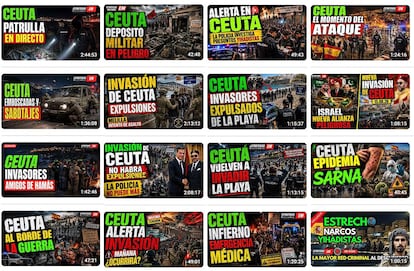 Video titles on Estrategias Militares’ YouTube channel. The titles include “Invaders expelled from the beach”, “Invaders, friends of Hamas” and “Ceuta, scabies epidemic”El País
On YouTube, Military Strategies helps raise funds for the campaign ‘A roast for our warriors’, aimed at preparing barbecues or roast dinners and serving them to Israeli soldiers to honor their work. The initiative belongs to an NGO that supports the Israeli army with volunteers who are “mostly Latinos” who live in Israel or abroad. Military Strategies helps by directing its followers to an Israeli fundraising platform.
ACOM, an organization that defends Israel’s interests in Spain, shares content from Military Strategies. It already did so before the Ceuta crisis, but this has become more intense since. The disseminator of far-right hoaxes Javier Negre, a Spanish propagandist for Donald Trump and Javier Milei who defends the positions of the Israeli government, also publishes videos of Military Strategies through EdaTV.
At ‘war’ with Morocco
Military Strategies began operating in 2023 and has addressed issues such as Venezuelan politics, the war in Ukraine and UFOs, though Israel has been its main focus. It has praised the IDF, defended Israel’s status as a “full democracy” in contrast to its neighbors and accused the Spanish government of “anti-semitism.”
However, from 30 July, its focus has shifted to the Ceuta crisis. With messages on X, YouTube and Telegram, it has combined two narratives. On the one hand, it stresses the “decline” of Spain, citing the “invasion” from Morocco as proof. On the other, it appeals to patriotism and calls for a “reconquest” of Spain, fanning the idea of an insurgency against Sánchez. “If the government is still in power tomorrow, someone in Spain has to do something. And if the King doesn’t do it, the people will,” the head of the network said on YouTube this week, before exclaiming that “we have to take to the streets” to “throw this government out once and for all.”
The outrage is based on Military Strategies’ estimate that 100,000 foreigners crossed the Spanish-Moroccan border into Ceuta and that there are still 20,000 left in the exclave city in North Africa – figures well above official data and most independent calculations. This, it claims, amounts to an “invasion” and not in a figurative sense. It is, according to the network, a “military invasion” orchestrated by the Moroccan army that is using it as the departure point for a multi-phase plan that will culminate in the “taking” of Ceuta “by force.” This theory is voiced while disturbing music plays in the background, creating an atmosphere of war hysteria.
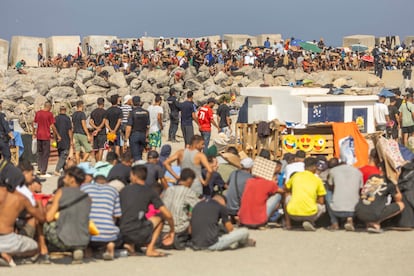 Immigrants wait for the distribution of food at Trampolín beach in Ceuta on September 3.Javier Hernández
The alleged Moroccan military action is not limited to Ceuta, according to Military Strategies. “Morocco declares war on Spain, it also invades the city of Melilla [another exclave city in North Africa],” it proclaimed at the beginning of the crisis. It added shortly after: “Melilla looks like Gaza right now;” Military Strategies is obsessed with comparing Spain’s two autonomous enclaves, especially Ceuta, with Gaza. According to this narrative, Ceuta and Melilla are at risk of becoming fertile ground for terrorism and Sánchez has a “golden dream” to “turn Ceuta into Gaza.”
Surrender and blackmail
According to Military Strategies, Morocco enjoys the complicity of Sánchez’s government which is guilty of “treason” against Spain. The charge of “treason,” also chanted during demonstrations on September 2, is based on the unproven hypothesis that the government had full knowledge of “what was going to happen” on 30 and 31 July and decided not to act. Another unfounded accusation follows: the government is making it easier for the “invaders” to surround “the military arsenal of Ceuta,” thereby facilitating the taking of the enclave if war breaks out. The network also claims the government planned to send the National Police to repress the “dissidents” in Ceuta opposing the “invasion.”
Why this alleged surrender by Sánchez’s government? “They are willing [in Sánchez’s government] to hand over Ceuta and Melilla to Morocco, because Morocco has things on the government and they know that they can go to jail for if Morocco opens its mouth,” says one video broadcast by the head of the network.
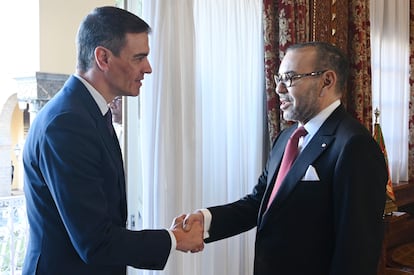 Spanish Prime Minister Pedro Sánchez greets King Mohammed VI in Rabat in 2024.BORJA PUIG DE LA BELLACASA (EFE / MONCLOA)
“The invaders are friends of Hamas” and “Is the government surrendering the enclave to Morocco?” are two of the soundbites that can be heard or read on these channels, which include fabrications regarding risks to public health. “Scabies epidemic in the city. Total fear,” is the headline for one video, despite the fact that no such epidemic has occurred, as the Spanish Ministry of Health confirms. Still, it is argued that the risk of spread is heightened by Ceuta being a “confined space” where “there is contact with all these vermin,” in reference to the newly arrived immigrants.
The head of Military Strategies tells EL PAÍS that he has been “quite faithful” to what is happening in Ceuta. When queried over the veracity of his claims, he does not retract, but gives a broad explanation in a much more measured tone than the one he uses online. On the “scabies epidemic,” he writes, “My statement refers to the appearance of cases, outbreaks and objective epidemiological risk factors.” On Morocco’s declaration of “war,” he points out: “I do not maintain that Rabat has issued a formal declaration of war in legal or diplomatic terms. It is a political, strategic and military assessment.”
“Disinformation” techniques
Expert in the analysis of disinformation campaigns, Marcelino Madrigal considers that this network is an example of a digital infrastructure of “disinformation” designed to “spread Israeli narratives” and “attack a country,” in this case Spain, during a “security crisis.” He believes that the government should assess the “risk” posed by its activity. The “connections” and “narratives” of this network indicate an “alignment” with both far-right channels and with Israeli “operators and proxies” that Madrigal places in the context of Israel’s hostility towards Spain for its position on Gaza. Regardless of whether there are economic links to Israel – which Madrigal does not go into – he believes that this “coalition” is in itself “significant” because it has the capacity to “influence public opinion” through “unsupported statements” and “exaggerations.”
“States that seek to amplify their propaganda through social networks covet, above all, having ecosystems in which their messages can reverberate,” says Iago Moreno, a specialist in disinformation and digital propaganda and head of the Future of Technology Institute think tank in Spain. In his opinion, Military Strategies is part of an “ecosystem” favorable to Israel, a condition that can exist independent of funding or direct influence. Moreover, for “effective digital propaganda,” it is preferable that there are no direct links between states and “content creators,” he says.
“In the Ceuta crisis, it is quite well understood that, both in the ecosystems aligned with Russia and in those aligned with Israel and the United States, existing channels have functioned as conveyor belts for messages that probably would not have had the same penetration through proxies more obviously subordinated to the interests of those powers,” says Moreno, whose think tank analyzes the activity of this network within a growing genre that he calls “military pornography.” This genre is of interest, he says, to the “great powers” for its ability to foment opinion on wars and conflicts.
Sign up for our weekly newsletter to get more English-language news coverage from EL PAÍS USA Edition