
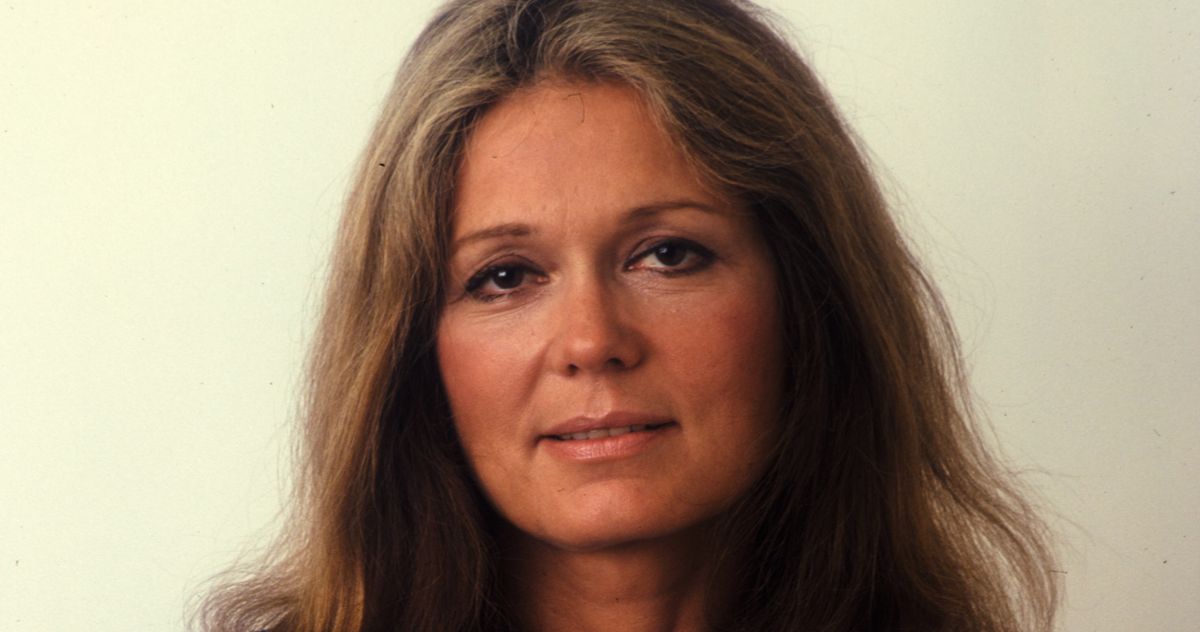
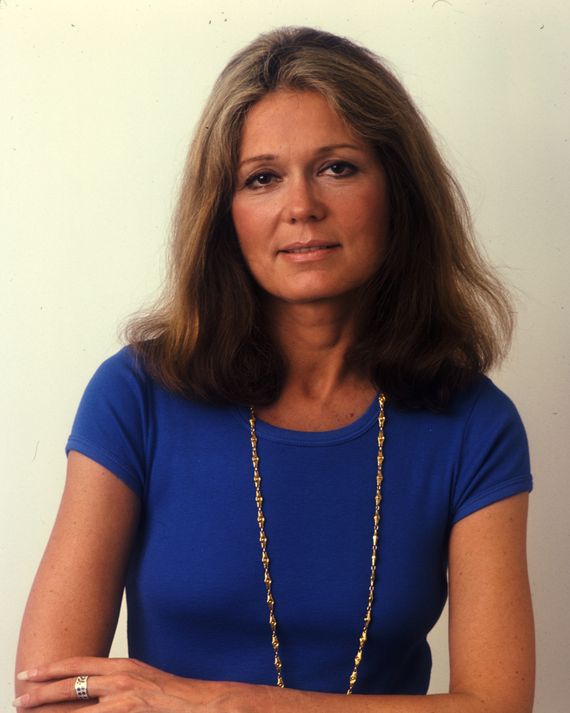
1980, New York.
Photo: ©Mary Ellen Mark, Courtesy of The Mary Ellen Mark Foundation
This article was featured in New York’s One Great Story newsletter. Sign up here.
I have written three books about three different subjects. My reporting on each of them began with a call to Gloria Steinem, with whom I was not especially close but who each time invited me up to talk.
I’d take the subway to her wacky Upper East Side triplex, which was covered in art, books, tapestries and murals and usually presided over by at least one three-legged cat, and listen to her. Steinem would always serve me cookies and chat for hours about whatever I asked her. She had lived through so much history and would spin it out studded with profanity, gossip, insight, clever turns of phrase, and some great one-liners, thrown off casually.
“I revirginized myself several times,” she once told me lightly. “Including when I was in India. I managed to revirginize myself then, too.” Less funny than the idea of revirginizing herself was Steinem’s rationale for doing so: “It was left over from my Toledo neighborhood, where if you were not a virgin, you were fair game. And girls really did get locked up in the garage and gangbanged by the whole football team. And then the family had to move, but it wasn’t the football team’s fault — it was the shame.” She could often find humor in darkness; it was crucial to her way of communicating with the world.
On another day: “The president of Smith said if we were ever going to have educated children, we must have educated mothers. I mean, no wonder Sylvia Plath did herself in; she was only two years ahead of me.”
She was scrupulous about attributing great lines to their originators (“For 30 years I’ve been quoting my friend Lee Grant, who once said, ‘I’ve been married to one Marxist and one fascist, and neither one took the garbage out”), but I often suspected that Steinem, who was a skilled speechwriter and also wrote for the satirical television show That Was the Week That Was, had given the quotes a little spit shine.
As a public speaker, Steinem had a gift for cutting through bullshit and often employed tmesis, the art of splitting one word with another; the splitter word was usually fucking. “There are some people who are really offended by profanity,” she said. “So I find the art form is to put the fuck in the middle of a word, as in fan-fucking-tastic.”
Steinem was the perfect popularizer. Her great contribution to the Second Wave of feminism was communicative facility: She could make spiky, roiling, uncomfortable, often messy ideas around gender, race, class, equality, and liberation sound smooth and snappy, attractive and funny. She was a talented, driven, and powerfully charismatic emblem for a movement that was always more complicated and sometimes more radical than she herself was. Her life, her work, and her contradictions together provide a remarkable illustration of the political and social disruption mainstream America is willing to tolerate, occasionally celebrate, and also revile.
In 2009, I asked Steinem, who’d been a surrogate on Hillary Clinton’s 2008 campaign for the Democratic presidential nomination and stood with Clinton as she gave her famous “‘18 million cracks’ in the glass ceiling” concession speech, what she had felt on that day.
“Relief,” Steinem replied without pausing. “I hate conflict.”
I must have stared incredulously at Steinem — who for half a century was perhaps the figure most popularly associated with the women’s movement, whose work had provoked wrath and resentment from both ideological opponents and her allies, a woman who had lived her adult life perpetually at the center of American conflict — because she laughed.
“I know,” she reassured me gently. “I’m in the wrong business.”
Steinem, whose business was feminism, died on Wednesday at the age of 92 in her home in Manhattan. A journalist, an author, and an activist, Steinem lived a life spanning decades of explosive progress and violent regress for American women. She was telling me the truth about hating conflict. You could hear that even in her funny stories, which were sometimes about how hurt she’d been by an attack or critique.
In the early years of Ms. — the country’s first mass-market feminist magazine, which she co-founded in 1971 as a supplement in this magazine — a pornographer put up a display outside the offices; it showed a cartoon of Steinem’s face over a graphically hirsute rendering of her naked body surrounded by disembodied penises. “It has my face and head!” she wailed to her close friend, the feminist and New York congresswoman Bella Abzug, trying to explain why it bothered her so much. “And my labia,” Abzug had replied, silencing Steinem’s distress with laughter.
You can see Steinem’s face fall on Larry King’s talk show in 1990, when a caller opens with “Hi, Gloria, I’m so excited to finally get to talk to you,” then continues, “I really believe that your movement was a total failure … you are one of the primary causes of the downfall of our beautiful American family … I have said for the last 15 years that Gloria Steinem should rot in hell.”
Steinem could express political fury through speeches and in interviews but found it hard to convey her personal dismay directly. “Coming from the Midwest, you have to be on LSD to know when you’re angry,” she told me in 2018. It took her many years, even as a public and often confrontational feminist agitator, to tell people she was mad. Even then, she said, “I could tell them Thursday that I’d been angry on Monday. But I couldn’t tell them at the time.”
But people could tell her they were angry.
One of the conflicts Steinem found herself embroiled in over the years concerned how much power her race afforded her with a public that was considerably less tolerant of or curious about a movement that had been pioneered and led by people who fit a less traditionally feminized white American aesthetic.
Steinem was hyperconscious of the role her whiteness played in her outsize fame and reputation, though she was never fully successful at displacing herself as the symbol of a movement that was far more varied in its colors, shapes, and sexualities than she.
In 2018, the writer Rebecca Carroll wrote of sorting through the New York Times photo archive looking at image after image of Steinem standing alongside, working with, and listening to Black women. “In each photo, there is ease and intent, focus and fury and perhaps above all, a nearly palpable, unprompted sense of racial solidarity that makes me wonder why it’s still so hard for us to get it right today,” Carroll wrote.
Steinem worked with Black speaking partners, including Florynce Kennedy, Dorothy Pitman Hughes, and Margaret Sloan-Hunter; she spoke to me about assiduously trying to ensure that panels she spoke on and stories she participated in were not all white, though she also described the bait and switch in which she’d find herself alone on the cover of a magazine after having been promised she would be featured with a diverse group.
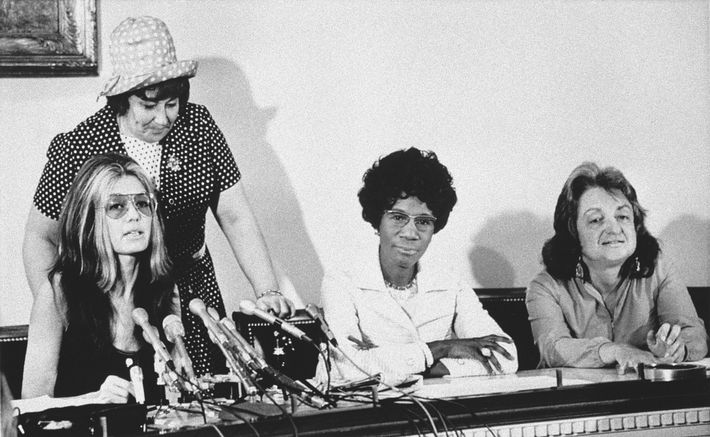
1971: Steinem with Shirley Chisholm and Betty Friedan. Standing is Bella Abzug.
Photo: Charles Gorry/AP Photo
“Black women were the first feminists I met,” Steinem said. “I learned feminism from Black women. All my lecture partners were Black women. They were so far ahead of us. There’s certainly racism, God knows, in the women’s movement. But in my actual personal experience it was the women of the National Welfare Rights Organization, it was Flo Kennedy, it was Dorothy Hughes, all these women from whom I learned.”
But it is incontrovertibly true that none of the Black women Steinem listened to, or spoke alongside, or learned from — none of those who did indeed come before her and have come after — ever became the famous face of the women’s movement and that none ever profited from that fame to the degree that Steinem did.
It is also true that despite her intellectual commitments and work alongside Black activists, Steinem was capable of spectacularly white fuck-ups. In 2008, after Hillary Clinton’s Iowa caucuses loss to Barack Obama, she published an op-ed in the New York Times titled “Women Are Never Frontrunners.” It began by imagining a female version of Barack Obama (as if ambitious Black female politicians did not exist in real life and had to be conjured) and made a blunted, largely ahistorical argument about Black men breaking political barriers before women, noting that Black men had won the vote before women of any race without mentioning the violent state-enforced suppression that disenfranchised Black voters throughout the Jim Crow era, setting up a false and distorted hierarchy of oppressions.
Steinem’s op-ed correctly met with angry objection, culminating in a contentious Democracy Now! debate with the professor and journalist Melissa Harris-Perry. As Harris-Perry told me afterward, Steinem’s op-ed, which appeared during a historic electoral contest in which all mainstream eyes were suddenly trained on issues of race and gender, was an example of the worst of a white-dominated women’s movement in all its stages. “This is Gloria Steinem, and she’s been having these conversations for 30 years,” Harris-Perry told me then. “The conversations in which people say ‘White feminists: Please don’t do this.’”
“Here is the important thing,” Steinem told me soon after. “If you want to maintain racism, you have to restrict the freedom of the women of the ruling class, of white women, otherwise you don’t have the means of reproduction and racial purity. It is not possible to be a feminist without being anti-racist. It’s all connected.”
Many years later, Steinem would point to a photograph of Kennedy, who died in 2000, hanging in her apartment. “I have her picture here still. It reminds me of what she always used to say to me: ‘Honey, the purpose of kicking ass is not that you get your ass kicked. It’s that it keeps your ass sensitive.’”
There was no question that Steinem became famous as a spokeswoman for feminism in part because she was a traditionally beautiful woman who made no secret of her active hetero sex life, dating prominent men and famously refusing to marry (“I can’t mate in captivity” was among her most famous anti-marriage quips) and sporting miniskirts and buttons that read “Cunt Power.” Her fame — even inside feminism, which worked in part to explode objectifying, restrictive, and sexualized aesthetic impositions on women — was built in part on embodying many of those aesthetics.
She had come to New York in the 1960s as a sexually liberated feminized ideal. Nora Ephron, who had been her colleague in New York’s New Journalism trenches, wrote of how Steinem had been “the glamour girl, all legs and short skirts and long painted nails, David Webb rings, Pucci, Gucci, you-name-it-she-had-it” and was linked “to one attractive man after another” but by 1972 had “managed to transform herself almost totally. She now wears Levi’s and simple T-shirts.” Still, as Ephron wrote at the time, “Every so often, someone suggests that Gloria Steinem is only into the women’s movement because it is currently the chic place to be; it always makes me smile, because she is about the only remotely chic thing connected with the movement.”
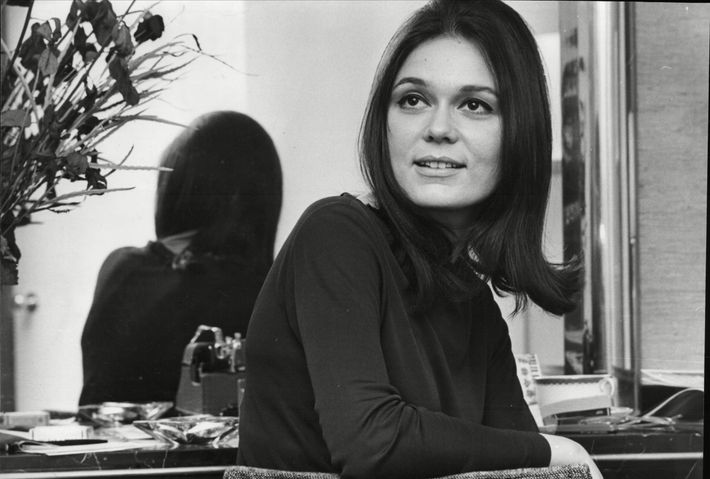
1966: Steinem at the Savoy Hotel in London.
Photo: Tony Prime/ANL/Shutterstock
Steinem’s allure, her feminized charisma, was undoubtedly a powerful weapon for the women’s movement in that it defanged an anti-feminist right (and an anti-feminist left) by complicating one of its most base and potent arguments: that women clamoring for liberation were doing so only because no man wanted them. Steinem was a walking repudiation of that claim. But that she had to exist in order to effectively fight against it was proof of how powerfully women’s worth was weighed in relation to their traditional appeals to men, and it pissed off plenty of other feminists who resented that Steinem’s beauty could shield her — and make her more famous than they — in a way they considered hypocritical and unfair, a distillation of the double standards and objectification they were fighting so energetically to dismantle.
The first time I saw Steinem in person was on the street in Washington, D.C., at the 2004 March for Women’s Lives. I had not grown up with any particular attachment to Steinem, but watching her walk down a sidewalk was like watching a movie star: At 70, she still shone, was glossy; light reflected off her well.
That day more than two decades ago, just as we were beginning to come out of a decadeslong anti-feminist deep freeze into a pop-feminist thaw, was the first time in my life I’d seen young women — teens, 20-somethings, women who were my peers — react to an older woman, a feminist, with adulation. Very young women stopped Steinem on the street, cried, stammered. It’s impossible to convey how strange that was back then, before the explosion of the feminist blogosphere and a corporate feminist media and girlboss enthusiasms and RBG devotional candles. For my whole life at that point, feminism had been profoundly, sickeningly, deadeningly out of fashion. Yet here were young women so overcome by star power that they had been rendered unable to speak upon seeing Steinem.
I have a visceral memory of watching this and realizing in an animal way how much it mattered that she was beautiful. It shouldn’t have. It sucks that it did. But it mattered a lot.
Steinem was keenly aware of these tense, circular dynamics, but it was never a subject on which she really managed to smooth out the contradictions and come up with any great, pithy one-liners. She could be very defensive about it. “The idea that I had a glamorous life came in part … from the idea that if you were a pretty girl, whatever that meant, that you must be getting assignments for that reason,” she said in an HBO documentary. “Or if you were ever photographed at a party, that was your whole persona. You couldn’t also be serious. So it did drive me crazy to be viewed in that way.”
But the idea that she had a glamorous life came in part from her having a glamorous life. She did like going to parties, did like being stylish, and would tell anyone that she modeled her aesthetic in part on Audrey Hepburn’s character from Breakfast at Tiffany’s. She once told me, with not a little pride, about how at a 20th reunion of the National Women’s Political Caucus, Congresswoman Shirley Chisholm, by whom she said she had always been intimidated, sidled up to her and whispered, “Only you and I have kept our figures,” a story Steinem thought was funny and I did not.
Betty Friedan, author of 1963’s The Feminine Mystique, famously detested Steinem, partly for stealing the spotlight from her. She once said of Steinem’s aesthetic and of her vaunted objections to marriage, “I guess [she] gave some comfort to the singles … But really, Gloria was a phony. She always had a man. And I used to catch her hiding behind a Vogue magazine at Kenneth’s having her hair streaked.”
Steinem told me that “there was no way out of” her feud with Friedan, in part because their tension was rooted in something deeper than professional jealousy or even the ideological gap between Friedan’s heteronormative middle-class vision of the movement’s aims and Steinem’s sympathies for multidirectional, multiracial sexual liberation, rights, and recognition. Friedan’s sister, Steinem told me, had once written her a letter. “She said, ‘I just want you to know that you represent me in Betty’s life.’ Because there was a pretty sister and a not-pretty sister. It was a very generous letter for her to write because she was essentially saying, ‘You can’t do anything about it, you just have to move on.’”
Steinem was born on March 25, 1934, in Toledo, Ohio, nine years after her sister, Susanne. Steinem’s mother, born Ruth Nuneviller, had worked as a journalist on the Toledo Blade (a rare path for a woman at the start of the 20th century) before marrying Leo Steinem, a traveling salesman who also ran a summer lake resort.
Ruth had tried to return to work after giving birth to her elder daughter in the 1920s. “You may love the baby, but a hundred baths are a hundred baths,” she told the New York Times in 1972, recalling her slow realization that she could not both write and parent in an era in which domestic responsibilities often fell entirely to women. “Papers were different then; we had scoops and I had my share. When I was on one, I’d work all night if necessary; and I’d worry about the baby … I was being torn apart, finally my doctor said I wasn’t cut out for it.”
Ruth left journalism for good a few years before Gloria’s birth. But her retreat from the professional sphere proved a loss so profound that it sent Ruth into long periods of incapacitating and hallucinatory depression and addiction to tranquilizers. As a child, Gloria was close to Leo, whom she would describe as immensely charming and terrifically irresponsible. He took his family with him on his sales trips, meaning Gloria didn’t complete a full year of school until she was 11; she would learn to tap-dance, a talent she believed might one day be her ticket out of Ohio, from the nightclub performers at his resort.
Ruth and Leo divorced when Gloria was 10, and with Susanne in college at Smith, young Gloria became Ruth’s only steady companion, her cook and caretaker, a lonely responsibility for which the child felt ill equipped.
Though Gloria, a teenager in the 1950s, had no vocabulary or framework to understand her mother’s plight, she recalled the mark that Ruth’s thwarted desires left on her. Ruth used to tell her of how she’d always wanted to move to New York City to be a journalist. Young Gloria would ask why she hadn’t gone, and Ruth would reply that if she had, Gloria would never have been born. “I never had the guts to say,” Steinem said, “but you would have been born.” After writing about her mother in 1983’s essay collection, Outrageous Acts and Everyday Rebellions, and again in her 2015 memoir, My Life on the Road, readers would often ask Steinem if she was worried that mental illness ran in her family. She told them, “No, only patriarchy is hereditary.”
Steinem moved east in 1952 to attend Smith College, where she majored in government. Upon graduation, she traveled to India on a scholarship for two years, eventually settling in New York in 1960, hoping to become a journalist; it was not just patriarchy that was hereditary.
Struggling to break into a suffocatingly male-dominated profession, Steinem wrote for Glamour and Ladies’ Home Journal (for which she would interview a 71-year-old Dorothy Parker, who told her, “It’s a terrible thing to say, but I can’t think of good women writers. Of course, calling them women writers is their ruin; they begin to think of themselves that way”). She contributed political satire to Help! and some pieces to Esquire, including one assigned to her by the editor Clay Felker in 1962 about the brand-new birth-control pill.
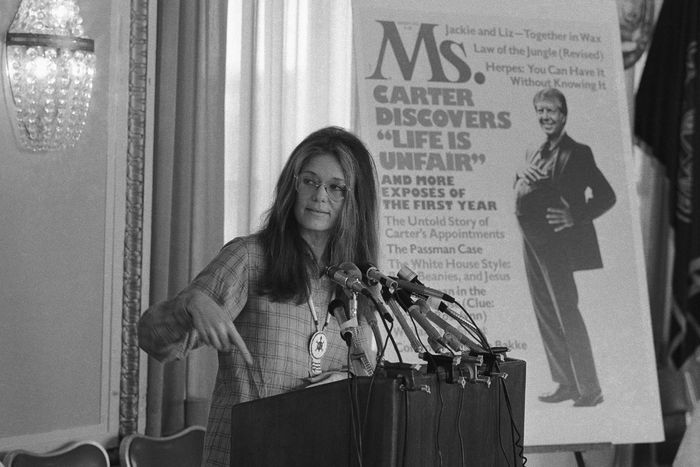
1977: Steinem at a news conference at the National Press Club in Washington, D.C.
Photo: Bettmann Archive/Getty Images
In 1963, she took an assignment from Show magazine to go undercover at Hugh Hefner’s Playboy Club, writing a first-person exposé on abusive work conditions experienced by the club’s female “Bunnies,” who served drinks while wearing high heels, strapless leotards, rabbit ears, and cottontails. For years, Steinem said, she regretted writing the piece because, while it made her famous, it ensured she would be taken even less seriously as a journalist and kept editors from giving her the meaty political assignments she really wanted to tackle.
It wasn’t just the Bunny piece that feminized her, though. In 1963, Steinem published The Beach Book, a paean to salt, sand, and sun; its dust jacket was made of reflective foil that could help readers tan. The market for women’s writing at the time worked neatly to sideline them: Steinem never forgot some of the indignities of her early career, including an assignment she viewed as the nadir, a trend piece on textured stockings for women.
But in 1968, she joined Felker as one of the founding editors of this magazine. In those years, Steinem was politically active, volunteering for Robert F. Kennedy’s presidential campaign and for United Farm Workers. In columns and features for New York, Steinem was able to cover the kinds of stories she cared about, including mayoral politics and the booming antiwar and civil-rights movements. She was not yet consciously engaged in the renascent women’s movement, which had kicked off for the white middle-class masses with the publication of Friedan’s The Feminine Mystique.
In a 1968 interview with Canadian television producer Moses Znaimer, Steinem is ironing (clothes that, she would later tell me, she’d worn to an antiwar demonstration down Fifth Avenue) while Znaimer asks if she ever wants to marry. “Eventually,” Steinem replies. “But it keeps receding two years into the comfortable distance … You imagine what it would be like to be married to people you’re going out with … maybe it’s a ladies’ thing … You think, ‘Let’s see, my name would be Gloria Burgermeister … nah.’”
Only when she was sent to a Greenwich Village church basement to cover an abortion speak-out organized by the radical-feminist group Redstockings in 1969 did she begin to think about gender inequity as having shaped her own life. She was 35.
Steinem had had an abortion in England, some 13 years earlier, on the way to India. (She would dedicate My Life on the Road to the doctor who performed the illegal procedure, revealing that he’d made her promise two things: that she would not tell anyone his name and that she would do what she wanted to do with her life. “I’ve done the best I could with my life,” Steinem wrote in that dedication.) The 1969 speak-out made Steinem understand her abortion as one of the first instances in which she had acted in her own life, on behalf of her own life, and that this experience was far from singular. “I finally knew that I wasn’t alone,” she said in a 2011 HBO documentary. “That I wasn’t crazy. The system was crazy.”
A little over a year after covering the speak-out, Steinem was testifying in front of the Senate Judiciary Committee in favor of the Equal Rights Amendment.
As she became more interested in feminism, she grew frustrated with how little space, interest, or patience her male editors had for coverage of the movement. Steinem turned increasingly toward speaking and activism, partnering with Hughes and Kennedy to talk about the intertwined and oppressive systems of race and gender.
In 1971, Steinem co-founded Ms. magazine, and it was astonishingly successful. The same year, she helped found — alongside Chisholm, Abzug, Fannie Lou Hamer, and Friedan — the National Women’s Political Caucus. In 1977, she was a key part of the National Women’s Conference in Houston. She published multiple books, including the best-selling Outrageous Acts and Everyday Rebellions and the considerably more self-help-y Revolution From Within, which chronicled her lifelong battle with low self-esteem. Steinem campaigned for innumerable political candidates in state and federal elections, including George McGovern, Walter Mondale and Geraldine Ferraro, Patricia Schroeder, Bernie Sanders, Carol Moseley Braun, Hillary Clinton, and Barack Obama.
Steinem — who barely slowed her speaking and travel schedule as she entered her 80s — published a collection called The Truth Will Set You Free, But First It Will Piss You Off!, in 2019.
In 2000, Steinem married the South African activist David Bale, whom she’d met the year before. When they’d met, she told me, “there seemed to be no reason on earth for us to get legally married” except that Bale needed a visa.
“I realized that the women’s movement had by then equalized the marriage laws, except for same-sex marriage yet to come,” Steinem told me, “and I wouldn’t lose my civil rights.” She asked her friend Wilma Mankiller, the former principal chief of the Cherokee Nation, what she should do; Mankiller took a night to consider and then recommended that Steinem marry Bale. Mankiller’s husband, Charlie Soap, performed the ceremony in Cherokee around a sage fire. “We had a wonderful breakfast — and that was it,” Steinem said.
She would soon conclude that the marriage, entered into for practical purposes, had been the correct choice given the barbaric health-care policies of the U.S. “If we had not been legally married, David would not have been covered by my insurance,” she said. “When he became ill with what was finally diagnosed as brain lymphoma about two years later, it would have financially broken everyone, including his children.” Bale died in 2004.
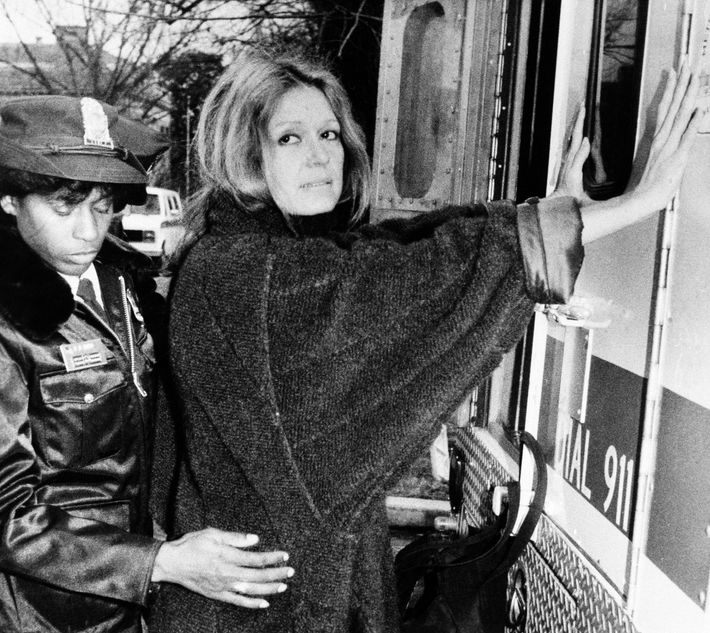
1984: Steinem being arrested during an anti-apartheid protest outside the South African embassy in Washington, D.C.
Photo: Pool/AP Photo
In 2015, Steinem told me that her marriage reminded her of how outdated our thinking about love is. “Some people still assume that because we got legally married, he was ‘the love of my life’ — and I was his. That’s such a misunderstanding of human uniqueness. He had been married twice before and had wonderful grown children. I had been happily in love with men who are still my friends and chosen family. Each of our loves is crucial and unique.”
She also told me of how she loved to watch young women crowd around Bale when she spoke on campuses. “I learned how eager they were to talk to a man who — because of our relationship and also because of who he was — showed that you could be loved by a man without giving up yourself. I hadn’t realized just how deep that hunger was and how few the examples to feed it.”
Back in 1968, while she ironed her clothes for the antiwar march, Znaimer asked the then-34-year-old, pre-feminist Steinem what she wanted to be when she “grew up.”
“Free,” she told him. “And old. And a little mean.”
Steinem was free. And she grew old. But she never actually got mean, at least as far as I could tell.
If anything, I sometimes felt she took too kind a view of the human race and its potential for progress. She once told me, explaining why she’d never been afraid that 2008 vice-presidential candidate Sarah Palin would be mistaken for a feminist despite Republican attempts to present her as such, “You have to always correct for the fact that I’m a hopeaholic, right?”
You did have to correct for that sometimes.
She clung perhaps a bit too fast to the notion that forward motion, more freedom for more people, was inevitable. During a 2018 interview, with the Supreme Court confirmation of Brett Kavanaugh imminent, I asked what it’s like to live through a period of progress you see being reversed. She was atypically unable to answer my question, assuring me — too confidently, I thought — that though, of course, backlashes were powerful, we wouldn’t really go back to where her life had started, a world of repressed and policed sexuality and the inaccessibility of reproductive health care. She said this even though she knew as well as anyone, and better than most, that actually, even while Roe stood, millions of Americans already lacked reproductive-health-care access and millions more were likely to lose it in the coming years.
Perhaps it was the denialism of a “hopeaholic” who had lived through such expansive change and then survived long enough to see much of it eroded. Steinem had a hard time with that: the reversals, the depth and tenacity of the furious resistance to her project.
For all the years she put into fighting injustice, she never got comfortable with the fact that, often, injustice prevailed. Back in 1972 in Miami, walking up Collins Avenue after McGovern had betrayed the women’s caucus at the Democratic National Convention over its proposed abortion plank, she had wept in front of Ephron about how politicians “won’t take us seriously … I’m just tired of being screwed and being screwed by my friends. By George McGovern, whom I raised half the money for in his first campaign, wrote his speeches … He just doesn’t understand … We went to see him at one point about abortion and the question of welfare came up. ‘Why are you concerned about welfare?’ he said. He didn’t understand it was a women’s issue. They won’t take us seriously. We’re just walking wombs.”
Ephron wrote that she didn’t know how to react to Steinem’s emotion: “I have never cried over anything remotely political in my life, and I honestly have no idea what to say.”
Steinem could always care enough to cry in part because she always believed that human beings not only should — but really might — be better than they often are.
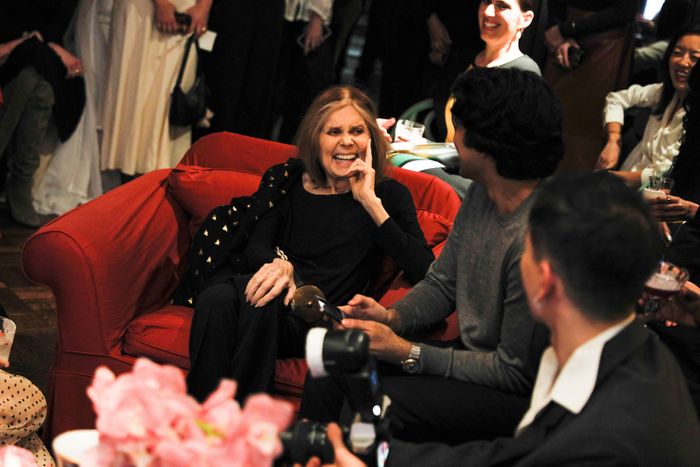
March 2025: Steinem at her home in New York for a storytelling circle.
Photo: Mike Vitelli/BFA.com/Shutterstock
Men could disappoint her profoundly because she actually loved them, believed in them, wrote their speeches, worked alongside them, fucked them eagerly and unapologetically, sometimes fell in love with them. That she could love men so much, even while ferociously bemoaning and challenging their unequal grip on power, was one of the things that gave her power: She could never be accused of man hating.
More than men, though, Steinem loved women, believed in women, thought the best of women. It was what powered her. But I often wondered whether that love, that tenacious faith in women, was one of her weaknesses.
The soapy 2020 Hulu miniseries Mrs. America, which Steinem hated, suggested she had not taken the threat posed by anti-feminist leader Phyllis Schlafly seriously enough to effectively forestall it or defeat her. And sure, it wasn’t just Schlafly but a system of corporate entities invested in keeping women oppressed that helped defeat the Equal Rights Amendment. But Steinem was sometimes in denial about the power and venality of some women, underestimating the army Schlafly summoned: women who thought Steinem and her comrades should rot in hell, women who didn’t want to give up their grip on class and racial supremacy, women who didn’t want to be liberated and who really didn’t want other women to be liberated, either.
But that love of women was, of course, also Steinem’s strength. Her abiding affection for women and conviction about their unceasing potential for growth and revolution is perhaps why, while many from her generation of Second Wave feminists grew resentful of young women they viewed as insufficiently radical (and then, more recently, too radical in their critiques of that older generation), Steinem remained a stalwart cheerleader for young women.
When I asked her about this dynamic in 2009, Steinem said, “If I were to lecture other people of my own age group, I would say that it’s true that most Second Wave feminist women were not appreciated enough — I was, but most women were not — for the hard work and sacrifice. But you cannot exact that price, gratitude, from your daughters. Even Susan B. Anthony said, ‘Our job is not to make young women grateful; it’s to make them ungrateful.’” Besides, Steinem liked to say, “I didn’t walk around saying, ‘Thank you for the vote.’”
Steinem treated young women like full humans with respect and humor and regard; she spoke to them as peers. I got a little teary when I heard her once say, “I feel about women under 25 or 20 that I just had to wait for some of my friends to be born,” because it was so cheesy and it rang so true.
Around that time, she was asked by a 12-year-old girl what advice she would give young feminists. “I am not here to tell you what to do,” she replied. “I’m here to support you in doing whatever the fuck you want to do. You know what is unjust and what needs to be fixed. Children are born knowing. Kids say two things: ‘That’s not fair’ and ‘You’re not the boss of me.’ The entire social-justice movement is based on those principles.”
For years, Steinem had offered her apartment to young feminists as a space for meetings and parties. After COVID brought an abrupt halt to her intense travel schedule, she opened the Upper East Side triplex even further to groups who wanted to hold off-the-record strategizing sessions, “talking circles,” post-theater discussions, and political arguments. As her sharp memory began to get just a bit fuzzier, Steinem would sit among women she often didn’t know, sometimes contributing to the conversation, sometimes just listening. And while the groups thronging into her colorful living room to meet and have their photos taken with her in her old age could feel a little like a stop at feminist Disney World, it was clear that Steinem had long wanted her home to be a gathering place and was explicit that she intended this to be part of her legacy after she was gone.
“Remember that I always want you to think of this as your living room, if you need one,” she said to a group of women in early 2026, when she was 91. On the subway afterward, a friend and I spoke about what that kind of promise — the promise of space, explicitly for women — meant in New York City.
Sometimes, Steinem had permitted young women who needed a place to live to stay with her, sleeping in a lofted bed in that living room. Back during the 2008 presidential race, she was housing the activist Shelby Knox, then in her early 20s. Knox had become a devoted Clinton supporter during the primary and was waiting for Steinem when she’d gotten back from Washington, D.C., and the “18 million cracks” concession speech.
When Steinem walked in, she found Knox still distraught and asked why she was crying, noting that so much progress had been made. “You’ll live to see a woman in the White House,” Steinem had assured the weeping young woman in her apartment.
“But you won’t,” Knox shot back.
Steinem did live to see a woman elected vice-president, a first in American history and politics. By the time Kamala Harris found herself the surprise Democratic nominee for president in 2024, Steinem was 90 and not much on the road anymore. Early on Election Day 2024, she reposted on her Substack a piece she had first written in 1970, headlined “What It Would Be Like If Women Win.”
She didn’t post again until four days after Donald Trump’s second inauguration, an entry called “Staying Hopeful,” in which she wrote, “One of the uses of a long life is remembering when things were worse, and also remembering that when bad times do come, so does an outpouring of community and energy amongst those dedicated to justice.”
I am so sorry Gloria didn’t live to see a woman — a feminist woman, a progressive woman, a woman who believed in liberation and the interconnectedness of oppressions — elected president.
Steinem was surely sorry too. She frequently said she hoped to live to 100. And she came really, really close.
“I’ve so loved being here,” she said in the HBO documentary. “I love it so much. I never want it to end.”
Thank you for subscribing and supporting our journalism.
If you prefer to read in print, you can also find this article in the September 7, 2026, issue of
New York Magazine.
Want more stories like this one? Subscribe now
to support our journalism and get unlimited access to our coverage.
If you prefer to read in print, you can also find this article in the September 7, 2026, issue of
New York Magazine.
One Great Story: A Nightly Newsletter for the Best of New York
The one story you shouldn’t miss today, selected by New York’s editors.
Vox Media, LLC Terms and Privacy Notice
Related