
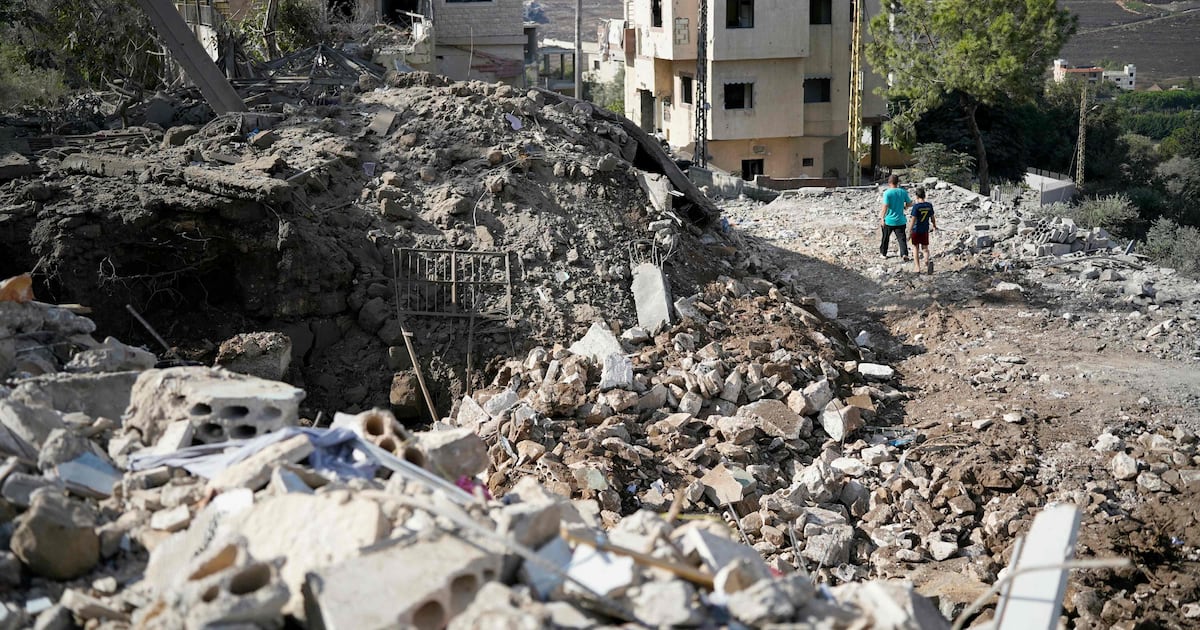
The Israeli military launched an overnight bombing campaign in Lebanon outside its so-called security zone, just hours after announcing it had cleared Hezbollah fighters from the strategic Ali Al Taher ridge in southern Lebanon, further straining the country’s fragile ceasefire.
The strikes killed five people and wounded 24 others across five locations in southern Lebanon and, for the first time since June, in the western Bekaa, according to a preliminary toll from Lebanon’s Health Ministry.
Two people were killed when an Israeli strike hit a motorcycle in the Nabatieh district. In a separate strike on a house in Ramadiyeh, in the Tyre district, one person was killed, and 15 others were wounded, including six paramedics, three women and two girls.
Israeli strikes also hit areas including Mayfadoun and Zawtar in southern Lebanon, as well as the vicinity of Ain Al-Tineh in the western Bekaa Valley, according to the state-run National News Agency.
Israeli forces also shelled the Wadi Al Salouqi and Wadi Al Hujeir areas of southern Lebanon early on Saturday, Lebanon’s state-run National News Agency reported.
Hezbollah reacted in a statement, saying that Israel continues “to escalate its aggression and crimes against Lebanon through killing, shelling, destruction, and the systematic demolition of homes and villages”.
Later on Saturday, reports indicated detonations of homes in Bint Jbeil, located a few hundred metres from the Israeli border.
The Iran-backed group called on the Lebanese state to “reassess its calculations” as the government pushes ahead with plans to disarm all non-state actors, including Hezbollah.
The latest escalation comes after Israel announced it had taken “operational control” of Ali Al Taher ridge, which has become a flashpoint in the Israel-Hezbollah conflict despite a ceasefire announced in June.
Israel had said Hezbollah fighters were holed up in tunnels dug beneath the ridge, which overlooks a wide area.
The group had denied reports that Iranian personnel were present there and sought to downplay the ridge’s significance.
Experts have linked Israel’s latest escalation in Lebanon to elections scheduled for October, with Israeli Prime Minister Benjamin Netanyahu’s Likud party facing a tough race after losing popularity in the polls since October 7, 2023.
“It is not so much the strategic position of Ali Taher that is provoking the intensity of this fight. It is, to a large extent, the upcoming Israeli elections,” Karim Emile Bitar, a Middle East expert at Sciences Po Paris, told The National.
“Mr Netanyahu would like to have some images showing the surrender of a few IRGC or Hezbollah members, showing some tunnel having been captured, in order to increase his chances.”
Nasser Khdour, Middle East assistant research manager at ACLED, said the surge in violence comes “at a politically sensitive moment for Israel”.
“The Israeli government is pushing for further escalation to resume unfinished military operations that it was forced to halt because of the ceasefire and diplomatic process,” he said.
For military expert and retired Brig Gen Mounir Shehadeh, Israel’s capture of the ridge points to the risk of further expansion into Lebanese territory.
“The danger lies not in the hill alone, but in the possibility that control of it becomes the first step towards expanding the security zone,” he said.
The National previously reported that Israeli forces had quietly deployed beyond their self-proclaimed “security line”, which covers about 7 per cent of Lebanon. Israel’s occupation in southern Lebanon has been widely condemned by the international community as illegal.
“The real danger is that control of Ali Taher shifts from a limited operation into a gradual pattern of territorial expansion,” Brig Gen Shehadeh told The National.
Reuters reported on Thursday that Iran had warned the US last month that it would retaliate forcefully against any Israeli attack on positions held by its Hezbollah allies on the ridge.
Brig Gen Shehadeh said the risk of further spikes in violence now hinges on whether Israel limits itself to consolidating its position or uses the hill as a platform to advance into new areas.
“That is precisely where the risk of a broader escalation lies,” he said.