
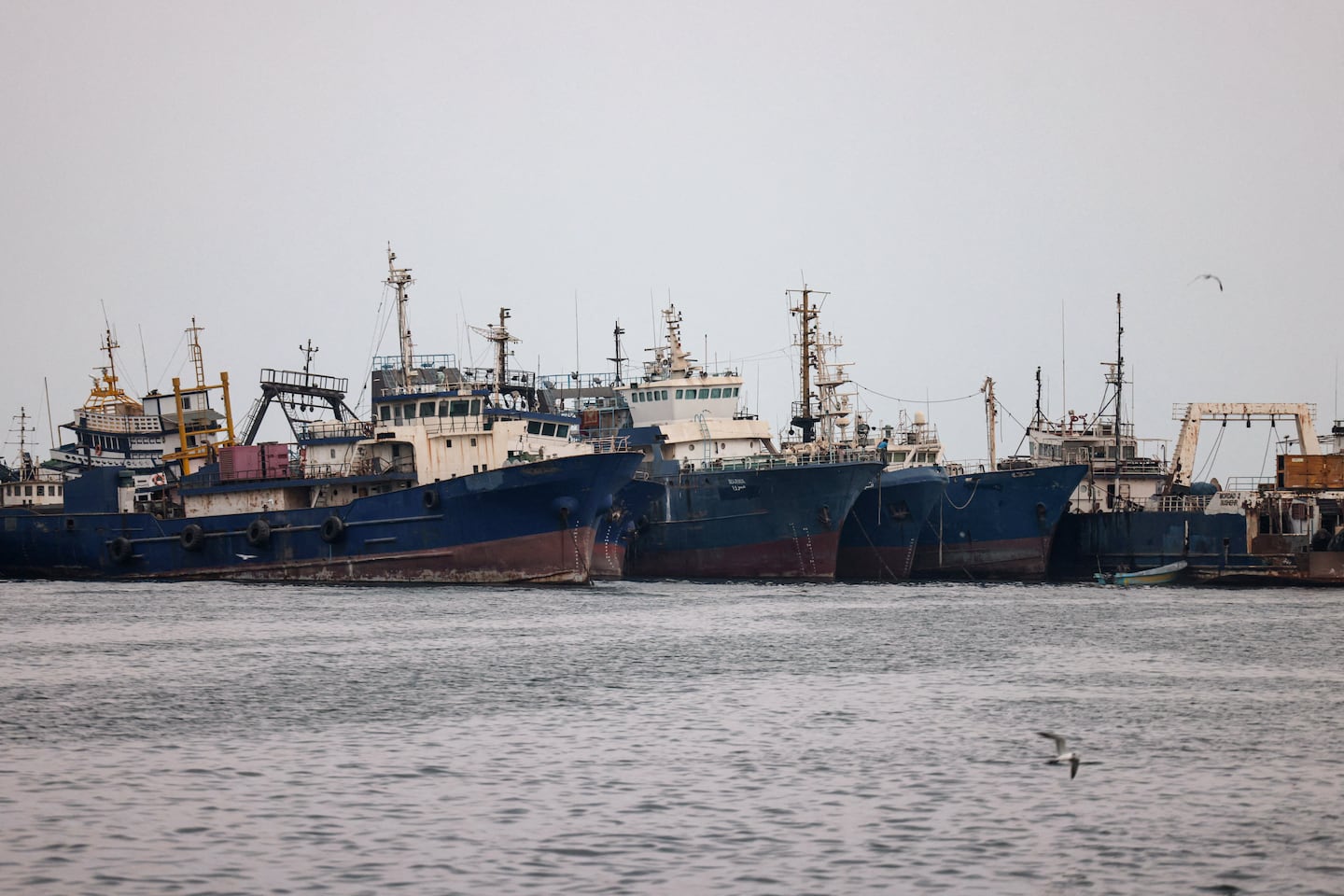
The U.S. statement called the tankers part of a shadow network helping to fund Iran’s powerful Revolutionary Guard and its armed proxies in the region.
A spokesperson with Iran’s joint military command later warned that strikes against U.S. military ships would be more severe, if the U.S. continues to interfere with Iranian shipping, the state broadcaster reported.
That Iran targeted a U.S. aircraft carrier with a ballistic missile “indicates that Tehran is becoming increasingly willing to accept risks it previously sought to avoid, including directly threatening some of the most important U.S. military assets in the region,” Danny Citrinowicz, an Iran expert at Israel’s Institute for National Security Studies, said on X.
Earlier, Iranian state television had said that four U.S. missiles struck a tanker about 6 miles (10 kilometers) from Kharg Island, home to a terminal through which the country exports most of its oil. Kharg Island has been repeatedly targeted during the war, including in U.S. strikes on military sites there in March.
The U.S. said that one tanker was struck off Kharg Island and another was struck near Jask, east of the Strait of Hormuz. The unladen tanker was hit in the Gulf of Oman, and the U.S. said its crew had been “directed to abandon ship.” The statement shared what it called video footage of the strikes.
After the U.S. statement, Iran’s state broadcaster reported the attack of the two other tankers, saying their crews had evacuated.
“We will not hesitate to defend American forces, and if necessary, destroy Iran’s limited and exposed oil fleet,” said Adm. Brad Cooper, the head of U.S. Central Command.
Iran’s Foreign Ministry called the attacks a war crime, and said that the consequences for continued U.S. aggression, including “economic warfare,” would rest with Washington and its allies.
Between the war and the disabling of ships during the U.S. blockade of Iranian ports, it’s not immediately clear how many Iranian oil tankers have been targeted. On May 8, the U.S. military said that it fired “precision munitions” into the smokestacks of two Iranian oil tankers, both unladen.
The latest strikes came nearly a week after the U.S. and Iran resumed attacks following a month of relative calm, with the Strait of Hormuz, and Iranian communities along it again, being targeted. At least five people were killed earlier in the week during a U.S. bombardment of southern Iran. One strike hit a wedding.
Masoumeh Zarei, 13, was wounded in the attack. She spoke to The Associated Press at a hospital while being treated for injuries to her abdomen.
She said the wedding celebration had already begun when she set out to join it. She never made it there. She was knocked unconscious when a telecommunications tower was struck. Her next memory was of waking up in a hospital.
“The party had just started, and we wanted to go there,” Zarei said, her voice hoarse. “I had made my nails really pretty for the party, but everything changed.”
Her friend, 14-year-old Kiana Karimi, also was wounded and in intensive care. She told the AP that she heard five explosions.
“The first three explosions at the telecommunications tower threw us to the ground,” Karimi said. “I quickly got up to pick my brothers up off the ground. Then there were two more explosions, and after that I don’t remember anything.”
The Trump administration appears to have adopted a dual-prong approach to the conflict, responding militarily to attacks on the strait while going after foreign financial institutions that handle Iran’s money. U.S. Vice President JD Vance on Thursday said that there was no prospect for renewed talks as long as Iran goes after ships, while noting that major military operations ended in July.
But Tehran’s hard-line new senior leaders have signaled the willingness to dig in after weathering decades of sanctions. The elected government of Iranian President Masoud Pezeshkian, however, has said that it favors a negotiated end to the war.
Iran has found ways over the years to circumvent sanctions — and now the U.S. blockade — and get its oil to buyers to help ease growing economic pressures. That relies in part on a shadow fleet transporting its oil.
Meanwhile, the issue that helped lead to the war — Iran’s nuclear program — was meant to be addressed in negotiations that fell apart soon after the U.S. and Iran signed a memorandum of understanding in mid-June. Now diplomats say the U.S., Britain, France and Germany seek to refer Iran to the U.N. Security Council for failure to comply with its nuclear nonproliferation obligations.
Instead, Tehran’s new leverage focuses on the strait that is crucial to global oil and natural gas shipments and was seen as an international waterway before the war began.
The U.S. military has been helping to guide ships through the strait as Tehran asserts control and targets some vessels, but overall traffic remains low.