
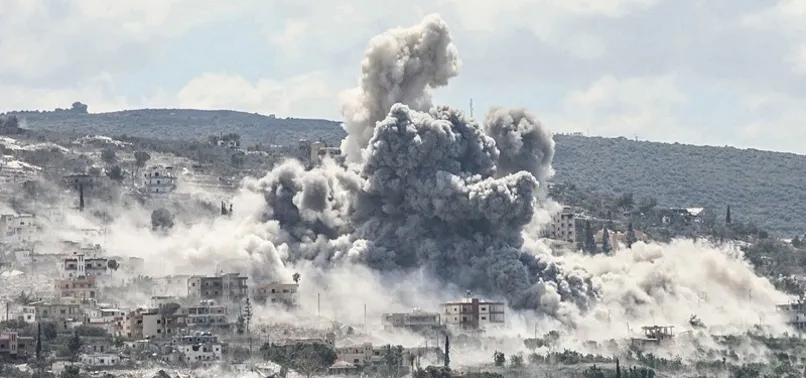
The Israeli army is considering establishing a new “security zone” extending 2 to 4 kilometers (1.2 to 2.5 miles) inside Lebanese territory as part of a plan to reduce its troop presence and redeploy forces in southern Lebanon, Israeli public broadcaster KAN reported Saturday.
Israel continues to occupy areas in southern Lebanon, some of which it has held for decades, while it seized others during the 2023-2024 war.
During its current offensive, Israel has expanded its incursion to more than 10 kilometers (6.2 miles) inside Lebanese territory, marking its deepest advance since withdrawing from southern Lebanon in 2000.
KAN cited unnamed security sources as saying that the army is considering establishing the proposed zone from the border and preparing to reduce its forces after destroying tunnels in the Ali al-Taher heights in the southern Nabatieh province.
The sources said the Israeli army’s redeployment plan in southern Lebanon is called the “gray line” and includes establishing positions that would be used to launch operations inside Lebanese territory.
The plan has not yet been approved by Israel’s political leadership and will be discussed before a decision is made, the broadcaster said.
The report came a day after Israeli Defense Minister Israel Katz said Friday that the army had consolidated its control over what he called a “security zone” in southern Lebanon.
His statement followed an Israeli army claim Thursday that it had achieved “operational control” over the Ali al-Taher heights.
The area has witnessed escalating tensions in recent weeks amid continuing Israeli airstrikes and military operations.
Israel describes the “gray line” as a new framework for redeploying its forces, similar to what it calls the “yellow line,” which currently defines the area of its military deployment, operations and security control inside Lebanese territory.
The Israeli plan came amid continued Israeli escalation across southern Lebanon despite an agreement between Beirut and Tel Aviv providing for a gradual Israeli withdrawal as part of a US-mediated negotiating process.
Since March, Israeli attacks on Lebanon have killed more than 4,000 people and injured over 12,000 others, while forcing more than 1 million people from their homes, according to Lebanese authorities.