
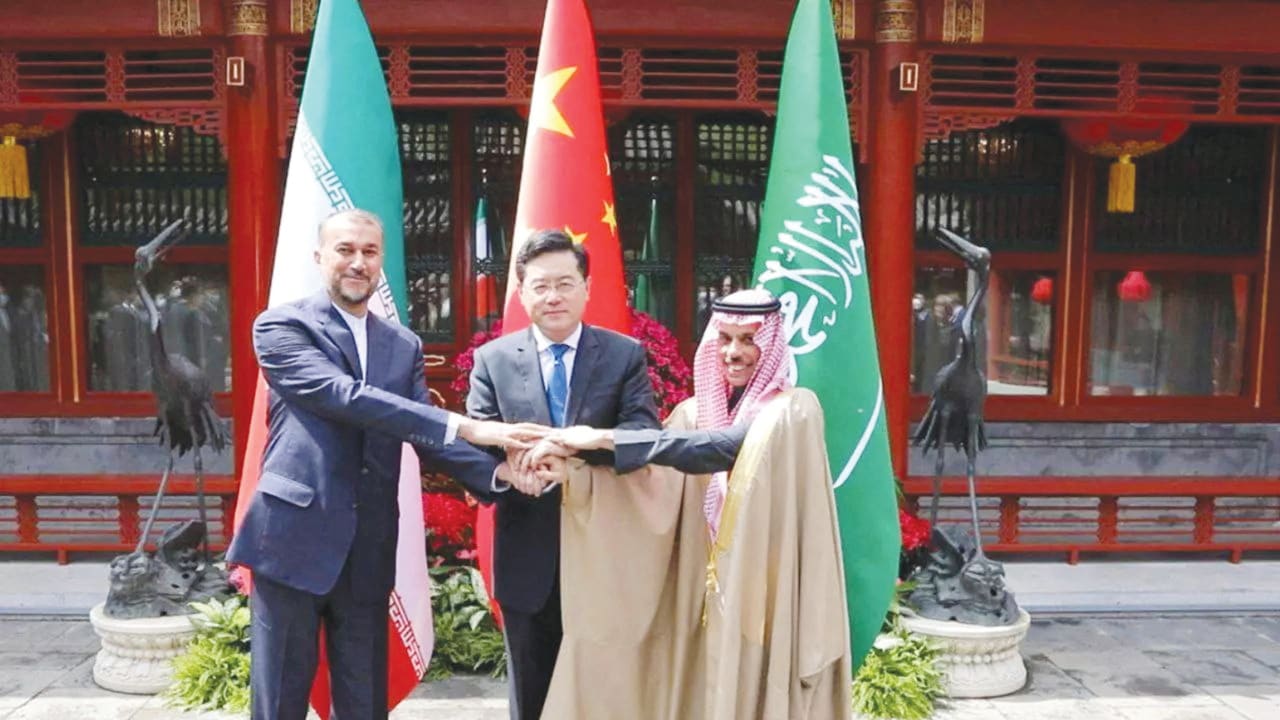
China between the Gulf and Iran
Asharq al-Awsat, UK, August 30
For more stories from The Media Line go to themedialine.org
The only thing Saudi Arabia and Iran truly share is China. It is the largest buyer of oil from both countries and is also suffering from the war, including supply disruptions and its broader effects. Gasoline prices have risen by roughly a third, while Chinese exports to Arab markets have fallen, though China’s economy continues to grow.
China is more directly concerned with energy and maritime security in the Middle East than any other major power because it is the principal importer of regional oil, whereas the US no longer buys Gulf oil and has become the world’s largest producer and exporter.
Yet despite the scale of Beijing’s interests in the region, its policy differs so sharply from Washington’s that it can sometimes be difficult for us to understand.
America’s regional posture has been clear, particularly since Britain’s withdrawal from east of Suez: protect the flow of energy and contain Communist expansion. Nixon backed both Iran and Saudi Arabia as regional pillars, followed later by the Carter Doctrine, which explicitly committed the US to using military force to protect the Gulf.

The Middle East matters enormously to China, but Beijing still does not behave as the guarantor of its own interests. It operates the world’s largest tanker fleet, yet its ships wait outside the Strait of Hormuz. It has naval forces in the Gulf of Aden near areas controlled by Yemen’s Houthi militia, but even amid attacks, those Chinese forces have not engaged them; Chinese tankers have simply waited offshore.
Chinese leaders likely prefer to avoid direct involvement in the US-Iran war and perhaps see some advantage in weakening the Trump administration by declining to intervene against Tehran.
Iran has now begun allowing some Chinese vessels through the Strait of Hormuz, but this gesture came late, after the Americans established a safer maritime corridor through Omani waters.
That alternative route prompted Tehran to go to Baghdad last week and persuade Iraqi authorities to exempt its oil tankers from attacks if they continued using the Iranian-controlled passage, after most shipping had already abandoned it for the Omani corridor.
The war will end sooner or later – perhaps now, perhaps in a year – but over the longer term China will likely follow the path once taken by Britain and the US in defending their interests: a larger navy, more bases, defense agreements, and a more openly partisan policy.
But not yet. For now, China coexists with American dominance because, first, it benefits from Washington securing the continued flow of oil, and second, because its primary geopolitical concerns lie elsewhere: Taiwan, the South and East China Seas, and then the Pacific and Indian Oceans.
This is why Barack Obama once described China as a “free rider,” benefiting from American protection of maritime routes.
Chinese policy feels strange to us because historically we were accustomed to an old international system in which states aligned clearly with one camp or another: France or Britain, Axis or Allies, the Soviet Union or the US. China is rising rapidly as a great power but has not yet reached the stage where it forces others to choose sides.
That does not mean Beijing has no alliances or positions; it certainly has adversaries in its immediate geopolitical environment. In the Middle East and Africa, however, China remains “everyone’s friend,” which makes its policy easy to deal with but difficult to interpret.
It appears contradictory: the largest buyer from warring Gulf states, the biggest trading partner of both Saudi Arabia and Iran, Israel’s second-largest trading partner, and at the same time a supporter of the Palestinian cause. The dull neutrality we see today will likely diminish as Chinese interests grow and increasingly collide.
The war in Iran is already testing that posture. So far, China has not been forced to abandon its public neutrality, though it may do so if the conflict widens and drags on. That does not negate the fact that Beijing is quietly providing Iran with limited assistance without openly challenging the American blockade. China would like to see US President Donald Trump defeated, but it also understands that the nature of the Tehran regime creates instability that harms Chinese interests.
Iran, for its part, regards China as its only true ally and seeks its support, while viewing Russia more as a temporary partner of convenience because of long-standing differences.
Arab states, especially those in the Gulf, have built deep economic ties with Beijing and are trying to draw it closer, or at least neutralize it, with some success.
China repeatedly says it does not want to become “another America,” meaning another hegemonic power. Yet there is enough evidence to suggest the dragon empire is coming. It has already built its first military base in our region in Djibouti, south of the Red Sea, and deploys warships near its entrance, where they once helped combat Somali piracy.
If the Americans eventually withdraw, China will be compelled to fill at least part of the vacuum.
– Abdulrahman Al-Rashed
A tale of two cities: Paris to Tehran
Al-Bayan, UAE, August 31
When I read Charles Dickens’s A Tale of Two Cities as a student, I did not understand why it had been included in the curriculum. Like many others, I assumed the purpose was simply to teach us some English through an engaging story set between Paris and London.
It took years, and a different kind of experience, to understand that language may have been the least important thing about the novel. Dickens was asking a much larger question: What happens when injustice accumulates until it explodes, and then the oppressed, once they gain power, become even more brutal than their former oppressors?
Dickens wrote the novel in the mid-19th century, but set it against the French Revolution. He portrayed a society whose balance had collapsed: an aristocracy detached from ordinary people, humiliating poverty, absent justice, and anger building beneath the surface.
The explosion was predictable, but the genius of the novel lies not simply in describing the revolution, but in what came after it. Those who had suffered injustice did not automatically become more just once they gained power; some carried the memory of their pain and transformed it into a project of revenge.
I thought of A Tale of Two Cities while watching Iran today. The Iranian Revolution was built, among other things, on grievances over repression, prisons, and the absence of accountability. But almost half a century later, the question is simple: What did the oppressed do once they became rulers?
An Iranian who knew both the shah’s prison and the revolution’s prison once told me something that stayed with me: “The shah’s prison, harsh as it was, was relatively better than the revolution’s prison.”
This is not a defense of the shah or an attempt to beautify a period in which injustice unquestionably existed. It is a question about a regime that came promising to remove oppression, only to expand its instruments and grant them a new legitimacy.
That testimony brings me back to Ehsan Naraghi’s book From Palace to Prison: Inside the Iranian Revolution. The title alone almost summarizes the tragedy: a person moves from a regime that fell because of its abuses to a new one that promised salvation, only to find himself imprisoned once again. The guards and slogans changed; the monopoly on truth remained.
Dickens did not portray Paris alone. He set London beside it, and London was hardly free of poverty. The difference was that British society possessed internal mechanisms that allowed, however slowly, for review and reform.
That comparison is useful if we transfer it, with all due regard for different times and circumstances, to our own region. Look at Tehran today, then look at any Gulf capital. The comparison is not between one perfect society and another evil one, but between two approaches: one turns grievance into a permanent source of political legitimacy, while the other tries to change, correct itself, and open doors toward the future.
This is not to say that Gulf experiences have reached some final destination; every human experiment remains open to development. What matters is direction.
In Gulf cities, one sees investment in education, urban development, the economy, openness to the world, and an effort to anticipate the future and accumulate development expertise.
In Tehran, by contrast, much of the state’s energy is still consumed protecting an ideological, missionary narrative, manufacturing enemies, and expanding costly influence beyond its borders through interference in other countries’ affairs.
One side asks, in varying degrees: How can we live better tomorrow? The other remains captive to historical slogans completely disconnected from the age we live in and from the direction of the rest of the world.
Worse still, the politics of grievance did not remain confined within Iran’s borders; they were exported across the region under the banner of “resistance.” Societies in Palestine, Iraq, Yemen, and Lebanon have paid enormous prices, even as the Iranian citizen continues to pay for the project at home. Each time citizens demand more room to live, they are suppressed.
Here Dickens returns to us, more than a century and a half later. Having suffered injustice does not grant anyone permanent moral immunity, and the oppressed do not automatically become just once they reach power. The real test begins on the day you acquire the ability to oppress others – and decide not to. – Mohammed Al-Rumaihi
Israel’s elections: Leadership crisis, uncertain strategic horizon
Al-Masry Al-Youm, Egypt, August 31
Israel enters its October 27 election at one of the most sensitive moments of political and strategic transformation in its history.
The vote comes after the shock of Oct. 7, a prolonged war in Gaza, and the expansion of confrontation to Lebanon, Iran, and Yemen, all amid deepening internal division over the nature of the state, the limits of authority, and the relationship between security and democracy.
The election is therefore not only about who will govern Israel next, but about what kind of Israel will emerge: one increasingly dependent on military force and religious nationalism, or one seeking to rebuild a political and social balance capable of translating military power into sustainable security and stability.
The 2026 election also carries special significance because it will be the first since 1988 to take place on schedule, after the 25th Knesset completed its full legal term following years of electoral instability.
Yet completing a term does not mean the political system’s crisis has ended; rather, it shows the government’s ability to survive despite the profound divisions surrounding it. The paradox is that temporal stability did not produce political or strategic stability.
The election is being fought largely as a referendum on Prime Minister Benjamin Netanyahu as much as a contest between political programs.
That equation has begun to change with the rise of former chief of staff Gadi Eisenkot, leader of the Yashar party, who now leads the Likud in several polls and has also overtaken Netanyahu personally when voters are asked who is best suited to serve as prime minister.
But electoral momentum does not necessarily translate into a transfer of power, because the decisive battle remains the ability to form a coalition that controls at least 61 seats.
Netanyahu has become more than simply the leader of the Likud; he is the center around which most Israeli political equations revolve. Alliances are increasingly built around attitudes toward him rather than policy platforms, deepening personal polarization and weakening the political system’s ability to generate stable consensus.
The election may therefore alter the balance among parties without necessarily changing the government, while the real struggle may be over whether any side can build a coalition capable of surviving for an extended period.
The deeper transformation created by the wars, however, is Israel’s shift away from the doctrine of the “short, decisive war” toward managing prolonged, open-ended conflicts on multiple fronts.
Since its founding, Israel’s security doctrine emphasized brief confrontations designed to restore deterrence and avoid attrition. Today it is engaged in conflicts that stretch both geographically and temporally, without decisive strategic victory or a clear concept for how to end them.
This is not merely a military problem. It exposes the limits of military power when force stops being a means to achieve political objectives and becomes a substitute for politics itself.
Here lies the central dilemma of the election: Israeli society feels the costs of war and exhaustion, yet the forces seeking to replace Netanyahu do not necessarily offer an integrated strategic alternative to the logic of force. Even his strongest rivals come from the military and security establishment, meaning a change of leadership may be far easier than a change in strategic doctrine.
Gaza illustrates the dilemma most clearly. Its future is no longer merely an Israeli domestic matter, but a test of relations with Washington and of Israel’s ability to translate military superiority into stable political arrangements.
The Trump administration is pressing for arrangements that move beyond the war, while Netanyahu insists that Hamas’s military capabilities must be dismantled before any withdrawal.
The disagreement goes beyond tactics to a strategic question: Can Israel move from managing war to managing the postwar phase, or has perpetual conflict itself become part of its definition of security?
Domestically, the struggle extends beyond Netanyahu personally to a deeper crisis over the meaning of the state.
The issue of haredi conscription exposes the tension between sharing the burdens of national defense and preserving coalition cohesion, while the growing weight of religious-nationalist and fundamentalist currents reflects a transformation in Israeli society and raises questions about the influence of religion on political and security decisions, as well as the relationship between the state’s Jewish and democratic identities.
Arab parties, meanwhile, could exercise influence beyond their numerical strength, even without joining the government directly, if the two main blocs remain closely balanced.
Regionally, Israel enters the election in a more complex strategic environment, with tensions in Lebanon and Syria, an open confrontation with Iran, and Gaza’s future unresolved.
Security, long Netanyahu’s strongest electoral asset, may become a source of accountability. The question will no longer be only who can wage war, but who can end one and turn its results into durable security and political gains.
From this perspective, the 2026 election may not mark the end of Israel’s crisis but the beginning of a new phase in redefining the state and its regional position.
It may produce a change in leadership or another Netanyahu term, but either outcome leaves Israel confronting the same dilemma: Can it translate military superiority into a political strategy capable of producing security and stability while rebuilding domestic consensus over the country’s future?
Despite sharp divisions, broad sectors of Israeli society still believe in the centrality of military power and in its ability, with Western and particularly American backing, to provide permanent security, while support for a two-state settlement and Palestinian national rights continues to decline.
Yet military power can deter and destroy; by itself, it cannot create sustainable security or resolve a political and historical conflict.
The real post-election test, therefore, will not simply be who governs Israel, but whether the country can reconsider a doctrine that has long assumed military superiority can substitute for political settlement. Otherwise, its crisis will remain deeper than anything the ballot box alone can resolve.
– Amr Helmy, Egyptian ambassador to Italy
What does the divergence in Hezbollah’s positions mean?
An-Nahar, Lebanon, August 30
In his latest appearance, Hezbollah Secretary-General Sheikh Naim Qassem returned to a hardline discourse toward the US, declaring that “America and all those who follow the path of polytheism, deviation, and disbelief are one community.”
Some observers saw in this language a regression, or perhaps a return, to the foundational rhetoric Hezbollah adopted in its early years, when it relied heavily on accusations of unbelief, betrayal, and deviation, culminating in the familiar description of the US as the “Great Satan.”
Yet there is another striking aspect to Qassem’s remarks: they came less than 36 hours after another senior Hezbollah official, Mahmoud Qamati, appeared on the party’s Al-Manar television channel and said Hezbollah “does not completely close the door to the possibility of direct communication with the Americans.”
To ensure that his words were not treated as abstract theory, Qamati added that “the decision to communicate will be taken according to the interest and the appropriate circumstances.”
Hezbollah officials do not usually speak casually or improvisationally on matters of such importance and sensitivity. The apparent contradiction between two statements issued so close together in time can therefore hardly be accidental, particularly at a moment when every word and position is carefully calculated.
According to people familiar with the party’s internal thinking, this oscillation between hardline rhetoric on one occasion and openness and flexibility on another points to two realities.
First, Hezbollah has acknowledged the transformations that have occurred in its environment and its own position.
Second, it now has little choice but to begin searching for ways to adapt to those changes, which requires opening doors that were once firmly closed and putting forward possibilities in order to gauge reactions.
In other words, Hezbollah has entered a phase in which it is beginning to reconsider positions it previously treated as fixed principles beyond negotiation.
In the past, the party openly boasted of receiving repeated proposals through intermediaries and communication channels from Washington and other capitals and of rejecting them in both form and substance.
Against that background, some interpret Qassem’s renewed language of excommunication and hostility toward America as an immediate response to recent remarks by US Ambassador to Beirut Michel Issa, who said Hezbollah must be prepared to offer something if it genuinely wants to open up to Washington.
Faced with that American position, Hezbollah now has two choices:
It can reconsider its calculations and pull back from the path of openness after receiving a conditional American response that carries difficult demands.
Or it can accept the logic of the situation and begin to seriously consider what it might offer Washington to entice it to take the risk of negotiating directly with the party. – Ibrahim Bayram ■
Translated by Asaf Zilberfarb. All assertions, opinions, facts, and information presented in these articles are the sole responsibility of their respective authors and are not necessarily those of The Media Line, which assumes no responsibility for their content.