
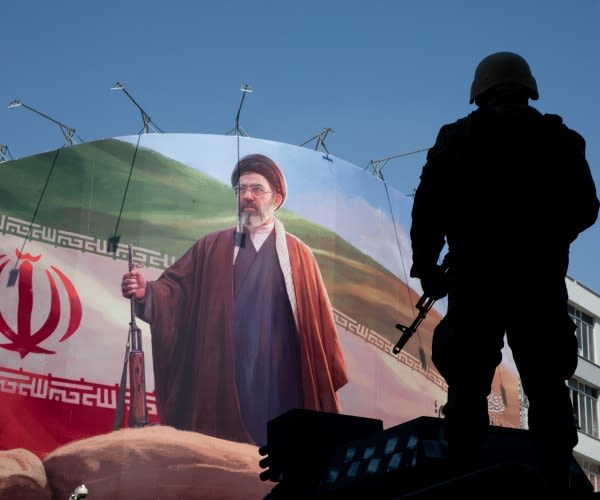

A member of the Iranian security forces stands guard under a large portrait of Iran’s new Supreme Leader, Mojtaba Khamenei on April 9, in Tehran, Iran. (Majid Saeedi/Getty Images)
An Iranian court has sentenced a 20-year-old woman to death and her twin sister to decades in prison for their alleged roles in January’s anti-government protests, months after their family said the women were dragged from their home by masked security forces and tortured in custody.
Taraneh Rahimi and her twin, Romina, were 19 and still in high school when they were arrested in February after allegedly participating in protests on Jan. 8-9 in Isfahan, according to human rights groups and multiple media reports.
Taraneh was sentenced to death by Branch 1 of the Isfahan Revolutionary Court and Romina was sentenced to 25 years in prison. Human rights groups that counted additional sentences imposed for other offenses put Romina’s total prison term at 36 years.
The initial verdicts are subject to appeal, although Iran has moved rapidly to carry out death sentences against people arrested during the January protests. Amnesty International reported in July that at least 13 protest-related death sentences had been upheld by the country’s Supreme Court.
Masoud Nourmohammadi, a cousin of the twins who is based in the U.S., told The Guardian in a story published Sunday that their mother spent four months searching hospitals, courts, and other institutions before learning her daughters were being held at Dowlatabad Prison in Isfahan.
When she was finally permitted to see them, Nourmohammadi said, “She did not recognize her own children.”
He said the women’s faces were badly swollen and bruised, they had suffered broken bones, and much of their hair was missing after guards allegedly dragged them between cells by their hair. Taraneh Rahimi also was allegedly threatened that guards would rape Romina in front of her unless she signed a confession, The Guardian reported.
The twins were among 16 people prosecuted in what has become known as the Isfahan Shohada Square case. Ten, including Taraneh, were sentenced to death, and the others received lengthy prison terms.
The defendants faced charges including “moharebeh,” or “enmity against God,” through carrying bladed weapons, destruction of public property, assembly and collusion, and propaganda against the Islamic regime.
The case arose from the Jan. 8 deaths of Islamic Revolutionary Guard Corps Col. Abbas Kamrani and another man.
HRANA, a U.S.-based human rights group, reported that the indictment did not charge the defendants with either killing and that no evidence was presented during their hearing specifically linking them to the deaths.
HRANA reported that video in the case file showed Taraneh urging people not to beat the second man as others attacked him. Defense attorneys also were denied access to a substantial portion of the case file before the hearing, according to HRANA.
The death sentences follow five executions in a separate case stemming from January protests in Isfahan’s Alikhani Square.
Gol-Mohammad Mohammadi and Erfan Esfandiari were executed July 19, and Abolfazl Sepahi-Badejani and Amirhossein Safari-Hosseinabadi were executed July 28. The latter two were publicly executed in Alikhani Square. A fifth defendant, Ghaem Hosseini, was executed Aug. 20.
Amnesty International said the Alikhani Square defendants had been prosecuted in a mass trial stemming from the deaths of four police officers and other allegations arising from the protests. The organization said “confessions” made in detention were used to convict some defendants and characterized the proceedings as grossly unfair.
Iranian-American journalist Masih Alinejad highlighted the Rahimi sisters’ cases Friday on X, writing that the twins had been arrested in the middle of the night and reportedly sexually assaulted in detention.
“Taraneh said that while held in solitary confinement, she could hear her sister screaming and crying as she was tortured,” Alinejad wrote. “Interrogators repeatedly struck Taraneh’s previously operated knee and threatened to sexually assault her sister if she refused to sign forced confessions. According to Taraneh, a prison medical official told her: ‘You’re going to die anyway. What difference does it make whether you die with a broken leg or a healthy one?’
“A complaint alleging sexual assault during detention was formally filed. Yet the court did not hold even a single hearing to investigate the allegation. Instead, the two sisters and other defendants in the case were handed death sentences and decades-long prison terms.”
Iran has accelerated its use of capital punishment against people arrested during the January uprising. Oslo-based Iran Human Rights said at least 532 people were hanged in Iran through August, including 29 people arrested during the January protests.
“Women who are executed in Iran are often victims long before they reach the gallows,” Iran Human Rights Director Mahmood Amiry-Moghaddam said Saturday in a statement. “Many have lived for years with structural discrimination, violence and little or no effective legal protection.”
© 2026 Newsmax. All rights reserved.