
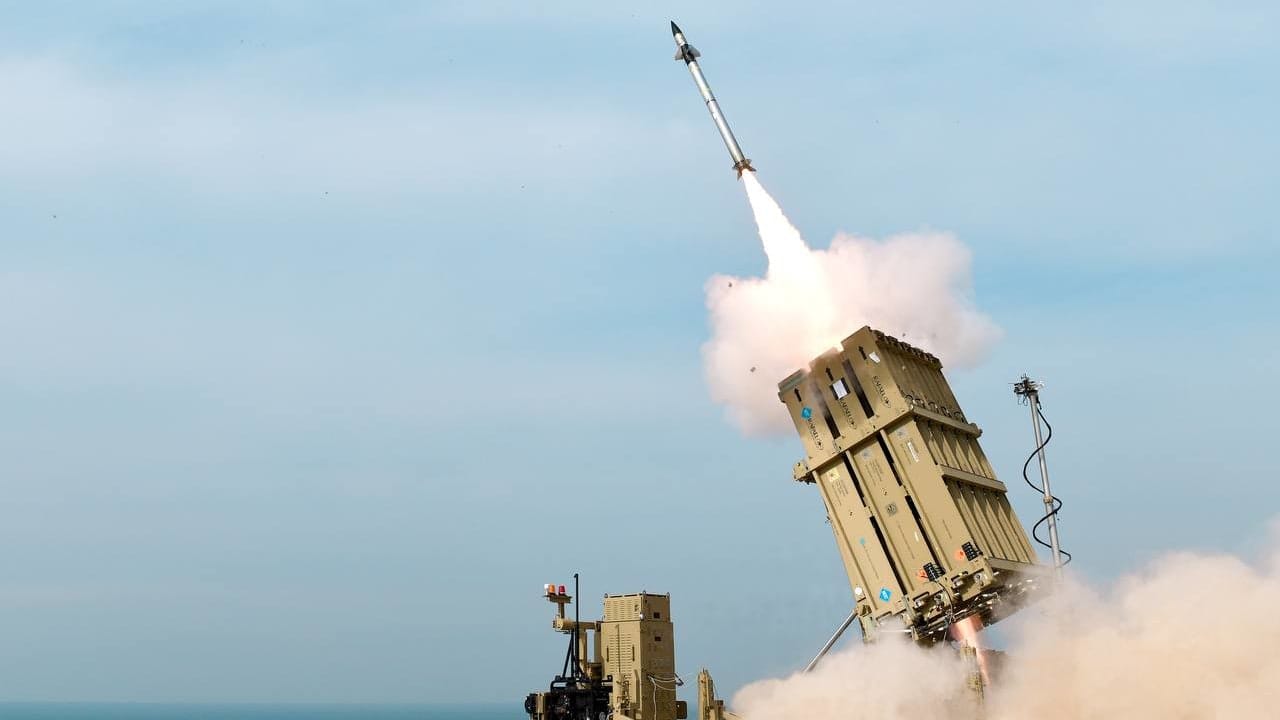
Germany is on its way to getting Israel’s Iron Dome missile defense system, Defense & Tech by The Jerusalem Post understands.
D&T has confirmed that the letter of intent signed by the German state of Lower Saxony, Rafael Advanced Defense Systems, and Aurelius Capital is the first step toward the European nation acquiring the Iron Dome.
The agreement, signed at the factory on Monday, will see the Volkswagen site in Osnabruck developed into a center of excellence for innovative security and defense solutions. It will combine German engineering expertise, industrial capital and quality standards.
Though it is not a signed agreement, sources who have spoken to D&T have said that the plan later down the road is for Germany to procure the famous interceptor. Germany, a key ally of Israel, currently has the Arrow 3 missile defense system that is manufactured by Israel Aerospace Industries. Berlin, like most of Europe has been bolstering its defenses as Russia continues it’s war against Ukraine.

Rafael has been active in Germany for over 20 years and has established a strong presence in the country with various subsidiaries including Dynamit Nobel Defence, EuroSpike and EuroTrophy GmbH.
Yoav Tourgeman, president and CEO of Rafael Advanced Defense Systems, said that the partnership with Germany is part of a long-term relationship with the country “with the idea that the technology will be fully produced in Germany, to protect Germany and Europe.”
“The technology at the heart of this partnership is built for the defense of today, tomorrow, and well beyond. Our outstanding combat-proven technology evolves constantly in order to be ahead of the threats, so that highly reliable defense will always be provided,” he added.
Integral part of Israel’s missile defense array
Initially designed to shoot down short-range rockets, the Iron Dome has, over the past 15 years, become an integral component of Israel’s multi-layered defense array.
The system’s modular architecture enables seamless integration with additional defense layers, and it can operate independently or as part of Israel’s broader air defense network that includes the the Arrow (Arrow 2 and Arrow 3) system, which intercepts ballistic missiles outside of the Earth’s atmosphere, and the David’s Sling missile defense system which is designed to intercept tactical ballistic missiles, medium- to long-range rockets, as well as cruise missiles fired at ranges between 40 to 300 km. Rafael has also manufactured the Iron Beam laser defense system, which has been operational along Israel’s northern border.
The system’s early years were defined by rapid operational learning. Iron Dome took part in a long series of conflicts and operations, from Operation Protective Edge, Operation Guardian of the Walls, Operation Breaking Dawn, Operation Shield and Arrow, Operation Swords of Iron, and Operations Rising and Roaring Lion, where it served alongside the Arrow and David’s Sling as a central pillar in the protection of Israel’s home front.
Each round of fighting was followed by a new wave of software updates, radar refinements, and interceptor improvements.
It quickly became evident that the system was a flexible defensive layer capable of handling dense salvos, more complex trajectories, and a wider range of threats. The system’s radar was upgraded to track more targets simultaneously, its algorithms became faster and more selective, and its interceptors were refined to handle longer ranges and more demanding engagement profiles.
Yet, despite its successes, the Iron Dome is not infallible.
Israeli officials have consistently noted that no air‑defense system can guarantee complete protection. Some rockets inevitably penetrate the system’s defenses, underscoring the importance of measures such as early warning sirens and reinforced shelters.
Nevertheless, the system’s high interception rate has significantly reduced casualties and property damage during periods of conflict, altering both military calculations and civilian life in Israel.

Europe has increasingly turned to Israeli air defense technology over the past decade, especially after Russia invaded Ukraine and the growing demand for rapid, combat‑proven systems.
The news comes just one week after Israel and Greece have formalized one of the largest defense export agreements in Israel’s history, a €3 billion government‑to‑government deal that will see Israel design and deliver a complete, multi‑layered national air defense architecture for the Hellenic Republic’s Achilles Shield project.
Though the Iron Dome is not part of it, the project will integrate several Israeli‑made systems into a unified national network. At its core are David’s Sling, BARAK MX, and SPYDER missile defense systems developed by the Israeli defense companies and already deployed operationally within Israel’s own air defense array.
The package also includes MMR radars produced by IAI subsidiary ELTA for air surveillance coverage and a new national command‑and‑control system developed by Rafael to integrate all layers into a single operational picture.
The agreement represents the first time Israel will supply a complete, end‑to‑end air‑defense array to another country. According to a statement released by the Defense Ministry, the architecture is based entirely on Israeli systems and incorporates operational lessons drawn from Israel’s recent wars wherein these systems played central roles in intercepting thousands of hostile aerial targets, including drones and ballistic missiles launched by Iran, Hezbollah, and the Houthis in Yemen.
Central European states have also moved toward Israeli systems, with the Czech Republic receiving the Spyder medium‑range system, Slovakia selecting the Barak MX, and Estonia contemplating purchasing the David Sling missile defense system as it bolsters its long-range air defenses and plans to invest over €1b. in a new long-range ground-based air defense system to protect strategic sites.
Germany has also purchased Israel’s Arrow 3 as a response to Russia’s war against Ukraine and the growing proliferation of advanced missile systems. Germany signed the $3.5b.Arrow 3 contract in November 2023, the largest defense deal in Israel’s history at the time. In December, the two countries signed a $3.1b. follow-up contract to expand interceptor and launcher stocks.
Arrow 3, developed by Israel Aerospace Industries (IAI), is a highly maneuverable system designed to provide ultimate air defense by intercepting ballistic missiles when they are still outside the Earth’s atmosphere.