
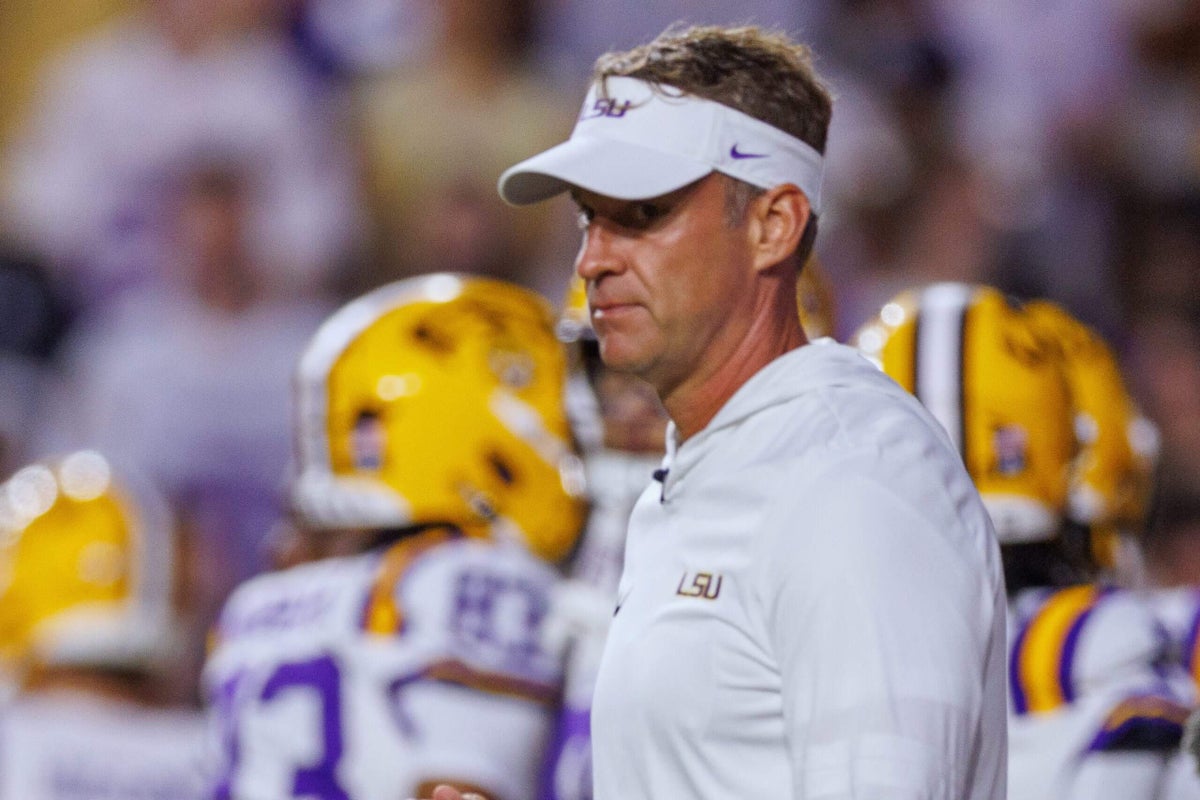
LSU has ended its quest to add two players who had signed NFL contracts to its roster, instead adding two others to complete the 105 spots, a person with knowledge of the situation told The Athletic. The source spoke under condition of anonymity because they were not authorized to speak publicly.
The decision means tight end Dae’Quan Wright and defensive end Zxavian Harris will not suit up for the Tigers this fall after weeks of legal drama, the furthest test yet of a conference attempting some self-governance. LSU is instead adding defensive end Gabriel Reliford and cornerback Aidan Anding, both of whom were on the roster last season.
The news comes the same day the SEC said in a federal court filing that it would discuss a vote on Thursday on whether to kick LSU out of the conference, a vote that would require 11 schools in favor.
The SEC is threatening to kick out LSU and Lane Kiffin
Justin Williams
Last week, a Louisiana state court cleared the way for roughly 40 former college athletes to return to college with immediate eligibility, including Wright and Harris, who previously played for Kiffin at Ole Miss. Both signed NFL contracts as undrafted free agents this offseason. The Louisiana ruling prevented the NCAA, SEC and LSU from taking action that would adversely affect the athletes.
LSU ultimately decided not to add those players for Saturday’s win over Clemson, but both players had enrolled at the school and still could have been added to the roster at a later date, since LSU had only filled 103 of its 105 spots.
Instead, LSU has backed down after Tuesday drama took things to an unprecedented level.
Ryan Downton, the attorney who represents Wright and Harris, told The Athletic that the players were considering their legal options.
In its amended filing on Tuesday, the SEC said its CEOs would “meet on September 10, 2026, to decide whether to terminate Louisiana State University as an SEC member institution pursuant to Section 3.1.5 of the SEC Constitution and Bylaws.”
In its reasoning, the complaint stated, “the consensus of the CEOs was and continues to be that LSU’s continued membership in the Conference would be inconsistent with the publicly stated values and principles of the Conference and its remaining member institutions, whether or not LSU ever includes Harris, Wright, or other football players who are ineligible under the Professionalism Rules on its football team roster.”
During a Friday meeting of 15 school leaders without LSU, according to the amended complaint, the group “expressed great concern” that Kiffin was working with the counsel for the athletes in the Louisiana lawsuit, with support and involvement from Louisiana Attorney General Elizabeth Murrill and Louisiana Gov. Jeff Landry, and that the LSU administration has “no meaningful control” over Kiffin or the LSU football program.”
It’s unclear if the SEC will continue to move forward with a potential vote to expel the school on Thursday, following this decision by LSU.
The NCAA simplified its eligibility rules this summer, giving every athlete moving forward five years to play up to five seasons. The change did not, however, apply to fourth-year seniors who had just completed their eligibility. That led to a wave of lawsuits from recruits in the 2022 high school class seeking an extra year, including the Louisiana suit that covers Wright, Harris and others.
In response to attempts to add players who had signed pro contracts (rather than just mini-camp tryouts), the SEC and other leagues clarified their adherence to an NCAA rule that prevents athletes who have signed professional contracts from returning to play in college football — a decision LSU voted in favor of. The school abstained from a vote on stricter penalties, which would include suspending the head coach for half the season, fines and the loss of voting privileges on conference matters.
Those penalties, it seems, now won’t have to be leveled. If the SEC believes it can self-govern certain aspects of rules through the threat of extreme punishment, this apparent victory might prove to be a big step in that direction.
— Justin Williams contributed to this story.