
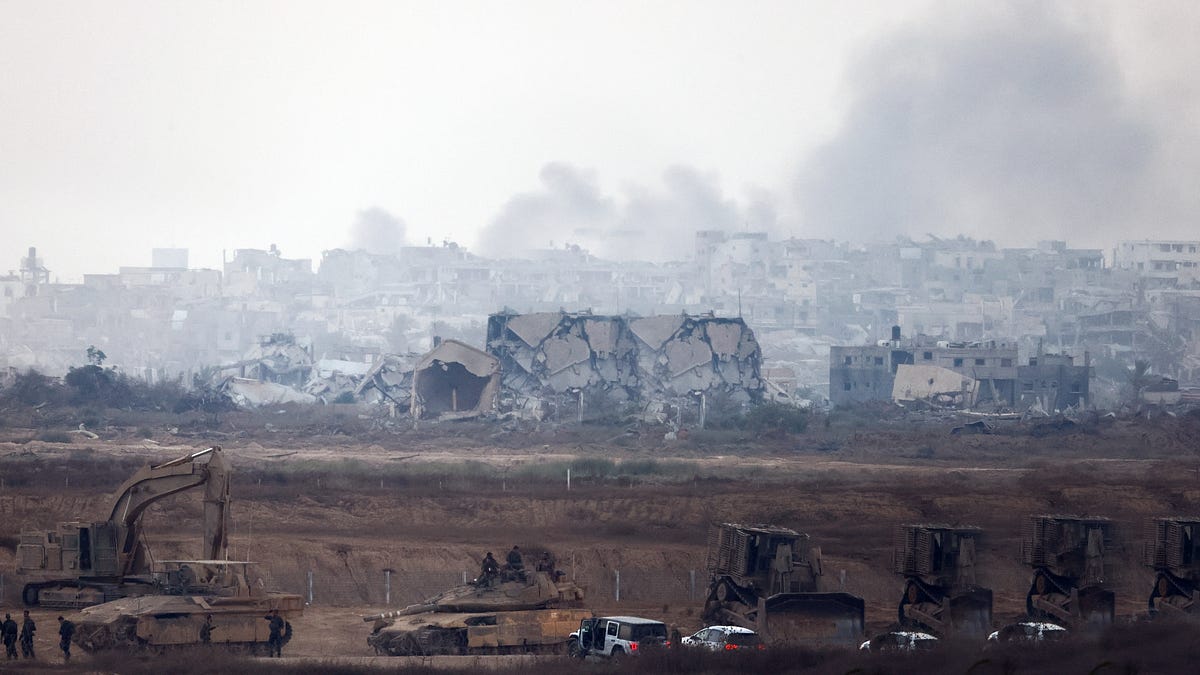
Since October 7, a broad swath of the Israeli national security establishment has embraced what amounts to a buffer-zone doctrine: The best way to prevent another catastrophic attack is to seize and hold territory beyond Israel’s borders, creating more physical space between Israeli communities and potential enemies.
At first glance, the logic is understandable. October 7 exposed Israelis living near Gaza to horrors that no country should tolerate. The desire to put more distance between Israeli civilians and those who would attack them is natural. And support for this approach extends well beyond Israel’s far-right government. It includes serious security experts and analysts in the Israeli political center.
But the doctrine is deeply flawed. In fact, it echoes America’s response to September 11: Fight the enemy abroad so we do not have to fight it at home. Seek something approaching absolute security through the aggressive use of military force and disregard for our own laws and values.
This week’s Word on the Street Live will be tomorrow, Thursday, September 10, at 3pm Eastern / 12pm Pacific. We’ll be joined by Rep. Jared Huffman to talk about his new book, “No Prophets,” on the rise of Christian nationalism.
Note: This is not our standard weekly time! Look out for an alert in your inbox or the Substack app when we go live!
For a time, that approach also felt intuitive to many Americans. But it produced long wars, enormous costs, international isolation and grave violations of American values without delivering the absolute security it promised. As the trauma of September 11 receded, more Americans came to understand how badly the “war on terror” framework had distorted U.S. strategy.
Israel’s post-October 7 buffer-zone doctrine is repeating the same mistake. Hopefully Israelis will reconsider it.
The first problem with the strategy is that it responds to the wrong diagnosis.
October 7 did not happen because Israel lacked territory, intelligence capabilities, border technology or military power. Israel had all of those things. It had a sophisticated barrier around Gaza, some of the world’s most advanced surveillance systems, a 300-meter buffer zone and a military more than capable of defeating a low-tech cross-border invasion.
It also had warnings and intelligence. In retrospect, the record is filled with indications that Hamas was preparing something significant. UAE President Mohammad Bin Zayed warned Netanyahu only days in advance. Junior analysts raised alarms that senior IDF officials reportedly dismissed. Israeli leaders had convinced themselves that Hamas was deterred and incapable of launching a major war. The West Bank, Lebanon and Iran were identified as greater threats, and the country dedicated its intelligence and personnel to those arenas.
When the 9/11 Commission presented its final report, its core conclusion was that the attack happened because of a “failure of imagination.” American policymakers could simply not imagine the type of attack Al Qaeda was able to pull off. An October 7th commission, if it were ever actually established and allowed to do its work, would likely find the same. Israel suffered a strategic surprise because too many decision-makers considered an attack of that scale unimaginable even when evidence was accumulating in front of them.
If the central failure was analytical arrogance, misplaced priorities and inadequate readiness, seizing more territory does not solve it. A wider buffer cannot compensate for leaders who dismiss intelligence that contradicts their worldview. And territorial depth is no substitute for forces that are properly deployed and prepared to respond.
Israel does need to ensure that Hamas can never again mass forces along its border and launch an October 7-style attack. But it can accomplish that through better planning, being prepared for such an attack and using its resources accordingly. And in the aftermath of 10/7, it should and will be much more ready for such a scenario even without expanding its territory. The reality is that you can only pull off a massive strategic surprise attack like October 7th once because after that the element of surprise is gone.
The second problem is inherent in the concept itself. A buffer zone does not exist in the abstract. It is someone else’s land. If Israel’s answer to insecurity is to take and hold territory from each neighboring population, it is embracing a fundamentally revisionist strategy – one that places it in continuing conflict with virtually everyone around it.
In Gaza, Israel has taken control of somewhere between 50%-70% of the territory while pushing more than two million Palestinians into an increasingly constrained and miserable space. Israeli forces have displaced roughly 1 million people in southern Lebanon. In Syria, Israel has moved beyond the lines that had largely defined the border for almost 60 years. In the West Bank, security rationales are repeatedly used to justify expanding settlements, entrenching Israeli control over Area C and settler violence displacing Palestinians.
That may produce a short-term tactical advantage. It cannot produce long-term stability. There will be no durable peace between Israel and its neighbors as long as Israel’s regional strategy depends on holding their territory indefinitely. Israel will instead be consigning itself to permanent war.
The phrase “buffer zone” makes this strategy sound clinical and bloodless. It is neither. These areas contain actual human beings who do not want to be displaced or live under Israeli military control.
Maintaining buffer zones therefore requires coercion: preventing people from returning home, restricting movement, destroying buildings and infrastructure, and using force against those who resist. Israeli strategists can label these consequences unfortunate but necessary. The rest of the world will increasingly see them for what they are: the permanent dispossession of civilians.
That will accelerate Israel’s international isolation. Sanctions and other forms of pressure will grow. Israel’s relationships with even its closest partners will continue to deteriorate. And the opportunity for a better future of deeper political, economic and security integration into the region will evaporate.
The tradeoff is especially unfortunate, because, as I described above, the territory Israel is holding is not essential to its defense. Israel would sacrifice diplomatic relationships, regional normalization, economic opportunity and international legitimacy in order to maintain a strategy that does not address the principal failure of imagination that actually produced October 7.
Finally, the buffer-zone strategy demands more personnel than Israel can sustainably provide. Israel’s military is a citizens’ army. It depends heavily on reservists who also have families, careers and businesses. Since October 7, many of those reservists have served for hundreds of days. Their burden has been extraordinary, and it cannot become the permanent baseline for Israeli national security.
Holding hostile territory against the wishes of the local population is manpower-intensive. It requires troops to guard roads and installations, patrol communities, protect supply lines, respond to attacks and suppress the resistance that prolonged occupation inevitably produces. And every new buffer zone creates another indefinite mission. This is simply not a sustainable approach.
Indeed, it is precisely because of how unsustainable this whole approach is that eventually Israel will likely be compelled to withdraw. Just as it withdrew from Southern Lebanon in 2000 after 20 years. Just as it ultimately calculated that it was in its interest to withdraw from the Sinai as part of the peace treaty with Egypt.
Israel’s trauma after October 7 is real, and its government has an obligation to ensure that such an attack never happens again. But trauma cannot be an excuse for the strategic and military disaster that its leadership and military are driving it towards. The United States learned that lesson after September 11 at an extraordinary cost.
Israel is one of the most innovative societies in the world with one of the most powerful militaries. Its scientists, engineers and military have developed extraordinary systems for detecting and intercepting threats, including missiles traveling thousands of miles outside the atmosphere. It has world-class intelligence capabilities and was remarkably able to achieve air superiority over Iranian territory thousands of miles away.
Surely a country capable of those achievements can devise a more sophisticated answer to October 7 than taking land – the oldest and bluntest instrument in the military playbook and one that will simply not work.