
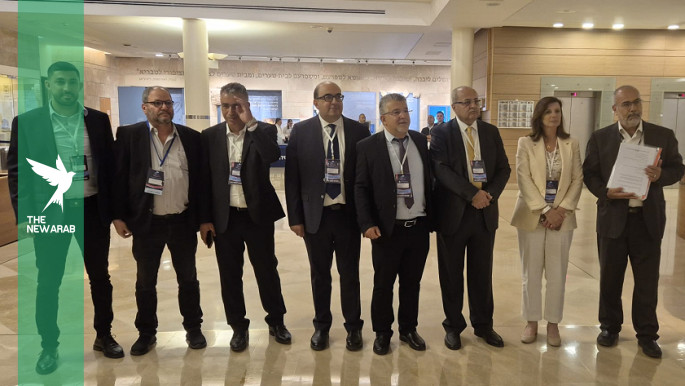
The Joint List submits its slate of candidates to the Central Elections Committee [Joint List media]
The Joint List, predominantly made up of Palestinians with Israeli citizenship, has submitted its final slate for Israel’s October election, vowing to fight “racism and supremacy” and setting out conditions for potentially backing a government to replace Prime Minister Benjamin Netanyahu.
The alliance of Hadash, Ta’al and Balad formally submitted its candidates to Israel’s Central Elections Committee on Tuesday ahead of the 27 October election, declaring itself “the only alternative to racism and supremacy”.
Hadash chairman Yousef Jabareen heads the ticket, followed by longtime Ta’al leader Ahmad Tibi and Balad chairman Sami Abou Shahadeh.
Hadash’s Faten Ghattas is fourth, followed by Balad’s Bakr Awawdeh and Hadash lawmaker Ofer Cassif. Former Hadash lawmaker Youssef Atauna is seventh, followed by Balad’s Maha Karkabi Sabbah.
The slate underwent a late change after Hadash replaced Jafar Farah in fourth place with Ghattas, a longtime party activist, following an internal examination of sexual harassment allegations against Farah.
The Joint List said it wanted to turn the electoral and political weight of Palestinian citizens of Israel into an effective force capable of influencing the balance of power, with removing Netanyahu and his far-right allies from government among its main priorities.
The alliance said the past four years had seen democratic space restricted and legislation targeting Palestinian citizens of Israel and democratic forces, while pledging to oppose “the destruction of Gaza, ethnic cleansing in the West Bank, and the political persecution of the country’s Arab citizens”.
It also pointed to increasing home demolitions, rising crime and violence within Palestinian communities and Israeli incursions into Al-Aqsa Mosque, as well as expanding settlements and displacement of Palestinians in the occupied West Bank.
But the Joint List made clear that any support for an alternative government seeking to replace Netanyahu would “not be a blank cheque”.
It said its position would depend on the political commitments made by any prospective government and its ability to deliver meaningful change on issues affecting Palestinian citizens of Israel and Palestinians more broadly.
Its demands include an end to home demolitions and fairer planning policies for Palestinian towns, serious measures to tackle crime and violence, as well as an end to the war on Gaza and displacement in the West Bank, with a political process recognising the Palestinian people’s right to self-determination and an independent state.
The Joint List also said it would only to provide a confidence and supply arrangement to an alternative Israeli government in exchange for what it described as a “real safety net” for its constituents, including its demands for an end to home demolition and action against crime.
Joint List projected to win seven seats
Recent polling projects that the Joint List will win seven seats in the next Knesset.
The three-party alliance was revived in August, four years after Balad split from Hadash-Ta’al ahead of the 2022 election.
Another Palestinian party, Ra’am led by Mansour Abbas, is not part of the alliance and submitted a separate electoral slate. The fledgling Jewish-Arab Makom LeKulanu party, meanwhile, withdrew shortly before the deadline amid low polling numbers.
The Joint List also includes Jewish candidates. Cassif is among its leading candidates, while Orly Noy, the first Jewish member of Balad, is in 15th place.
Jabareen said the alliance’s return offered Palestinian citizens of Israel an opportunity to strengthen their political and parliamentary influence.
“We agreed on the Joint List because the interests of our people are greater than any disagreement,” he said.
“Our goal now is to restore hope to our people, raise voter turnout and transform the weight of our community into a political force that cannot be ignored.”
A total of 38 lists have registered to compete for the Knesset’s 120 seats, with a governing coalition requiring the support of at least 61 lawmakers.