
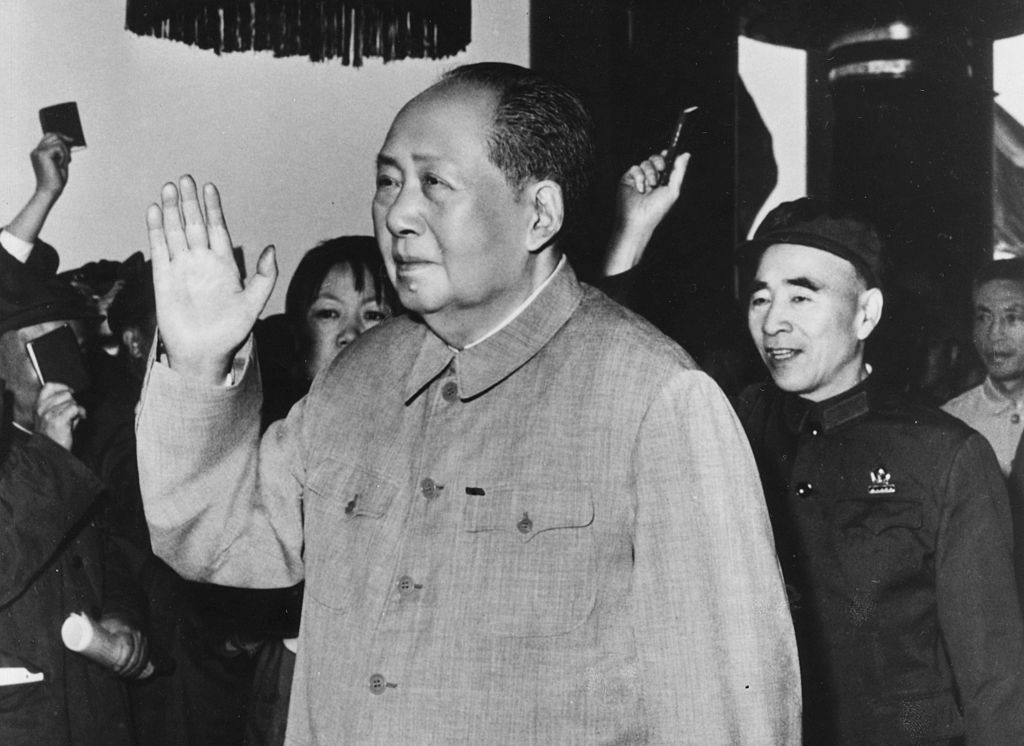
On October 1, 1949, Mao Zedong stood on top of the Tiananmen Gate in Beijing and proclaimed the establishment of the People’s Republic of China. The dynastic system that had endured for two millennia had come to an end in 1911, but it was far from clear what should replace it.
The new Republic of China soon descended into warlordism that evolved ultimately into a civil war between nationalists led by Chiang Kai-shek and communists headed by Mao. Mao’s first great achievement was establishing effective control over all of China and securing its international autonomy for the first time since the Western encroachments that began with the Opium War (1839–42).
On October 1, 1949, Mao Zedong stood on top of the Tiananmen Gate in Beijing and proclaimed the establishment of the People’s Republic of China.
By the time he died, on September 9, 1976, Mao had also revolutionized China’s political and economic structures. Politically, the People’s Republic still looks largely unchanged today: although the personality cult around the Chairman has been dismantled, it remains a party-state, with the Communist Party firmly in charge. Economically, however, it would be unrecognizable to the Great Helmsman.
Over the course of the 1950s, Mao reorganized the two leading classes of the revolution, workers and peasants. The new class of socialist workers was distinct from its bourgeois counterpart. Rather than constituting a subordinate economic stratum, workers toiling in state-owned factories enjoyed the status of a kind of labor aristocracy. Numerically, they were a privileged minority, numbering somewhere between three and five million in the early 1950s out of a population of over half a billion.
The state provided its industrial workforce not only with lifetime job security — known as the “iron rice bowl” — but also with a cradle-to-grave system of welfare, including housing and childcare as well as educational, medical, and cultural facilities, along with retirement benefits. All of this was made possible by a program of land reform that allowed the state to draw resources from the countryside while tying peasants to the collectively owned fields they cultivated.
When Mao grew impatient with the pace of industrial development, he infamously decreed that China must take a Great Leap Forward (1958–62). That campaign ended up mostly producing mountains of useless scrap iron while causing one of the greatest famines in history, as rural collectives were combined into ever-larger communes and were subjected to ever-larger grain quotas. Eventually the communes were downsized, while peasants and industrial workers resumed their prior economic roles.
The single greatest transformation since Mao’s death has been the commodification of both labor and land, effectively unmaking the erstwhile socialist working class as well as the peasantry supporting it. The so-called breaking of the iron rice bowl accompanied the dismantling of most state-owned enterprises, and even the remaining state employees have become subject to the vagaries of hiring and firing. With the commodification of land, ever-increasing numbers of landless peasants are also finding themselves in cities, joining China’s vast pool of migrant labor.