
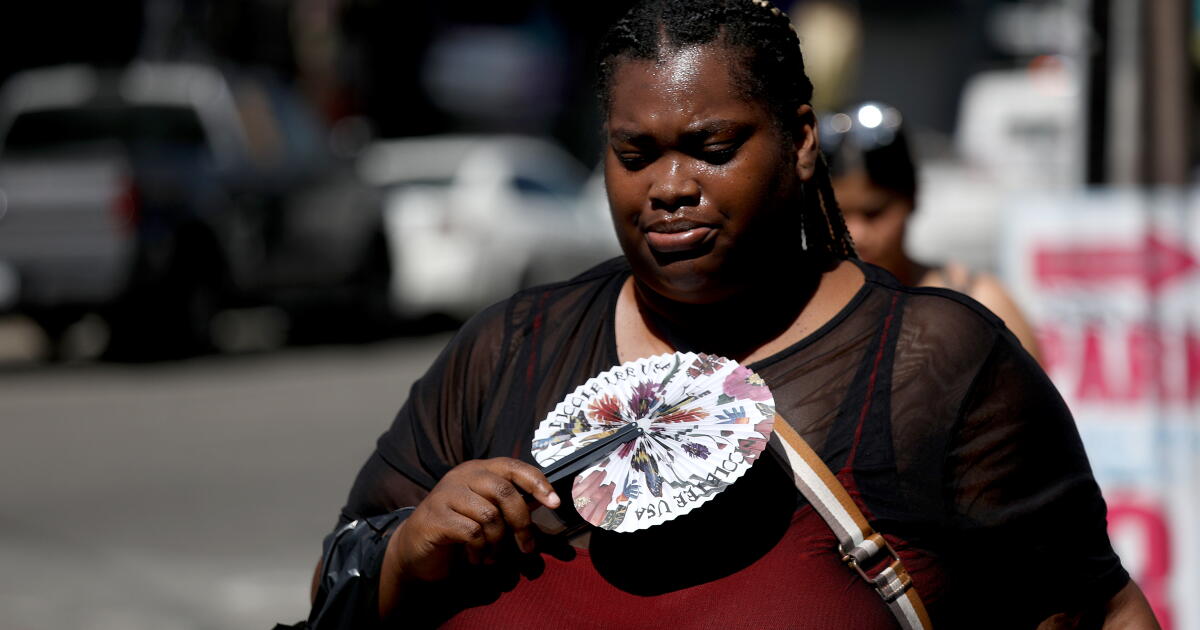
Punishingly hot temperatures coupled with drastically high humidity Wednesday, making the weather feel even more intense than during previously blistering days, with real relief not expected to arrive until Friday.
Temperatures across large swaths of Southern California reached above 100 degrees by midday, with temperatures feeling 5 to 10 degrees hotter due to the extra humidity, according to the National Weather Service Oxnard office.
Officials said it’s only going to get hotter.
“Peak may be a bit higher still later this PM,” said climate scientist Daniel Swain in a post on X. “This humid heatwave is no joke!”
Public health officials warn that the unusually high temperatures and humidity raise the risk of heat-related illnesses, particularly among older people and those with medical conditions.
“The temperatures we’re going to see today are going to be extreme heat warning temperatures regardless of the humidity,” said Bryan Lewis, meteorologist with the National Weather Service’s Oxnard office. “But that humidity certainly adds to the discomfort and the ‘real feel’ heat,” he added.
The sizzling temperatures are brought on by a combination of a strong upper-level ridge of high pressure coming from Arizona and an offshore flow coming from the north and east.
This one-two punch has raised temperatures about 8 degrees higher than normal in areas south of Point Conception and a whopping 10 to 15 degrees higher in those to the north.
As a result, maximum temperatures climbed to the mid- to upper 80s at the beaches, 90s across the rest of the coast and 100 to 108 degrees in the valleys.
Forecasters say there will be little relief for Southern Californians when the sun goes down as temperatures will remain uncomfortably warm at night.
Experts say the heat will feel even worse due to higher-than-normal humidity brought by the remnants of former-Tropical Storm Marie and warm temperatures coming from the ocean.
Lewis said dew point temperatures are projected to be in the 70s for most of Los Angeles and Ventura counties.
The higher the dew point rises, the greater the amount of moisture in the air, according to the National Weather Service. Generally, a dew point of 55 or less feels comfortable, while 65 or higher can feel oppressive.
The National Weather Service office in Oxnard, which issues forecasts for Los Angeles County, doesn’t keep historic records for dew point or relative humidity, he added.
“But from my recollection, we generally sit somewhere between the mid-50s to maybe the low 60s,” Lewis said. “Even if it’s a 10- to 15-degree difference in dew point, it’s pretty drastic.”
Tarik Benmarhnia, a climate change epidemiologist at Scripps Institution of Oceanography at UC San Diego, said it’s a misconception that there is a biological process that makes people in different parts of the country more acclimatized to some climates. Instead, he said, it’s really about differences in lifestyle, housing and landscape.
“That’s why in Miami, Florida and New Orleans, for example, this is normal heat [to those residents] and society is more organized according to this type of heat event,” he said. “So that makes [those communities] more resilient.”
In California, many homes and rentals don’t have air conditioning because it historically wasn’t needed thanks to the area’s Mediterranean climate.
Extreme heat warnings are in effect until Thursday for a majority of Los Angeles County — from the Malibu coast, to the San Fernando Valley and all the way south to the Palos Verdes Hills.
The humidity makes this heat much more dangerous than previous heat waves, according to Los Angeles County Public health officials.
Public health officials say all residents should limit their outdoor activities during the afternoon, seek air-conditioned spaces, and take lots of breaks. Residents are advised to check on those at high risk for heat-related illness, including people with preexisting conditions, older adults, pregnant women, children and anyone without access to air conditioning.
Unsafe weather conditions can create an added heat stress by forcing a person’s body to adjust to maintain a stable core temperature, said Dr. David Eisenman, a professor at the David Geffen School of Medicine and UCLA Fielding School of Public Health.
A person’s body is working to maintain 98.6 degrees and if it gets hotter and more humid outside, the body has to work harder to maintain that stable temperature, he said.
The moisture in the air prevents the body from efficiently sweating which is needed to regulate the body’s temperature, Benmarhnia said.
If the body’s system isn’t functioning properly, there is a risk of dehydration, heart strain and overheating, he said.
To aid the body in getting as close to stable temperature as possible, Eisenman said people can practice “skin wetting” by keeping as much bare skin continuously damp as possible.
Use a spray bottle, for example, to mist water directly onto a person’s face, neck and forearms, he said. Repeat every five to 10 minutes to keep skin visibly wet.
People can also soak their clothing in cold water or apply an iced or chilled damp towel to their body.
Officials warn of the possibility of showers and thunderstorms over the mountains in Los Angeles and Ventura counties into the afternoon.
Forecasters anticipate a slow storm movement and plentiful moisture, bringing the risk of flooding across the mountains this afternoon and early into the evening.
Forecasters say temperatures should drop by 5 degrees on Thursday but the high humidity will continue to loom through the day.
By Friday, Lewis said, the region will experience another cooling trend — with temperatures dropping another 5 degrees — but the bigger relief will be the decreasing humidity that will probably “be a lot closer to what we normally expect in terms of that amount of moisture in the air.”
“Friday is when we’ll start feeling it, and we’ll also start to kind of lose some of that really humid tropical air,” he said.