
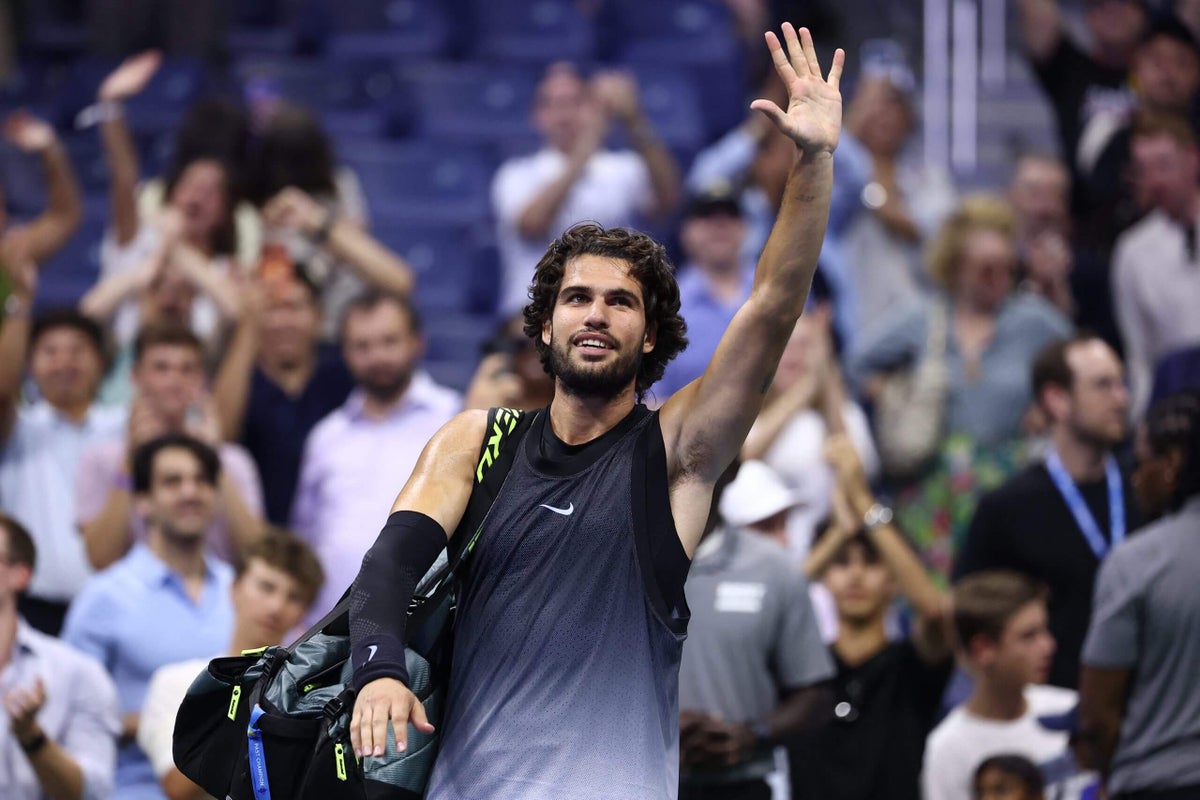
NEW YORK — A little before 4 a.m. Wednesday, everybody remembered where they were. The cheers and gasps and thwock-thwack-thwock-thwack call and response between two of the biggest stars in tennis had evaporated into the morning air, replaced by the piercing beeps of trucks whirring around the Billie Jean King Tennis Center to restore order to a night of chaos.
It was so late. It was so early. It had been so much. And under Arthur Ashe Stadium, minutes after being dethroned as the king of the U.S. Open in a match that he had chances to seize at the most vital moment, Carlos Alcaraz was smiling.
“I leave the court happy. I leave the court with a smile, healthy, and this is what I needed,” he said in a hallway after a 6-7(5), 6-1, 6-3, 1-6, 7-6(10-7) quarterfinal loss to Ben Shelton, his opponent in a tennis match that turned into a late-night spectacle.
The match was thrilling, even for the version of Alcaraz that spent the middle part of it listless and disoriented, chattering to himself about misses, occasionally vomiting into a towel, glaze-eyed from playing a sport at its apotheosis gone 2 a.m. after nearly five months out with an injury to his playing wrist, the kind that players fear the most.
That’s also why he was grinning. Ever since Alcaraz injured his wrist at the Barcelona Open in April, the 23-year-old, seven-time Grand Slam champion has taken the long view on how to manage it. He withdrew from his French Open title defense one month before it was scheduled to begin. He withdrew from another tilt at the Wimbledon title a full six weeks out. His last withdrawal before the fourth Grand Slam of 2026, when he pulled out of the Cincinnati Open tune-up mere days before it started, would ordinarily have set alarm bells ringing. Taken in the context of Alcaraz’s other decisions, it in fact signaled readiness.
“My expectation was to go there, you know, compete, play in these kinds of matches for me. Being healthy,” Alcaraz said
“It was close. It was close. So I’m just not going to be disappointed about not getting the win at the end. You know, I’m just happy. I’m just proud about myself, about how I fought.”
Sometimes Alcaraz and Shelton made tired misses, prompting expressions of frustration and lethargy and disbelief. Sometimes they produced individual brilliance. Shelton springing east and west along the baseline, showing a rally tolerance and return strategy that lasted for hours. Alcaraz, hovering north and south, blasting the ball into the corners.
And in the best moments, they combined, matching each other flick for flick, lunge for lunge, lob for lob and stab for stab, covering every scrap of blue until one of them either produced the unthinkable or could not take it any more.
By the time they played, Alcaraz’s run to the quarterfinals, along with the absence of world No. 1 Jannik Sinner and the first-round dissolution of Novak Djokovic, had turned what he always planned to be a reconnaissance mission into something that acquired more and more gravity as he rolled through the draw.
He kept a dangerous first-round opponent, Russia’s Roman Safiullin, at arm’s length in round one. He responded to dropping a set to big-serving Jaime Faria in round two by unleashing the full potency of his first-serve return, one of his most quietly devastating shots.
And in the round of 16, he dispatched No. 20 seed Tommy Paul, who is capable of giving the most practiced version of Alcaraz a little bit of trouble, with a swashbuckling confidence, mixed in with the implausible shots that send shockwaves around the court.
Alcaraz, through it all, had remained steadfast. He described beating Paul as “great feedback” in a news conference. After all, defending a U.S. Open title after four months away would surely be impossible.
Alcaraz, the youngest man to complete the career Grand Slam, who won his debut Wimbledon title by out-returning the greatest returner ever on grass, who stole the 2025 French Open final from Sinner, who makes tennis look like a computer game to which only he has the code, has proven himself capable of the impossible time and again.
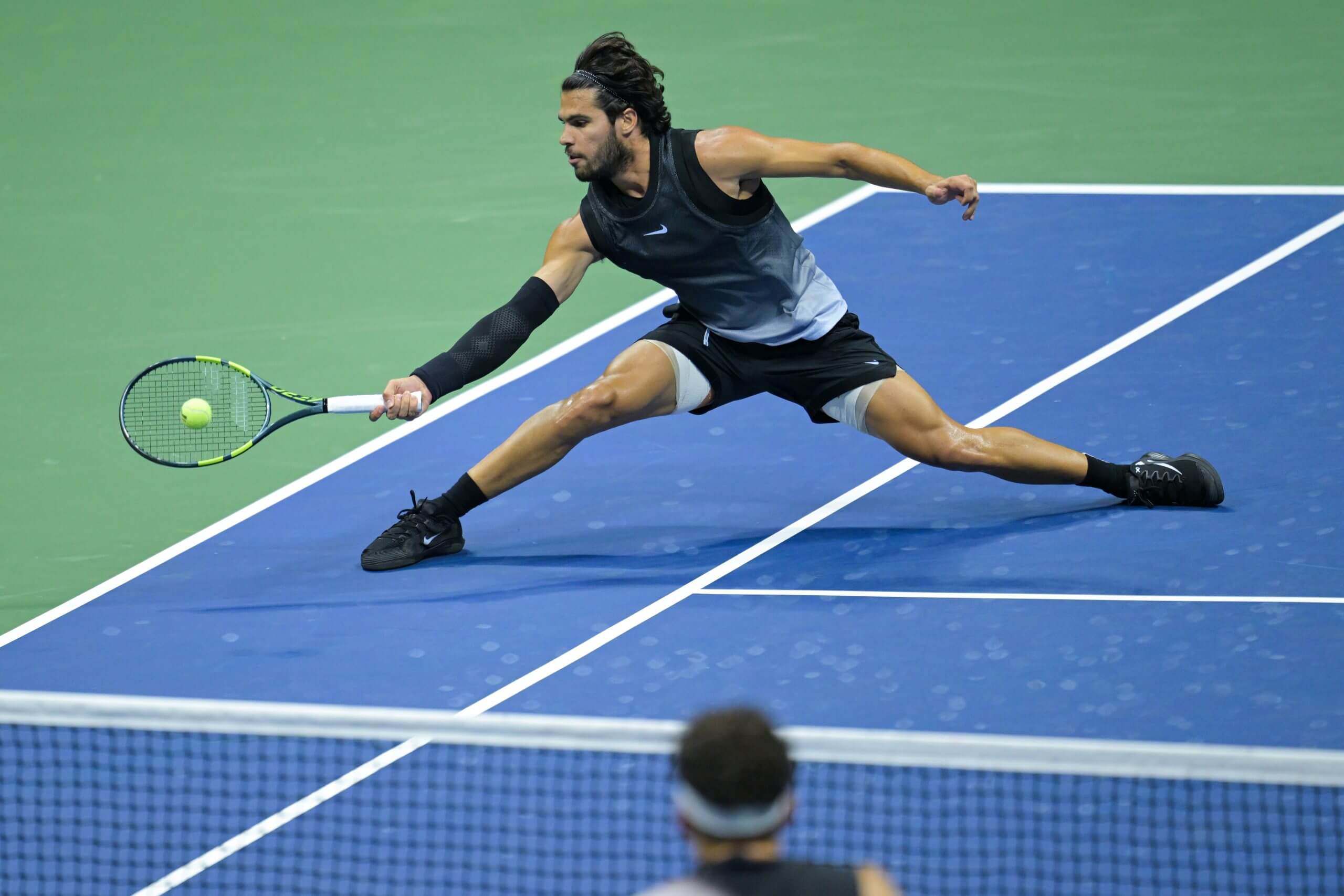
Carlos Alcaraz and Ben Shelton delivered a thriller on Arthur Ashe Stadium. (Pete Staples/USTA via Getty Images)
In the maelstrom of Arthur Ashe Stadium, against Shelton, he tried. After playing a listless game when serving for the opening set and falling behind in the ensuing tiebreak, Alcaraz put together one of those symphonic runs of points that break opponents’ hearts. He ended it by lobbing the ball over Shelton’s head, coaxing him into hitting a successful tweener that meant nothing to the scoreboard.
Then Alcaraz went away for about two sets, as any ordinary player coming back from such a layoff might have done many rounds earlier against a far less accomplished player. But then, he came back again to level the match.
And then came the fifth set. The set that Alcaraz just does not lose at Grand Slams, with 12 out of the last 12. He got to 0-30 on Shelton’s serve twice, but both times could not force his way into the lead. He brought up one break point in a separate game, but Shelton resisted.
A 10-point tiebreak then, another crucible of pressure in which Alcaraz so often hardens into diamond. He grabbed an early lead, but then the errors came. A flit of confusion flashed across his face. Shelton, as solid as he had been all night, had his serve firing. Alcaraz couldn’t quite summon the return brilliance it would take to stave him off.
At 3:33 a.m., they were both on the brink. Shelton, match point up for the biggest win of his life, ball in hand, looked up with a steely glint in his eyes. The one normally found in the eyes of the player looking at him.
He snapped an ace. The crowd roared. Alcaraz’s status as reigning champion evaporated into the sky.
He congratulated Shelton, walked off the court with a wave to the crowd and entered the hallway that runs out of Arthur Ashe Stadium. A TV camera pointed down it, designed to capture the contrast between victory and defeat.
Alcaraz looked up at it. And then he grinned.