
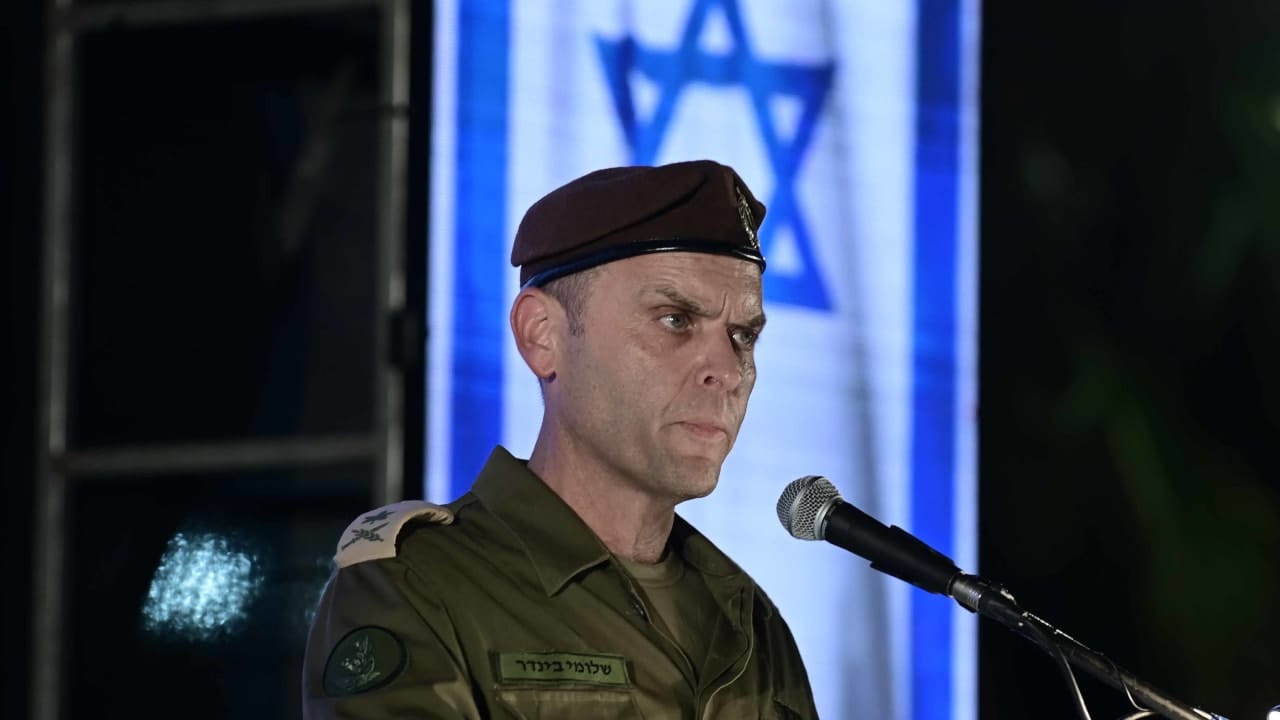
From the mid-1990s until August 2024, a running line of top Mossad and IDF officials made it their mission to block Iran from getting a nuclear weapon.
When Shlomi Binder was sworn in as the Military Intelligence chief in August 2024, he took up the baton and has pursued the crusade with a tenacity possibly unmatched in history.
There have been some great Mossad and IDF officials in office who have accomplished extraordinary missions to keep the Islamic Republic’s nuclear charge at bay.
But Binder is the man who ordered and managed the bombing of Natanz, Isfahan, and dozens of other sites, and provided the critical intelligence used by the US to bomb Fordow in June 2025.
He is also the major-general who directed the assassination of Ayatollah Ali Khamenei and the dissection of Iran’s ballistic missile and wider military apparatus.

To be sure, the air force dropped the bombs, and the Mossad delivered on key special missions. But if Israel struck Iran around a staggering 4,000 times in June 2025 and around an unthinkable 18,000 times in 2026, the intelligence for well over 90% of those strikes came from Binder and his juggernaut IDF intelligence teams.
Where has Binder’s crusade left Iran’s nuclear weapons program, five months after the 2026 war and 15 months after the 2025 war?
The Jerusalem Post has learned that the positives are that Iran currently has no centrifuges enriching uranium, all or most of its more enriched uranium is not yet easily accessible, and that most of the regime’s nuclear facilities were destroyed or forced out of operation by the 2025-2026 strikes.
There has been no period of time in decades where enrichment was brought down to zero.
For decades, its facilities expanded and never really contracted, and while operations attributed to the Mossad managed to take one or more facilities offline for temporary periods, at no point was the whole active program broken or shuttered.
Even during “pause” periods from 2003 to 2007 and from 2015 to 2018, large aspects of Iran’s nuclear program were frozen, not broken, and new aspects were almost always being built, even if under the radar.
However, the Post has learned that despite these achievements, future concerns are greater than hoped for right after the 2025-2026 operations.
While the vast majority of Iran’s 20,000 centrifuge fleet was destroyed or rendered unusable, a not insignificant number of centrifuges survived deep underground.
Moreover, multiple sources have expressed concern to the Post that even if only a few hundred advanced IR-6 centrifuges (for enriching uranium) can be salvaged and hooked up again at some medium-term point, that could be enough, at some later undefined point, to secretly weaponize enough uranium for a bomb.
Also, multiple sources are worried that the Iranians could pull off some kind of clandestine digging mission to extract their more enriched uranium from under rubble and underground in a way that sidesteps US and other surveillance.
Regular satellite reports by the Institute for Science and International Security and others show that Iran has added structures on an ongoing basis to block certain areas from continuous satellite coverage.
These same open-source reports have noted the Iranians digging in a variety of areas, sometimes not all that close to the main parts of a nuclear facility that was struck.
Digging underground from a distance could take months or years to smuggle out the 60% enriched uranium, or in some areas 20% enriched uranium. But only maybe around one tenth would need to be clandestinely transferred to have a basis for a nuclear weapon.
Binder’s view is not that Iran is likely to outwit American and Israeli intelligence, but neither does he want to underestimate or discount Iranians’ often surprising and powerful resourcefulness.
That means that the key to the whole picture to some extent is again shifting from uranium enrichment to weapons group issues.
One of the highest priorities – but less reported aspects – of the Israeli attacks on Iran’s nuclear program sites was hitting not only the enrichment facilities, but also the facilities for converting enriched uranium into uranium metal and into hemispheres for use on a nuclear warhead.
Without these and other items, even large quantities of weaponized uranium will do Iran no good, because it will not be able to deliver the uranium 1,000 or more kilometers away in Israeli territory.
The Post understands that thwarting Tehran from rebuilding such weapons group facilities is one of Binder’s top focuses, and so far the regime has not made any serious progress on the issue.
All of this leaves a highly complex picture where the nuclear program is far more damaged than some critics have said, but where there are more gaps in that damage than top Israeli officials, political or defense, admitted right after each round of fighting.
Iran’s nuclear program was set back by some years, and its ability to reconstitute it was also set back. Yet in some ways, Iranian ingenuity has kept the threat alive and able to return, even if less broadly and with great difficulty.

Major news was made in a July 13 interview on the Hugh Hewitt Show, when US President Donald Trump said, “We’re going to take out Pickaxe Mountain. Tell the Iranians to be ready,” while in another breath said, “We see no activity there.”
Pickaxe Mountain, once operational, will be the deepest underground nuclear facility the Iranians have ever built, significantly deeper than even the Fordow underground nuclear facility. It is hotly debated whether even the extremely unique and expensive 30,000-pound Massive Ordnance Penetrator mega bunker buster bomb could penetrate it.
The second part of Trump’s statement about Iran’s nuclear facility at Pickaxe Mountain – that there is no activity there; or as the hawkish Institute for Science and International Security has put it, that the facility is still not operational – is the major reason that neither the US president nor Israel has ordered a strike to date, despite his first statement promising to attack.
Across the board, top US and Israeli defense sources told the Post in classified briefings earlier in the summer that there was no current threat from the site, and that the best reason to target it would, at most, be to eliminate a potential future threat.
All of these views contradicted the stunning July 14 reports by The Wall Street Journal and CNN that Israeli intelligence had told the US that Iran had moved thousands of centrifuges and also enriched uranium to Pickaxe Mountain.
In an article on the issue on July 21, none of the several sources that had told the Post that there was no current threat at Pickaxe Mountain clarified the matter, despite several attempts by the Post to get to the bottom of the dispute.
Since then, the Post has more recently clarified the issue.
Both the Mossad and IDF intelligence view Pickaxe Mountain as a strategic threat that must be removed at some point, because it is so difficult to attack.
In addition, both agencies highly prefer to do so before it becomes operational and before the Iranians manage to move sufficient assets there to operate centrifuges and enrich uranium.
The Post understands that what occurred in July was that Prime Minister Benjamin Netanyahu hoped to get Trump to strike Iran, with Pickaxe Mountain being one of the top-of-the-line potential targets.
Senior Israeli defense officials leaned into the issue also because they thought it might be a unique chance to finally rid themselves of the hovering potential threat.
It remains somewhat unclear whether Israeli political officials exaggerated how operational Pickaxe Mountain was, whether one or more Israeli defense officials assisted with this, or whether American officials afterward exaggerated what they had been told.
But as of early September, the Post understands that Pickaxe Mountain remains high on Binder’s list of concerns, but that the facility is still not operational.
One recent change is that some Israeli officials have voiced to the Post greater confidence than in the past about the ability of allied air forces to disable the facility, even if destroying it might not be possible.
All of this highlights that Binder’s view is that the Iranian threat has not passed, that any agreement that gives Tehran the right to enrich to 3.67%, like the 2015 deal, would keep the threat alive, and that Israel must be ready for the real possibility of needing to attack the Islamic Republic at some point in the not-so-distant future.
What about recent talk of Russia providing Iran with supersonic missiles which will be harder for Israel to shoot down?
No one is getting too detailed on this issue yet, and some of the challenges are just starting to evolve, but it does not yet seem to be at the top of the IDF’s list of concerns about Iran.
Regime change
While Netanyahu, Defense Minister Israel Katz, and Mossad Director Roman Gofman still mention regime change publicly and privately, that term has mostly disappeared from the IDF lexicon.
IDF officials are no less enthusiastic about the idea in theory. Regime change has the best chance of promising a long-term end to Iran threatening the Jewish state.
But IDF high command officials, including Binder, were highly skeptical that the regime would easily and quickly fall when they went to war with the Islamic Republic in early 2026, and they believe the chances of this occurring are even more dubious now.
Neither Binder nor other top IDF officials favored the plan to try to use the Kurds to foment an internal rebellion.
While Netanyahu and top officials in the Mossad believed that, along with other moves which Trump vetoed, supporting a Kurdish internal insurgency could potentially radically alter the playing field, Binder and others viewed this move as possibly propping up the regime.
The majority of Iran – regime supporters and opposition – is Shi’ite.
Just as the Kurds often see the Iranian Shi’ites as outsider oppressors, many of the Shi’ites, even those who hate the regime, hate or distrust the Iranian Kurds even more.
In other words, Binder and others in the IDF high command worried that bringing the Kurds in as an officially Israel-US sponsored kingmaker could lead to the largest group of opposition Shi’ites changing sides back into the hands of the regime.
They also noted other major issues, such as that dropping lots of bombs makes protesting harder.
While some said that careful coordination could lead to enabling protests to grow by only bombing regime oppression forces, this never really occurred in a significant way, and most protesters were just too scared and stayed home.
Of those who did not stay home, Binder and the IDF high command would note that many of the bravest protesters were killed during the largest fight between the protesters and the regime over January 8-9 or were killed or tortured after the main war ended on April 7.
None of this means that Binder and the IDF have given up on regime change.
But they believe that it will take longer than some in the Mossad believe, and compared to Netanyahu’s promises, and that in the immediate short term it may even be difficult to make progress, with progress waiting for the medium term when protesters regain their daring.
Despite these truths, Binder and the IDF high command were highly optimistic about the jump in pressure on Iran in late August-early September, with the pace of economic deterioration jumping significantly.
They hope this elevated economic pressure will give the US the upper hand in the standoff over the Strait of Hormuz and the nuclear issue.
All of the talk about the US has also crystallized a realization from Israeli intelligence: instead of leaving the Middle East, Trump has put the American military on the front lines of managing most of Israel’s conflicts with its neighbors.
With one brief 24-hour exception, Israel and Iran have not fought since April 7, whereas Washington and Tehran have been going at it at low-grade military levels sometimes for weeks on end.
The US is managing aspects of Israel’s conflicts with Hezbollah and Hamas, and trying to encourage deconfliction and cooperation between Jerusalem and Damascus.
Lebanon
The UN has said that 360,000 Lebanese remain uprooted from their homes due to the war and the IDF security zone in southern Lebanon.

At the height of the invasion, over 1.1 million Lebanese had been uprooted.
The Post has learned that IDF intelligence estimates that around 500,000 Lebanese have still not returned to their homes, some because they cannot, and some out of fear of IDF forces nearby, or because of low-grade fighting between Hezbollah and the IDF.
This factor is the single largest pressure on Hezbollah to reduce its threat to Israel.
Despite Iranian attempts to protect Hezbollah in Lebanon, the Post learned, a little before it became public last week, that the IDF succeeded in a slow and grueling siege to defeat a sizable Hezbollah force that had been trapped in a standoff with the IDF at Ali Taher Ridge for months.
IDF intelligence correctly analyzed that while an overt and dramatic attack on Ali Taher Ridge might have given Iran an opening to attack Israel in support of Hezbollah, a quiet and gradual wearing down of those Hezbollah forces fell under the Iranians’ radar, or provided them with a face-saving outcome where they could look the other way.
Hezbollah’s FPV fiber cable drone threat is far from gone. But whenever Hezbollah has launched drones, the IDF has responded harshly, either striking a dozen Hezbollah targets or forcing another Shi’ite village to evacuate the area near where the drone launched from.
Binder and the IDF high command are skeptical that the Lebanese army will succeed in evacuating Hezbollah from southern Lebanon areas where it is still operating.
This could leave a standoff regarding how long the IDF remains in parts of southern Lebanon and regarding what conditions will be required of Lebanon-Hezbollah for ongoing partial withdrawals.
There is a similar standoff with Hamas in Gaza. However, even if no one expects Hamas to disappear, Binder and the IDF high command believe they have stronger cards to play versus Hamas given its weaker position.
Saudi-Pakistan-Turkey alliance
While much of the world has viewed the Saudi Arabia-Pakistan-Turkey alliance as another move by Riyadh to try to deter Iran from striking it in the future, as it has in 2026, Binder and the IDF high command have specific Israeli concerns.
For example, what if Iran joins the alliance? Although it was built to deter the Islamic Republic, in the messy world of Middle East politics, both sides could decide that integrating Tehran could have advantages.
These advantages for the Saudis and Iran would likely be clear negatives for Israel and could even complicate aspects of relations with the US, if Washington gives critical nuclear and F-35 weapons technologies to Riyadh.
More generally, such an alliance could reduce Israeli influence in the region.
Though highly unlikely, there is even a slim chance that Egypt could join the alliance, which could undermine decades of close Jerusalem-Cairo military cooperation, as set down in the Camp David Accords.
Artificial intelligence revolution
Binder has mostly been known to the public for transforming IDF intelligence from its pre-October 7 state of “bubble thought” and complete reliance on technology to rebuilding human intelligence collection and elevating branches that question conventional wisdom.
However, he is also engineering a new AI revolution in IDF intelligence.
The key is not only using AI to perform data mining against targets, but also to shape human-AI agent relationships so that most or all IDF intelligence officials’ strategic and tactical visions broaden to see and predict big-picture trends before they happen.
In many ways, Binder has brought IDF intelligence back from the brink after October 7 to new highs, now and moving into the future.