
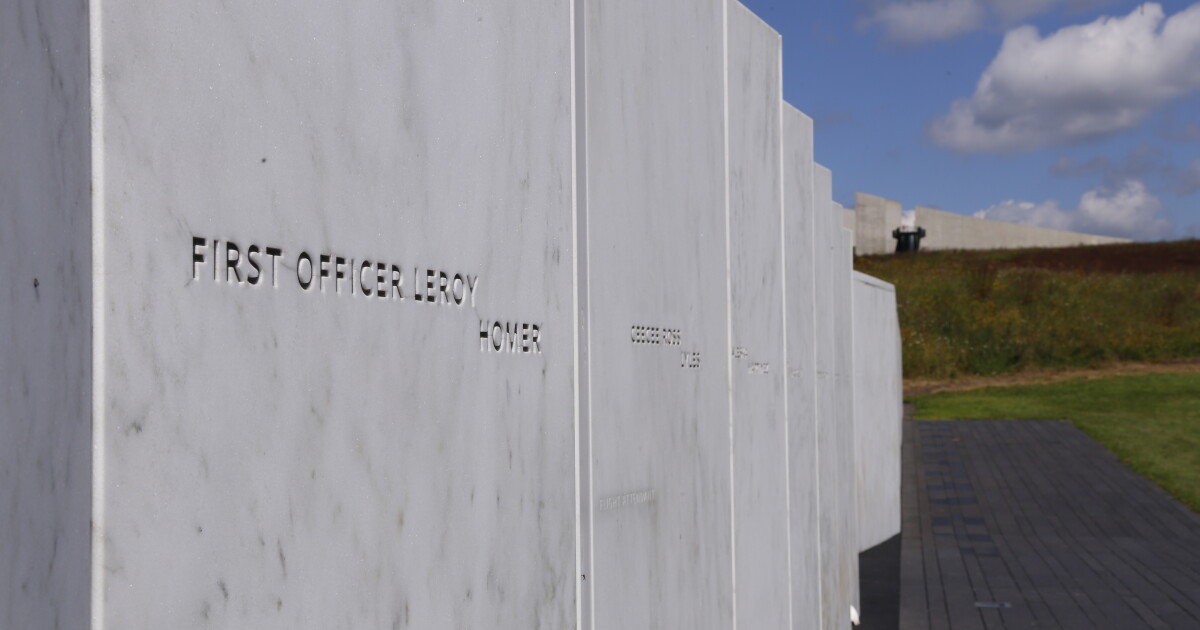
Tuesday, Sept. 11, 2001, started out as a regular workday for Paul Murdoch, founder and president of the Los Angeles-based architectural firm bearing his name.
Being located in the Pacific Time Zone, Murdoch’s day was just getting started when the events began to unfold, and he watched live coverage from his workplace.
“It was a very frustrating feeling being so far away, feeling kind of helpless, not really understanding what we could do,” Murdoch said.
Helplessness and frustration were feelings many Americans felt that day, but for Murdoch more than many, the developments hit close to home, literally.
Christopher Ayers
/
90.5 WESA
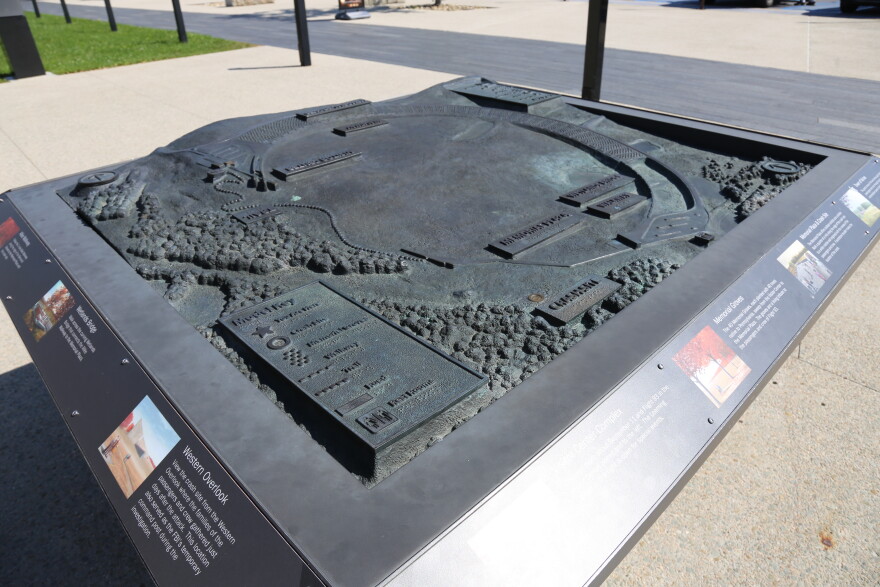
A tactile model at Flight 93 National Memorial shows the layout of the memorial grounds near Shanksville, Pa.
Murdoch grew up in Newtown Square, Pa., a suburb of Philadelphia.
The area is roughly two hours from New York City, where the World Trade Center was attacked; three hours from Washington, D.C., where the Pentagon in nearby Arlington, Va., was targeted; and four hours from Shanksville, Pa., where United Airlines Flight 93 crashed.
“Growing up in Pennsylvania, I had camped and canoed out in Western Pennsylvania where Somerset County is, in the Laurel Highlands,” Murdoch said.
“So I knew that landscape. I knew that place. It’s an unbelievably beautiful, beautiful part of Pennsylvania.”
“Yeah, there were a lot of personal and emotional things going on that day besides the overall tragedy as an American.
“Deeply personal.”
Christopher Ayers
/
90.5 WESA
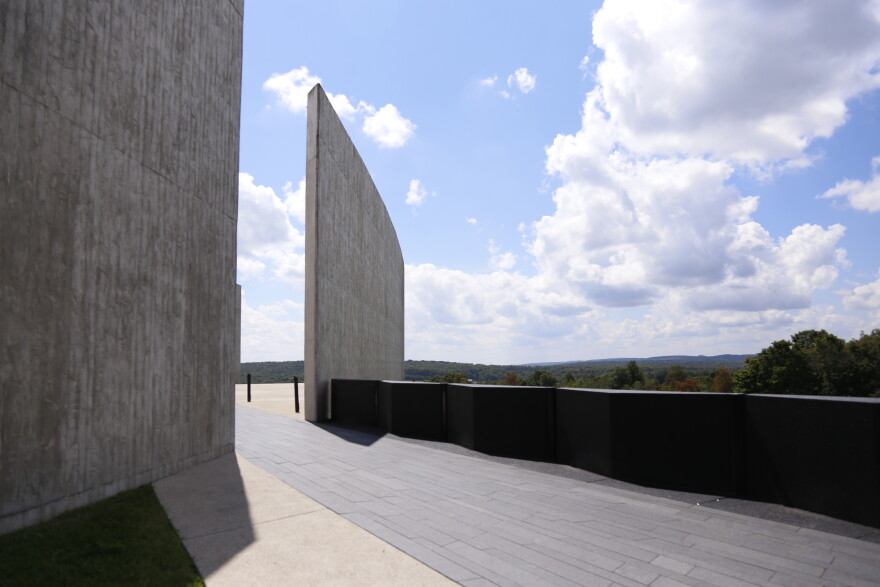
Concrete walls frame a walkway and overlook at the Flight 93 National Memorial near Shanksville, Pa.
This familiarity played a role in Murdoch’s bid to build the Flight 93 National Memorial, a job his firm was awarded out of over 1,100 proposals.
“We very much wanted to work with the character of the local landscape there and the feeling of that place,” Murdoch said.
“We had a very simple, clear scheme with very discretely defined elements to it. And so I think we had a very, you know, kind of clear and compelling presentation.”
“It was only one [presentation] board at that stage, so we had pretty much distilled it to the essential elements that we defined as our memorial expression, and I think people resonated with those, and could grasp the concept very quickly.”
Christopher Ayers
/
90.5 WESA
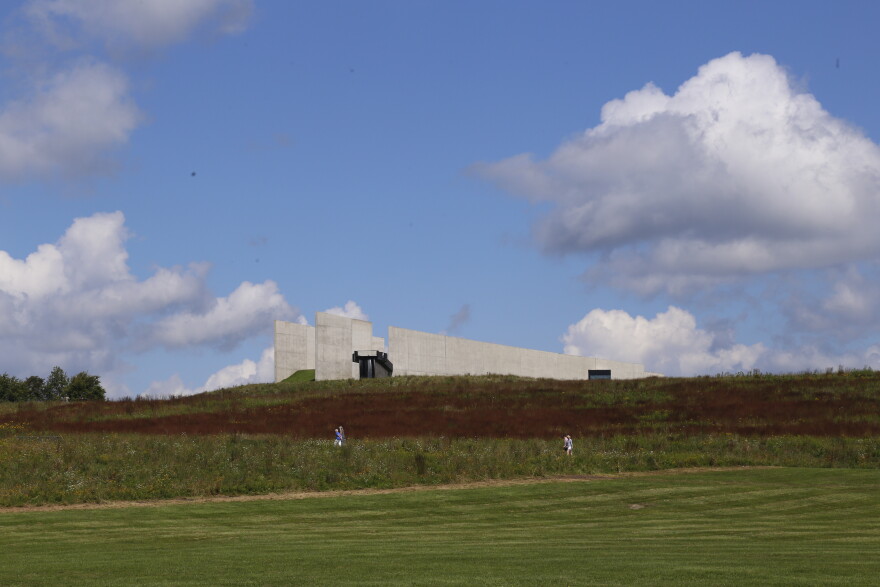
Visitors walk through the grounds below the visitor center at Flight 93 National Memorial near Shanksville, Pa.
Murdoch explained this project forced his team and him to deviate from their typical mindset.
“We’re architects, and our first impulse is to create a building [or] create a monument. When we saw the scale of the landscape there, what we wanted to express in this memorial was heroism,” Murdoch said.
“When we set about to do something more architectural, the scale of that really was dwarfed by the scale of the land. And that’s when we made a fundamental change in our approach to really work with the land to create the memorial and approach it from the point of view of a landscape.”
“So, it’s an overall experience for somebody to move through that landscape there, as opposed to, say, one particular feature.”
While it may be more of a collective memorial than a typical tourist attraction, Murdoch admitted there is one particular point of pride: the Tower of Voices.
1 of 2
— Flight 93 National Memorial — Tower of Voices
The Tower of Voices rises above the landscape at the Flight 93 National Memorial near Shanksville, Pa.
Christopher Ayers / 90.5 WESA
2 of 2
— Tower of Voices at the Flight 93 National Memorial
Looking upward from inside the Tower of Voices at the Flight 93 National Memorial.
Christopher Ayers / 90.5 WESA
The 93-feet-tall chamber contains 40 wind chimes, each one representing a different crew member or passenger aboard Flight 93.
“It’s unprecedented,” Murdoch said. “Using 40 wind chimes at that scale together to commemorate each of those folks — and achieving that — we’re proud of.”
The construction of the Tower of Voices was part of phase three of construction, completed in 2018.
While the national memorial’s official website calls the third phase the final phase, Murdoch indicated more could be in store.
“The critical thing that’s still needed at the memorial is to finish the commemorative tree planting. The 40 groves of trees are meant to commemorate the 40 heroes,” Murdoch explained.
Christopher Ayers
/
90.5 WESA
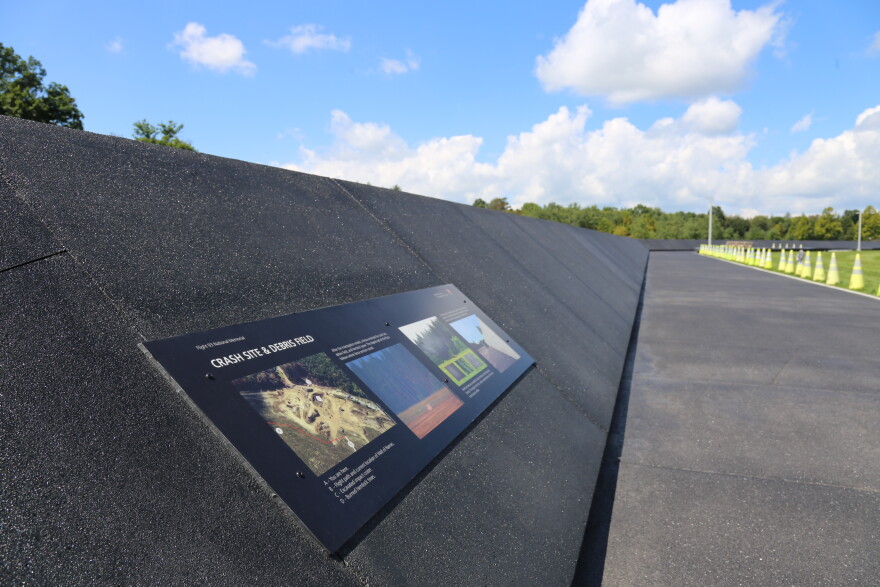
An interpretive panel at Flight 93 National Memorial identifies the crash site and debris field near Shanksville, Pa.
The 2,000 trees that were initially planted ended up being removed because their health was compromised, a reason the National Park Service and botanical experts have attributed to poor natural soil — the memorial was built on a former open coal pit mining site, the Diamond T mine operated by PBS Coals out of Friedens, Pa.
The park service and non-profit Friends of Flight 93 National Memorial have embarked on a public-private campaign to restore the trees, Murdoch said.
“I think if there is a phase four, it’s to really implement the successful planting of those trees because they really are important to not only symbolically commemorate, but they help shape the space of the memorial landscape.
“They form the edge to the field. They form the shade for the walkway for visitors to walk around the field, and then they’re backed up by the 40 groves of trees that form that broader edge that embraces that field.”
“The trees are a critical part of the memorial. So the success of that, I think is, for all intents and purposes, a phase four.”
Christopher Ayers
/
90.5 WESA
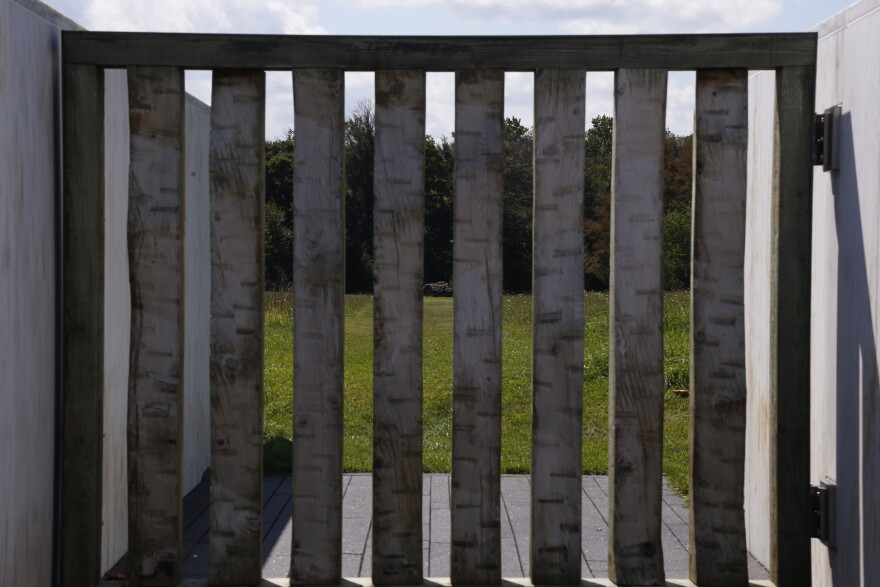
A wooden gate frames the grassy field and boulder marking the Flight 93 crash site at Flight 93 National Memorial in Shanksville, Pa.
The memorial has won myriad awards — Murdoch’s website specifies 10 of them — yet Murdoch said it’s not the hardware he’s proudest of.
Merely being awarded the opportunity to take on the project has led to something greater, he said.
“I don’t know if you may call it a reward instead of an award, but the reward of having the family members [of the deceased] be able to experience the opening, or having people send a letter or card of gratitude, saying they visited and what it meant to them.”
“These are the really meaningful takeaways, more than formal awards.”