
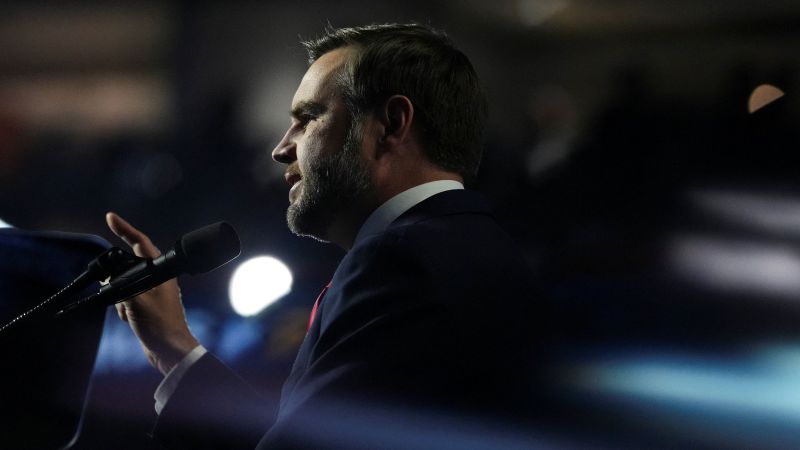
In his keynote speech Thursday night at the Republican midterm convention, Vice President JD Vance offered a very different midterm pitch than his boss.
He acknowledged many voters dislike certain things about the Trump administration, but he urged them to nonetheless vote against the Democratic “crazies.”
It was a more realistic and nuanced pitch, and it’s a striking contrast to President Donald Trump’s all-is-great, we’re-in-the-Golden-Age approach.
But it’s a difficult sell — in large part because Trump has given voters so much to dislike.
Vance devoted a significant chunk of his speech to this argument. He even invoked the late Charlie Kirk, whom he strongly suggested would have opposed Trump’s war with Iran.
Vance cited “some people who love some of our policies but maybe don’t agree with others.”
He called out “young men, many of whom felt inspired by Charlie Kirk but are unhappy with some of what has happened in the wake of his death.”
“Do not throw the baby out with the bath water,” Vance added. “Don’t give the country over to a bunch of crazy people because you happen to disagree with us on a policy issue here or there.”
And finally, he said: “I’m not asking anybody to agree on every single policy of the administration. What I am asking you to do is to recognize the contrast with the radicals and recognize the achievements of the last 18 months.”
This is vastly different from Trump’s pitch.
The president followed up Vance’s speech by riffing on how great everything is, arguing the United States is in a new golden age.
And just hours before Vance’s speech, Fox News released an interview with Trump in which host Laura Ingraham posited that the same “young men” Vance later cited were “demoralized.” Trump quickly reject the premise out of hand. He insisted they still supported him, weren’t demoralized and understood the value of the Iran war.
That is, of course, not true — not in the broad strokes. A Pew Research Center poll in March showed just 49% of Republicans under 30 approved of Trump’s handling of the war, compared to 84% of GOP senior citizens.
But that hints at the limits of Vance’s pitch.
The problem is that for many would-be Republican voters — including young men — it’s not just an issue or two that has alienated them. Trump has saddled his party with a large swath of things that polls show Americans decidedly don’t like.
The president even cited many of them in his keynote address on Wednesday. A Quinnipiac University poll released Thursday showed independents overwhelmingly opposed Trump on a number of things:
74% disapproved of his handling of the Iran war
75% disapproved of his handling of the economy
71% disapproved of his handling of the Russia-Ukraine war
70% disapproved of his handling of trade with Canada (Trump recently launched a trade war)
76% opposed his recent renaming of Lake Ontario as “Lake America”
69% opposed his White House ballroom project
And on each of these, between 17% and 38% of Republicans also disapproved.
Similarly, CNN polling in July showed that Republicans and GOP-leaning independents — the kinds of voters the GOP needs to convince — often oppose what Trump does by 30%, 40% and even 50% or more.
There is also one issue that is far and away No. 1 for the vast majority of Americans: affordability. And Trump has lost the plot on it.
He’s spent months falsely claiming that prices are down and the economy is booming. But he hasn’t seemed to convince virtually anyone of this alternate reality.
That’s led people to believe Trump is asleep at the wheel. Around three-quarters of people think he’s neglected the issue. The July CNN poll showed 81% of independents and 43% of Republicans disapproved of him on inflation.
It would be one thing if inflation were bad, Trump was out there trying to fix it, and it was just a tough slog. But he’s piled on things that Americans aren’t asking for, that make clear his priorities are elsewhere, and that in some cases could even exacerbate inflation: the tariffs, the Iran war, the ballroom and his many legacy projects.
Trump is acting like he simply doesn’t care about public opinion; he just wants to do what he wants to do, for his legacy.
Vance’s presentation Thursday was at least an attempt to level with people. But it was a discordant one next to a president who insists on a different reality — and has governed as if he has the political capital that that alternate reality would afford him.
And that showcases the weakness of Vance’s argument — at least to the extent it was intended for the 2026 election, rather than a future race in which he might need some distance from Trump.