
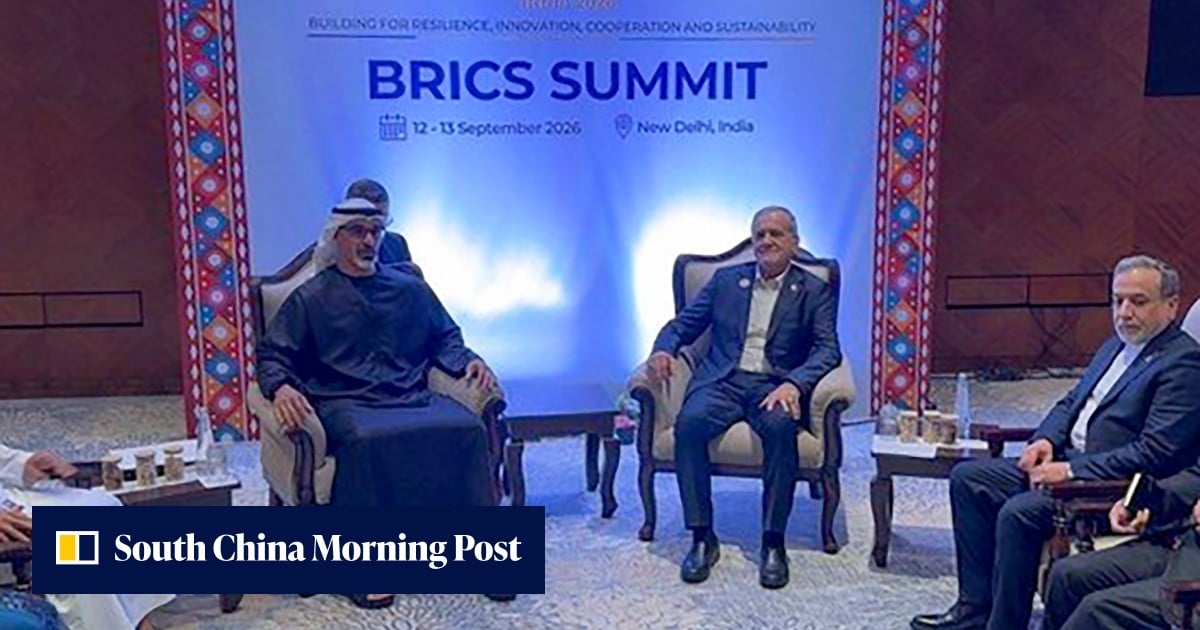
Iranian President Masoud Pezeshkian and Crown Prince Sheikh Khaled bin Mohamed bin Zayed Al Nahyan of Abu Dhabi met on the sidelines of the Brics summit in New Delhi on Saturday, marking the highest-level meeting between the two sides since the Iran war began.
The bilateral meeting came as the fallout of the war in Iran widened, with Saudi Arabia shutting its key East-West oil pipeline after it was attacked by drones on Friday. The closure of the pipeline stretching across the Arabian peninsula has heightened global concerns over more oil supply disruption.
The meeting, confirmed by the Iranian embassy in New Delhi, brought the Iran and UAE leaders face to face months after bilateral frictions intensified sharply in late February, as US-Israeli strikes saw Tehran hit back at American allies in the region.
US blockade on Hormuz Strait to take effect on July 14 after UAE tankers hit
Retaliatory strikes across the Gulf region saw Iran launch sustained ballistic missile and drone attacks against the United Arab Emirates that damaged energy infrastructure, ports and commercial facilities across Dubai and Abu Dhabi.
Meanwhile, escalating tensions in the Strait of Hormuz have led to strikes on commercial vessels, including oil tankers operated by the Abu Dhabi National Oil Company.
Relations reached a breaking point last month after two Iranian ballistic missiles splashed down in waters near the UAE coastline, prompting Abu Dhabi to enact a comprehensive, indefinite embargo.
The UAE suspended all trade, commercial exchanges and financial transactions with Iran, cutting off the banking and transshipment channels that Tehran has historically relied upon to bypass international isolation.
As Iran’s second-largest trading partner after China, the UAE has long been an indispensable commercial hub for the Iranian economy, providing roughly 30 per cent of its imports and access to foreign currency, banking networks, and global shipping.