
Welcome to the Surge, your weekly political sanity check: What matters, what might, and what’s just political theater. Sign up here to get it in your inbox.
Welcome to this week’s historic edition of the Surge, here in our brand-new home. Do you like the imported marble floors and silk window treatments? We’ll tell ya, it was a real hassle getting those through the Strait of Hormuz.
Indeed, today is the exciting launch of Surge 2.0. To recap, each Saturday we’ll break down the biggest news of the week into three categories: what mattered most, what we’re keeping an eye on, and what’s unfathomably inane. Plus, there’s a fresh new section of quick hits at the end. Let us know what you think!
Now we begin with the GOP’s counterprogramming to the kickoff of the new NFL season.
What matters now: Trump is not entirely crazy for saying, “I’m on the ballot this fall.”
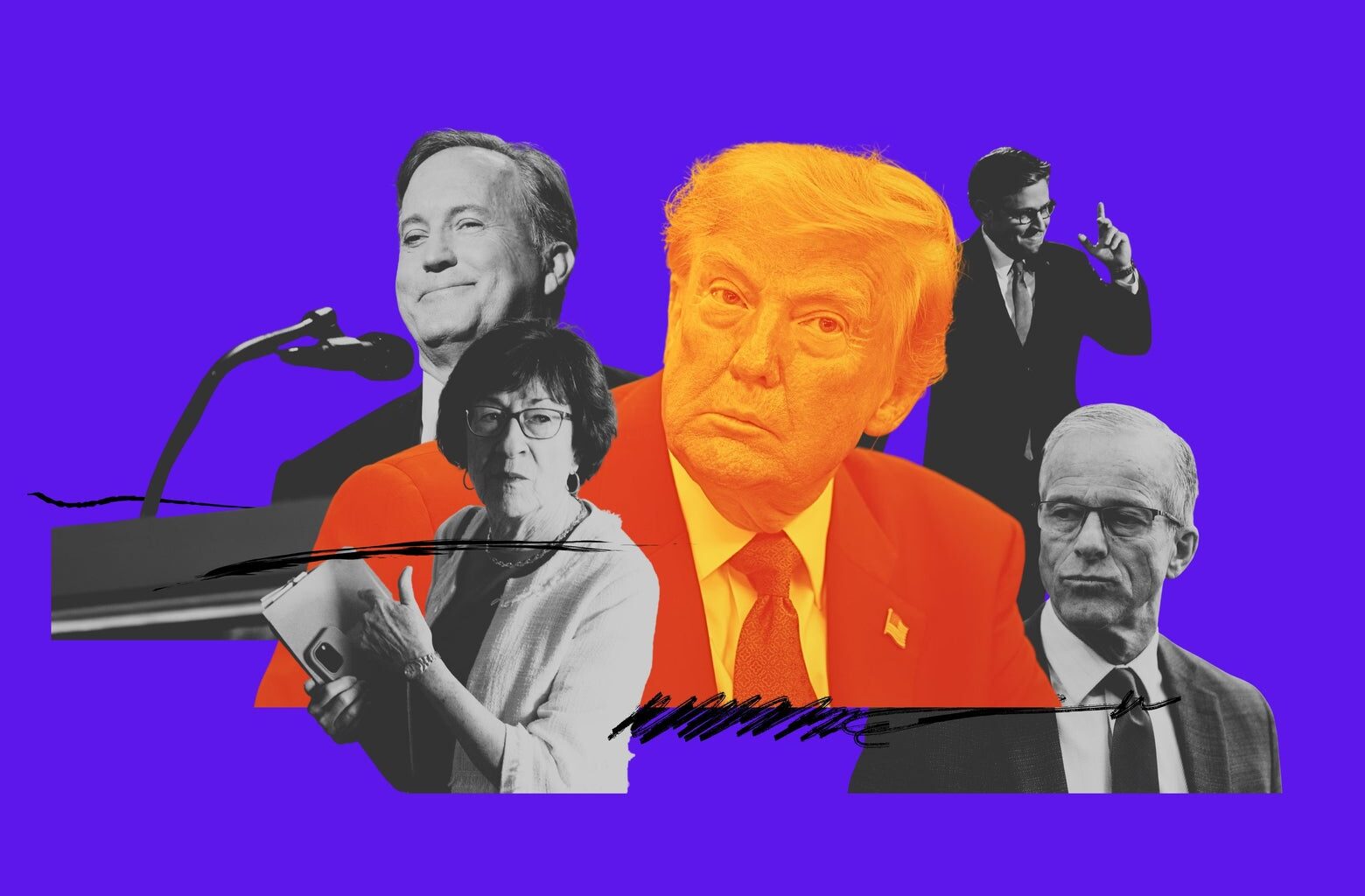
Republicans this week held their midterm convention, something that we “definitely” “watched.” Aside from a few stray clips and a couple of other newsy items we’ll deal with below, though, the most enduring message from the event were these words from President Donald Trump: “I’m asking you to pretend that I’m on the ballot. I’m on the ballot.” He would also tell the attendees, during a mock pledge, that they will “go to hell” if they don’t vote.
Democrats have celebrated this unsurprising decision of Trump’s to put himself forthrightly in the center of the midterm discussion. It’s a move that neatly aligns with Democrats’ strategy of making the midterms a referendum on Trump, whose approval rating is atrocious.
But we’re not willing to say that Trump’s strategy is all downside for Republicans.
The Republicans were never going to be able to stuff the president in a box this election season. Consider, for example, that Trump forced the Republican National Committee to hold its first-ever midterm convention in order to celebrate him. And at this point, the thing that would worsen these midterms from bad to catastrophic for the GOP is if MAGA stayed home.
Poll after poll indicates that Republicans are suffering from an enthusiasm gap. Democrats and Democratic-leaning independents don’t have to be told that Trump is on the ballot this year; it’s Republicans who could use all the motivational nudges they can get. Bringing MAGA enthusiasm closer to what Democrats are showing wouldn’t just help Republicans save, say, their Senate seats in places like Alaska, Ohio, Texas, and Iowa either. Sen. Susan Collins needs MAGA voters to turn out in rural Maine just as much as Ken Paxton needs them to in Texas.
Although Republican strategists would prefer a more targeted deployment of Trump’s motivational tools to specific races where his presence would help, the president’s never really been a scalpel guy. He’s foreclosing on more-delicate persuasion efforts and pushing the one button available to him—let’s get my people out there in force—as hard as he can. There’s no choice but to roll with it.
Get the Surge in your inbox.
Worth keeping an eye on: Will Congress do anything about “extinction by computer”?
Developers of artificial intelligence have long been undersocialized creeps who openly and casually talk about how the technology they are creating has a decent chance of ending all human life. This week, a couple such comments went viral. Jacob Coxon, who has worked at both OpenAI and Anthropic, resigned from the latter and said that “neither company is acting responsibly,” asserting that the “people building AI earnestly believe that it could kill us all by the end of the decade.” His thread on X has hundreds of thousands of reposts. Another Anthropic employee, Evan Hubinger, agreed with Coxon, adding, “We really do earnestly believe AI could kill all humans!” (That exclamation point will haunt our dreams.) “I personally think it is >10% within the next decade.”
While the public debates whether these fears are overblown—only the robots know for sure—the conversation seems to have reached people who might have the power to do something about it.
Democrats in both the House and the Senate on Tuesday discussed establishing select committees on artificial intelligence. (Even if Democrats win one or both chambers, this will be a challenge, as various committees with jurisdiction over A.I. won’t want to cede power. This is one reason why the machines deserve to win.) And even some Republicans saw where the wind was blowing. Ted Cruz, who chairs the Senate Commerce Committee, noted that “AI is advancing at an extraordinary pace, and some of the risks are dangerous and frightening” and stated that he’s working on legislation “to address catastrophic risks involving biological or nuclear threats.”
Our own A.I. policy preference is that the government should unplug it, then repurpose gigantic data centers into the biggest Chili’s franchises you’ve ever seen. We’re hoping that the public, which was never consulted on whether it wanted to reorganize life this way, is at least dragging politicians somewhat in our direction. Cruz, for example, hasn’t become an A.I. opponent, by any means, but his remarks were a notable tone shift from his substantial work this Congress trying to limit states’ ability to control the technology. The scope and terms of a federal A.I. regulation bill will be one of the biggest debates, in both party primaries, in the 2028 presidential election.
New frontiers in garbage: Macroeconomics 101, but the opposite.
This Content is Available for Slate Plus members only
I Have a Theory About Who Leaked a Story About Iran, and It Rhymes With A.P. Mance
This Content is Available for Slate Plus members only
Democrats Are Laughing at Trump’s Midterm Plan. They Shouldn’t.
At the GOP midterm convention, Trump promised $5,000 “divided” checks to every American adult if Republicans hold both the House and Senate in the midterms. (This came as a surprise to House and Senate Republicans.) It’s an act of political desperation and objectively incorrect as policy. There’s no trove of tariff lucre from which to pay “dividends.” Deficits are soaring, and tossing another $1 trillion–plus of stimulus into this economy would send inflation and interest rates rocketing further upward. The bond market could not be clearer about this. This goes against everything congressional Republicans believe about fiscal policy regardless of the economic environment, and congressional Democrats would have little interest in facilitating Trump’s bribe.
But Trump has made Republicans go along with terrible ideas before—for example, his political career—and it would be uncomfortable for Democrats to uniformly band together to oppose people getting cash.
So can we guarantee that this pledge will have no political pull, or that it couldn’t pass Congress? No. Mothers, don’t let your sons grow up to be populists.