
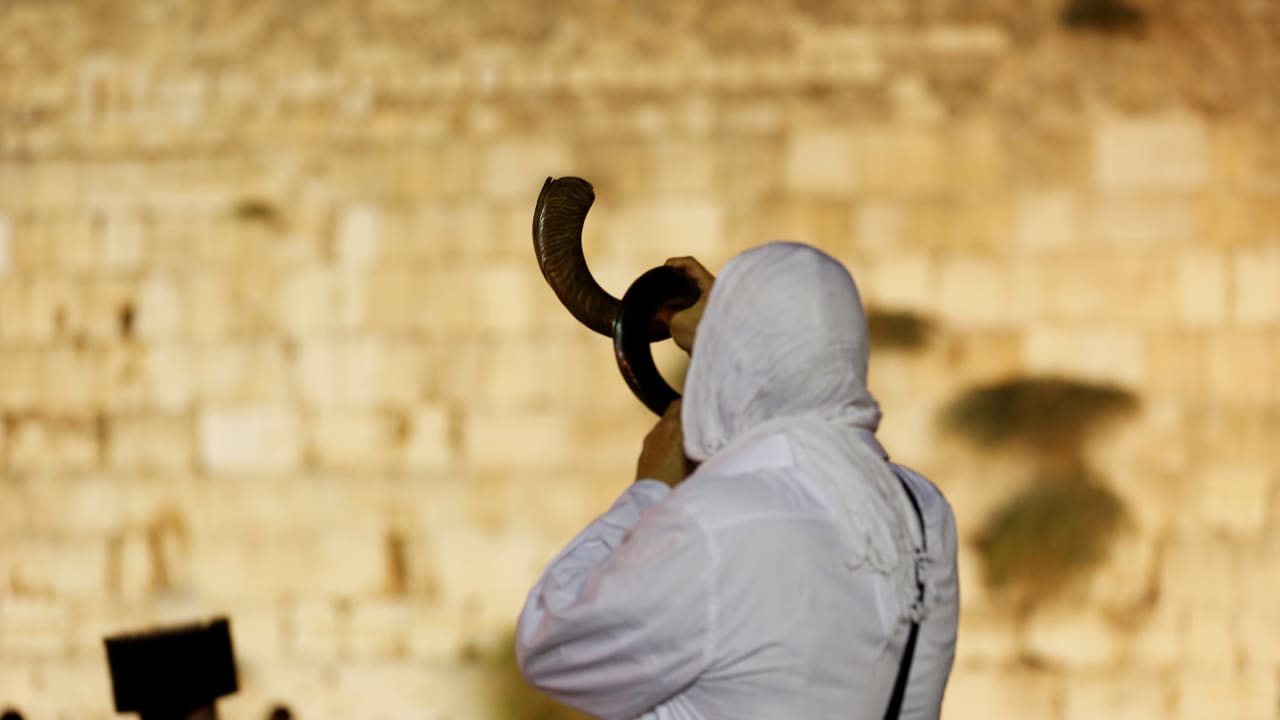
What do we mean when we wish our friends, acquaintances, and passersby a shana tova (good year)?
If we are speaking on the personal level, the answer is simple: we are speaking of good health, happiness, prosperity, a good education for their children, satisfaction in everything they do, etc.
I suppose this also expresses the hope that we shall have a government that will enable us all to realize all these wishes, such as properly functioning health and education systems, and a solid economy. But all this is innocent and more or less politically neutral.
The moment we come to political issues, both short-term and long-term, we find ourselves in trouble, for here we are deeply divided in our beliefs and aspirations. Nothing exemplifies this division more clearly than the approaching general elections and the current election campaign.
For half of the Jewish population in Israel, the wishes for a good year are for the continued rule of the existing Right/religious coalition, at least for the time being, under its current leader – Prime Minister Benjamin Netanyahu.

This half of the population is inclined to reject a negotiated settlement of the issues that are the cause of the war on seven fronts of the last three years, supports a major, revolutionary legal reform, and the weakening of the vestiges of Israel’s liberal democracy.
Much of this bloc also wishes Israel to become more religious, and large parts of it do not seek coexistence with Israel’s Arab population – whether citizens or only inhabitants – but rather its “voluntary” emigration.
For the other half of the Jewish population, getting rid of the current government and its head are considered primary goals – not only for ideological reasons, but also because it believes that this government is a badly functioning government in almost all spheres, but most notably health, education, economics, foreign affairs, justice, transportation, and environment.
This part of the population is inclined to believe that the use of military force must be accompanied by diplomacy and clear political goals based on non-religious realpolitik. It believes that the prime minister must be motivated exclusively by national interests rather than by an ambition to remain in power at any price.
Belief that government is tainted by corruption
It is also inclined to believe that the current government is more tainted by corruption and illegality than any previous Israeli government.
There is no doubt that each of the blocs believes that the victory of the other bloc in the election will be a catastrophe, so the “good year” of each side clashes with that of the other. If we wish a good year to whoever we happen to come across, we place ourselves in a stormy medley of irreconcilable contradictions.
Today’s government bloc believes that a government formed after the elections by the current opposition and supported by even a single Arab party – whether or not it includes Jews among its members – will be dangerous to Israel’s security and existence as a Jewish state in the religious sense.
Supporters of this bloc also believe that the return of today’s opposition to power will also cut short the current government’s efforts to do away with an alleged “deep-state” within Israel’s administration, its universities, its legal system, and even its military establishment – a deep-state which prevents the Israeli Right, and the various Jewish religious groups in the state, from effectively manifesting their numerical strength in the Israeli power structure and society.
Parts of the government supporting bloc even believe that certain elements in the opposition – primarily the Democrats and their leader, former IDF deputy chief of staff Yair Golan – are no less than traitors who collaborated with Hamas and other enemies of Israel.
On the other hand, the opposite bloc believes that a victory of the existing government bloc will bring about the end of Israel’s liberal democratic system and turn Israel into an authoritarian state, which disregards the international law on which the State of Israel was established 78 years ago, and is treated as a pariah state by its former friends in the enlightened world.
Furthermore, this bloc believes that Israel has been led for much too long by a man who started as a breath of fresh air, but today is not only flimsy with facts but whose cognitive and decision-making faculties are no longer as sharp as they were in the past, and is no longer surrounded by an entourage that elicits confidence and respect.
Netanyahu’s failure to appoint to the Likud list for the elections respected and inspiring personalities such as former chief of staff Gabi Ashkenazi, former Likud minister and confident Ron Dermer, and former Likud minister Yuval Steinitz (all of whom declined the offer), and the persons who were finally appointed (such as Yaakov Bardugo, a former TV presenter and commentator on channel 14), points to his declining power of persuasion.
The real danger, of course, is that even though there is still a small chance that one of the blocs will win a decisive victory, if neither side manages to form a government after the election – especially if the Arab parties win (as predicted) 13-15 Knesset seats – neither side will actually enjoy much of a good year.
Unless, under such circumstances, the two sides opt for a grand coalition (an unlikely occurrence) and the current government will turn into a transition government, with new elections for the 27th Knesset being called within several months, the situation will only get worse.
Such a development will be more favorably received by the current coalition than by the opposition, but it is still nobody’s vision of a good year.
Why is the vision of a grand Zionist coalition unlikely? First, because the current opposition bloc simply does not trust Netanyahu. Secondly, because a grand coalition would require rotation in the premiership, and as long as Netanyahu is on trial, he can serve as prime minister but not as a minister.
Thirdly, because neither of the two parties running in the elections that advocate such a government – Benny Gantz’s Blue and White, and the new union between Yoaz Hendel’s Reservists Party and Yaron Zelekha’s New Economic Party – are likely to pass the qualifying threshold.
So at the moment, let us stick to personal wishes of a shana tova to everyone, but especially to those wounded physically and/or mentally in the course of fighting during the last three years, and who are far from recovery, and to those who have lost loved ones on October 7, as hostages in the Gaza Strip, or in the fighting on seven fronts in the last three years and are still mourning.
In the final reckoning, we could all do with a better year.
The writer has written journalistic and academic articles, as well as several books, on international relations, Zionism, Israeli politics, and parliamentarism. From 1994 to 2010, she worked at the Knesset Library and the Knesset Research and Information Center.