
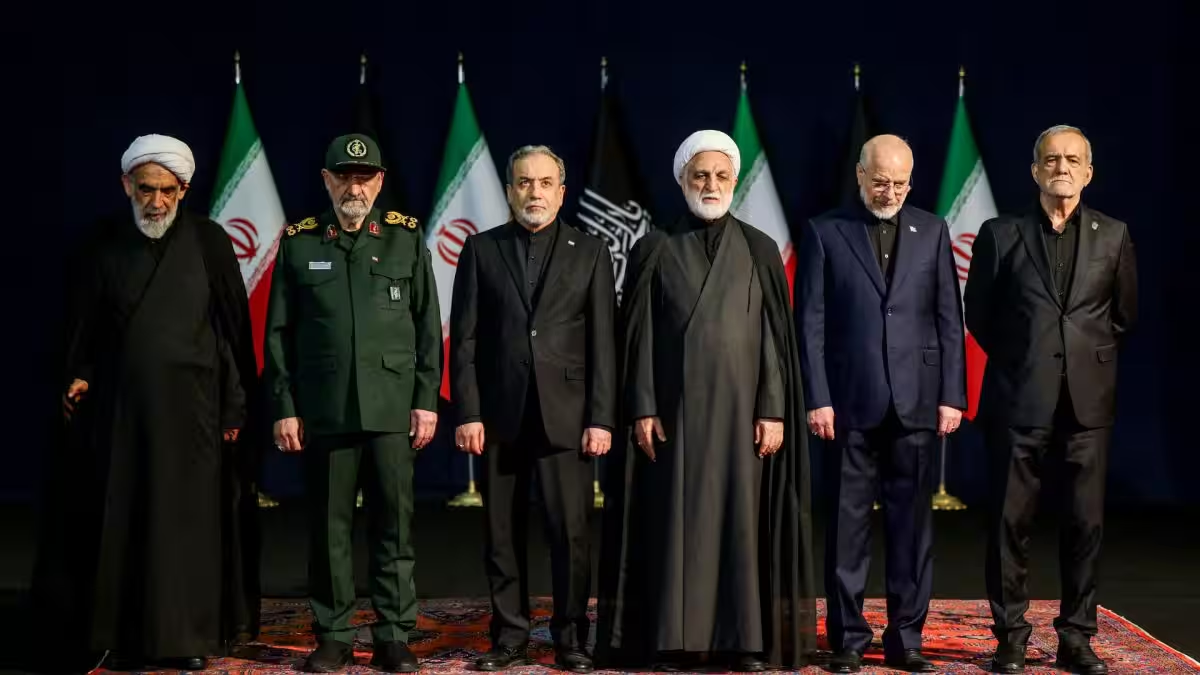
Defying Iranian President Masoud Pezeshkian and IRGC chief Ahmad Vahidi, a rogue faction of the Iranian military, controlled by a former spymaster, reportedly launched attacks in July that derailed the US-Iran interim peace deal.
Weeks into the fragile ceasefire between Iran and the United States, President Masoud Pezeshkian was informed that Iranian forces had attacked three commercial ships in the Strait of Hormuz.
A furious Pezeshkian, who had staked his presidency on negotiating the deal, called IRGC chief Ahmad Vahidi and demanded answers. Vahidi said he had not authorised any military action, and it soon emerged that the Supreme National Security Council was also in the dark.
The implication was damning: a faction of the Iranian military had gone rogue and taken matters into its own hands.
Even as Pezeshkian and other officials sought to rein in the rogue commanders, the masterminds behind the attack had already achieved their objective. The United States retaliated, setting off a cycle of tit-for-tat strikes that ultimately derailed the peace deal.
Subsequent inquiries found that the mastermind behind the sabotage was a former spymaster close to the new Supreme Leader, Mojtaba Khamenei.
The account was reported by The New York Times, which said it was based on interviews with Iranian officials, including members of the Islamic Revolutionary Guards Corps (IRGC), and a review of statements by senior officials.
The report comes as the US-Iran conflict has expanded beyond the Strait of Hormuz into the Red Sea. Iran-backed Houthis have captured the Yemeni port city of Mocha and the island of Perim in the Bab al-Mandeb, the southern gateway to the Red Sea. — about 12 per cent of the world’s seaborne oil trade and 30 per cent of global container traffic pass through the waterway.
 More from World
The account reveals an intense power struggle in Iran where moderates led by Pezeshkian, Foreign Minister Abbas Araghchi, and parliamentary speaker Mohammad Bagher Ghalibaf have been working towards a negotiated end to the war while hardliners within the clergy and factions of the IRGC have sought to derail negotiations and continue the conflict until victory.
How Iran’s hardliners won — thanks to an ex-spymaster & phantom Supreme Leader
Inquiries into the strikes traced the decision to cleric Hossein Taeb, who led the IRGC’s intelligence organisation for more than two decades until 2022.
It emerged that Taeb had been telling Mojtaba that Iran had made a mistake by agreeing to the interim peace deal.
When Pezeshkian pressed for further details, he was told that field commanders had acted independently under an order empowering them to attack any ship violating Iran’s control of the Strait of Hormuz without waiting for approval from central command. As he continued to seek answers, he was informed that the order had come from Khamenei. But he demanded proof.
The report said Pezeshkian does not believe the claim that Khamenei had directly authorised field commanders to act on their own.
Instead of being punished, Taeb, described as the driving force behind the attacks, was promoted by Mojtaba and appointed head of the Basij, an intelligence militia under the IRGC. Mojtaba also appointed former IRGC chief Mohsen Rezaei as head of the Supreme National Security Council.
While Rezaei’s appointment has been seen as a victory for the hardliners, some observers have suggested that it may also be an attempt to manage internal divisions, given his experience as a politician and crisis manager.
But observers have also argued that Mojtaba’s absence from both public life and day-to-day governance is itself the reason Iran is witnessing such an intense power struggle. Under normal circumstances, the word of the Supreme Leader serves as law in Iran. Today, however, Mojtaba is a phantom figure. The Times reported that there is uncertainty about his whereabouts, physical health, mental acuity, and the extent of his involvement in state affairs.
While Pezeshkian has publicly said that he has met Mojtaba twice, he has not disclosed details of those meetings. The Times reported that the first meeting took place virtually through an interlocutor and that Pezeshkian privately told allies he was not certain Mojtaba was actually on the other end of the call.
Mojtaba’s absence, and the lack of confidence in messages issued in his name, have empowered the hardliners.
In recent months, hardliners, including Majid Mousavi, head of the IRGC’s aerospace force, have pressed for a more confrontational approach. They told the Supreme National Security Council that they had developed a detailed plan under which Iran and its allies, including the Houthis in Yemen and Shia groups in Iraq, would expand the conflict by intensifying attacks on energy facilities across West Asia to raise the cost of the war for the United States and its allies.
The faction led by Pezeshkian and Ghalibaf warned that the plan risked plunging the country into a deeper crisis.
Amid continuing friction, the hardline faction had gained the upper hand by last Saturday, according to The Times.
As per Mousavi and other hardliners’ wishes, the Houthis have over the past week expanded the conflict by controlling the southern gateway to the Red Sea.