
NEED TO KNOW
Cristina Rapti‑Tzelepi, 54, welcomed a baby girl using a 22-year-old frozen embryo after her only son Giorgos’ death
She and her husband, Constantinos Raptis, acted quickly due to federal age limits for IVF procedures in Greece
They named their little girl Georgia in tribute to their late son and described her birth as a “new start” for the family
A couple welcomed their second child using an embryo frozen for 22 years less than a year after their first child, a 21-year-old son, died in an accident.
The Greek couple, 54-year-old Cristina Rapti‑Tzelepi and 60-year-old Constantinos Raptis, decided to expand their family using the decades-old frozen embryo after their only son, Giorgos died in an October 2025 road crash, according to the Associated Press.
As Rapti‑Tzelepi told the AP, translated from Greek, “an accident occurred and we lost our child.” She added, “Sometime later — even while in deep mourning — we decided to make use of the embryos that were already cryopreserved.”
Rapti‑Tzelepi gave birth to her daughter in an Athens hospital on Wednesday, Sept. 9, the AP reported. She and Raptis named the newborn — who weighed 7 lbs., 11 oz. — Georgia in tribute to their late son Giorgos, per the outlet.
The parents decided to act quickly using the 22-year-old frozen fertilized egg due, in part, to the Greek government’s age limit for women to complete in vitro fertilization (IVF) procedures. At 54, she had less than a year to get federal approval before aging out.

Cristina Rapti-Tzelepi holding the hand of her daughter, Georgia
Credit: AP Photo/Thanassis Stavrakis
“Due to time constraints and the strict age limits imposed by the legal framework, we had to act very quickly,” Rapti‑Tzelepi told the AP. “I only had a 2½-month window,” she explained of the government deadline.
Twenty-two years is an “unusually long time for a frozen fertilized egg to be used to produce a pregnancy,” according to the AP. The oldest human embryo used in a successful pregnancy was nearly a decade longer, however, at over 31 years old, per Guinness World Records.
Due to Greece’s federal IVF age limits, Rapti‑Tzelepi and Raptis would have to travel outside of Greece to expand their family again — which, per the AP, they have not ruled out.
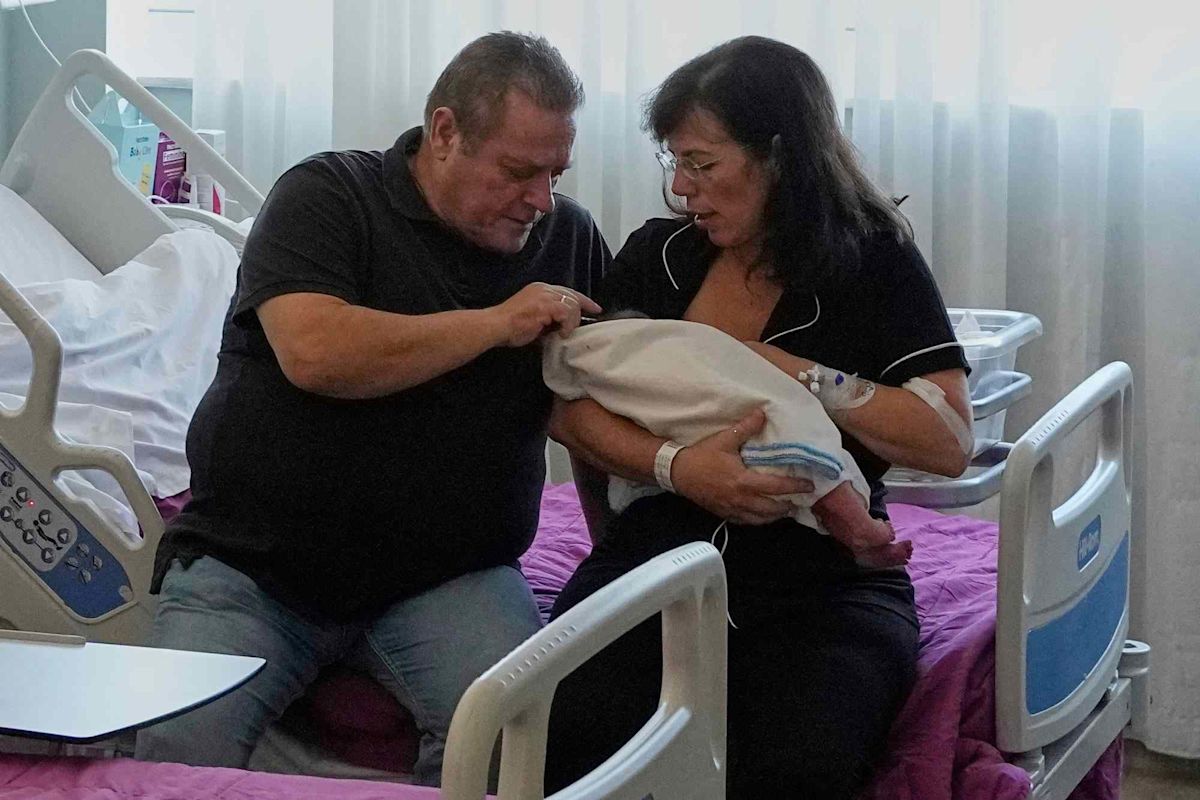
Photos captured by the AP show the new parents huddled over their newborn daughter, holding the little girl in their arms. A pink, polka-dotted balloon reading “It’s a girl,” decorated the hospital room.
Speaking with the outlet, Rapti‑Tzelepi described the birth of her baby girl as a “new start,” while Raptis spoke of the little one as an escape from “darkness.”
Never miss a story — sign up for PEOPLE’s free daily newsletter to stay up-to-date on the best of what PEOPLE has to offer, from celebrity news to compelling human interest stories.
“We decided to give life a second chance, to make a new start, bring new life into our home and keep our family’s story going,” Rapti-Tzelepi said. “My wish for her is to grow up healthy and happy, full of joy like our first child, who filled our home with laughter.”
“Along with the little one came the oxygen that enabled us to breathe and get on with our lives because we were living in absolute darkness. For us, the world had been lost,” Raptis told the AP, adding that his wife’s gynecologist, Dr. Kostas Pantos, “was our companion on this journey.”
Of the experience, Rapti-Tzelepi told the outlet, “It was stressful, but with inner strength and our doctor and his whole team by our side, we got through every obstacle.”
“He took us by the hand and pulled us out of our deepest darkness,” Raptis said of Pantos in the hospital room, while holding his little girl. “We escaped from that darkness, and I believe we have a lot to live for now.”
Read the original article on People