
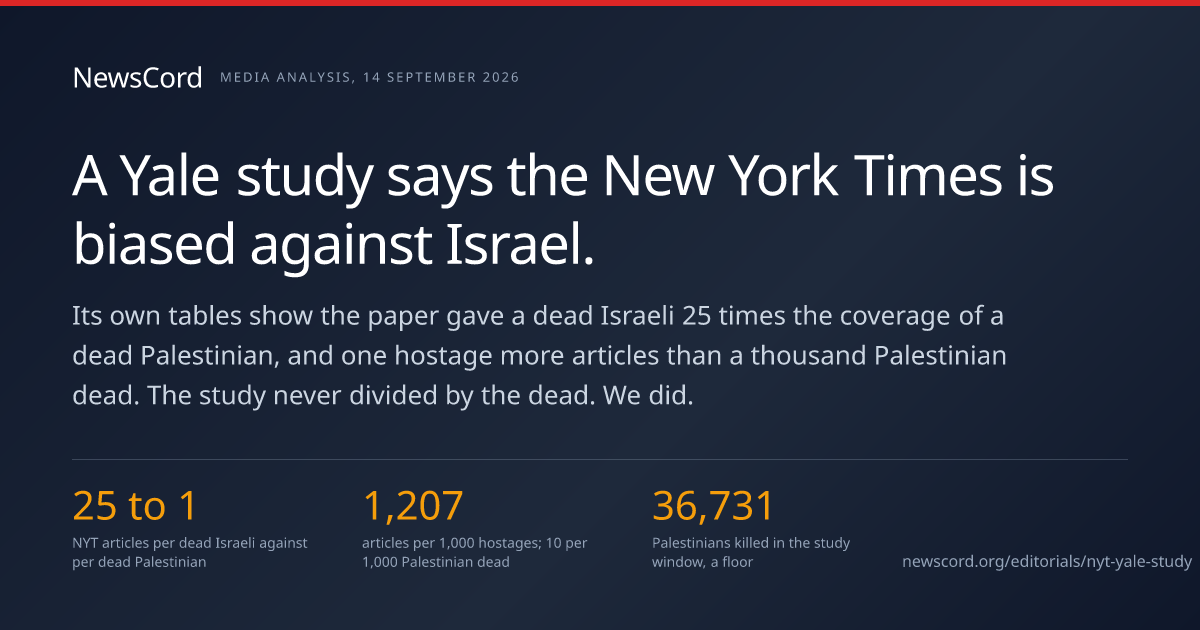
On 7 September 2026 the journal Studies in Conflict & Terrorism published a short paper by Edieal Pinker, a professor of operations research at the Yale School of Management, on how the New York Times covered the first eight months of Israel’s genocide in Gaza. Israel National News called it proof of “deep and systematic” anti-Israel bias. The Times of Israel called it a peer-reviewed study of the paper’s “bias against Israel”. The paper itself says, on page six, “I do not make a claim that the NYTimes is ‘biased’ in its reporting.” We read all twenty-two pages and took its tables at their word. Every figure about the New York Times below is the study’s own. The only thing we added is division.
What the study counts as a distortion
The corpus is 1,559 Times news articles that mention both Israel and Gaza, published between 7 October 2023 and 7 June 2024, 244 days. The headline finding is a “dominant narrative”, defined on page eight. An article fits it if it says that Hamas attacked Israel on 7 October and killed Israelis, that Israel’s response has killed many Palestinians, and does not also mention Israeli soldiers killed after 7 October or Hamas fighters killed. 969 articles fit. The paper calls this
“a distorted view of the conflict, namely that Hamas attacked Israel on October 7, killing many Israelis, and this led to Israeli violence that has been killing only Palestinian civilians since then with no further Israeli deaths.”
Pinker, page 9
Read the definition again. It is a correct description of what happened. The complaint is that an article about Israel killing forty people in a school did not also tell the reader how many Israeli soldiers had died that month and how many of the dead the Israeli army says were fighters. The study’s central statistic is a count of how often the Times declined to append a justification to a massacre.
Even by that measure the Times was generous to Israel. Of the 532 articles about events on the ground, 57% mention the Israelis killed on 7 October and 57% mention the hostages. Eight months in, with Palestinians dying at 151 a day, more than half of every ground report still carried the 7 October preamble. The author’s response is that this is not enough, and that the 55% of narrative articles which do not restate the 7 October dead are a problem.
Divide by the dead
The paper compares parties. It never once divides by the number of people killed. Do that with its Table 1, which gives the share of ground articles mentioning each side’s dead, and the Gaza Ministry of Health count on the paper’s last day, 7 June 2024, and the picture inverts.
New York Times articles about events on the ground, per 1,000 dead
Israelis killed on 7 October: 303 of 532 ground articles for 1,195 people, 253.6 per 1,000Israelis killed on 7 October254Israeli soldiers killed after 7 October: 59 of 532 ground articles for 364 people, 162.1 per 1,000Israeli soldiers killed after 7 October162Israeli hostages taken to Gaza: 303 of 532 ground articles for 251 people, 1,207.2 per 1,000Israeli hostages taken to Gaza1,207Palestinians killed by Israel: 378 of 532 ground articles for 36,731 people, 10.3 per 1,000Palestinians killed by Israel10
WhoDead by 7 June 2024Ground articles mentioning themPer 1,000 deadIsraelis killed on 7 October1,195303 (57%)253.6Israeli soldiers killed after 7 October36459 (11%)162.1Israeli hostages taken to Gaza251303 (57%)1,207.2Palestinians killed by Israel36,731378 (71%)10.3
Article counts are the paper’s Table 1 percentages applied to its 532 “Ring 0” articles. Israeli figures after 7 October are the paper’s own. The hostage row divides by the 251 people taken on 7 October. Palestinian dead are the Ministry of Health cumulative count on 7 June 2024, 15,517 of them children.
A dead Israeli on 7 October got 25 times the coverage of a dead Palestinian: 254 articles per thousand against 10. A dead Israeli soldier, the group the paper says the Times neglected, got 16 times: 162 per thousand. Each hostage got 1.2 articles, which is more than a thousand dead Palestinians got between them.
This is not a quirk of the ground articles. Across all 1,559 articles, 643 mention the 7 October dead and 801 mention Palestinian dead, and the per-victim ratio comes out the same, 25 to 1.
The paper’s tally of personal stories has the same shape. Ring 0 carries 90 personal stories of 7 October victims and 21 of other Israelis: 111 stories for 1,590 Israeli dead, 70 per thousand. It carries 207 Palestinian or Lebanese personal stories for 36,731 dead, 5.6 per thousand. 12 to 1, in favour of Israelis. The paper presents the 207 as excess.
One thing to be exact about, because the paper is not. In its own window Israel killed 30.7 Palestinians for every Israeli killed on 7 October, 23.1 for every Israeli killed in the whole period including soldiers, and 93 for every Israeli killed after 7 October. Any of the three would do. The paper uses none of them.
The count is a floor, so the gap is wider than this
Everything above uses the Ministry of Health count, because it is the figure the paper’s own sources use and because it is the lowest number anyone credible has put forward. The count stands at 73,670 on 10 September 2026, 20,179 of them children. Every independent estimate says it is an undercount, and the studies agree on the direction and roughly on the size.
StudyPeriodMinistry countEstimateGapThe Lancet, capture-recaptureto 30 June 202437,87764,260ministry 41% shortThe Lancet Global Health, household surveyto 5 January 202549,09075,200ministry 35% shortThe Lancet, direct and indirectprojection, July 2024up to 186,000direct and indirect deaths, at a conservative four indirect deaths per direct death
The first two count violent deaths only. The household survey separately estimated 16,300 non-violent deaths from the collapse of food, water and medical care. Thousands of people remain under rubble and are in no count.
Apply the capture-recapture ratio to the paper’s own window and the 36,731 becomes roughly 62,316. The per-victim gap then reads about 42 to 1. Use the ministry count and it is 25 to 1. Use the Lancet and it is 42 to 1. There is no count of the dead on which the New York Times comes out favouring Palestinians.
“Never more than five days without a Palestinian story”
Page ten reports, as a defect, that there are 163 days with a Palestinian or Lebanese personal account and that a reader “will never go more than five days in a row” without one. Over the same 244 days Israel killed an average of 151 Palestinians a day. That is one personal story for every 225 dead. On the 81 days with no such story, about 12,193 Palestinians were killed without the Times telling a single one of their stories.
The paper’s Table 3 also carries the mirror figure it does not draw out. There are 128 days on which at least one Israeli soldier died, and the Times mentioned a soldier’s death on 61 of them, 48%. There are 244 days on which Palestinians died, and the Times ran an article whose topic was Palestinian suffering on 116 of them, 48%. The same rate. The difference is that a quiet day for the Israeli army meant one dead soldier, and a quiet day in Gaza meant a hundred dead children.
Israel-only articles and Palestine-only articles: the same number
Table 2, the paper’s own count. 121 articles mention Israeli casualties and no Palestinian casualties, and 110 mention only the Hamas attack: 231 articles in which the only victims are Israeli. On the other side the paper reports 237 articles in its dominant narrative that omit the Hamas attack, which is to say they mention Palestinian dead without 7 October.
231 against 237, in a period when the dead were 23 to 1. The Times was as likely to run an article whose only victims were Israeli as one whose only victims were Palestinian. The paper reports the second number as a problem and never puts the first beside it.
The rocket section proves the opposite of what it says
Pages eleven to fourteen complain that between 8 October and 2 November 2023 the Times mentioned Palestinian rocket fire on only 12 of 26 days and rarely itemised the Israeli injuries. The paper’s Table 4 lists them from the ACLED database: a woman seriously injured in Ashkelon, a boy hit by shrapnel, five people lightly injured at Nirim, two foreign workers killed at Magen, one person killed in Sderot.
In the nine days that table covers, 8 to 16 October, the Ministry of Health counted 2,808 Palestinians killed, 853 of them children. By 2 November, the end of the paper’s rocket window, it was 9,061. The grievance is that “5 others were lightly injured” did not get the same salience as that.
Counting the word “Israel” measures who the Times quotes
Table 5: “Israel” appears 27,205 times across the corpus and “Hamas” 8,499 times, and the paper says this “diminishes the responsibility of Hamas”.
Israel is a state. It has a government, a cabinet, a prime minister, an army with a spokesman, a border, a parliament, settlers, hostages and an embassy in every capital. Every “Israel said”, “the Israeli military said”, “Israel denies” and “Israeli strikes” adds to that count. The paper does not say whether “Israeli” and “Israelis” were counted as hits on “Israel”. If they were, and a plain string count would do that, the figure means nothing. If they were not, it is still a count of how often the Times put the Israeli government’s claims in print. Hamas has no adjective, no ministry and no spokesman the Times rings for comment.
The paper then compares Hezbollah and Iran and finds the same ratio. Of course it does. Those articles are about Israel’s attacks on Lebanon and Iran. The finding is that the New York Times is an Israel-centred newspaper. That is the pro-Israel finding, not the anti-Israel one.
Hamas fighter deaths are unreportable, and the paper excludes the way the Times reports them
Only 12% of ground articles mention Hamas fighters killed. The only source for that number is the Israeli army, which claimed 17,000 to 20,000 fighters dead in 2024 with no published method, while US intelligence in June 2024 put it at 11,000 to 13,000 and Haaretz’s own reporting from serving commanders in March 2024 said the army’s count included “Palestinians who never held a gun in their lives”. Against a total toll that was more than two thirds women and children, the claim is not a fact a newspaper can print as one.
Appendix A then rules that “Israeli army says it targeted Hamas militants” does not count as a mention. That sentence is the single most common way the Times relays Israel’s claim about who it killed. The paper excludes it by design and then reports the result as the Times hiding Hamas losses.
Seven bins for Israeli suffering, three for Palestinian
Appendix A gives the Israeli side seven categories: casualties on 7 October, casualties after 7 October, suffering, personal suffering, 7 October victim suffering, 7 October victim personal story, and hostages. The Palestinian side gets three: casualties, suffering, personal suffering. There is no tag for the thousands of Palestinians held in Israeli detention without charge. None for settler violence in the West Bank. None for the aid blockade, none for famine, none for the Palestinian journalists killed. A study built to find whether Israeli suffering is undercounted gave Israeli suffering seven bins and Palestinian suffering three, then reported that the Israeli bins were emptier per article.
What it leaves out, and admits leaving out
Pages sixteen and seventeen concede that the study excludes headlines, photographs, editorials, op-eds and “how language choice might induce a framing”. That is where the real bias at the New York Times has already been measured, by other people, in the other direction.
The Intercept counted 1,100 articles in the New York Times, the Washington Post and the Los Angeles Times over 7 October to 24 November 2023. “Slaughter” was used for Israelis 60 times and for Palestinians 1; “massacre” 125 to 2; “horrific” 36 to 4. At the Times alone, “massacre” was 53 to 1 and “slaughter” 22 to 1. 2 headlines out of 1,100 mentioned children in Gaza. Per death, Israelis were mentioned 16 times as often as Palestinians. That is the same arithmetic as this page, done two years earlier, and it reached the same answer.
The Times’s own leaked style memo of April 2024 told reporters to restrict “genocide” and “ethnic cleansing”, to avoid “occupied territory”, to use “Palestine” only in very rare cases, and not to call Gaza’s refugee camps refugee camps. The paper cites that memo in a footnote and moves on.
Page seven explains why Palestinian voices are thin: Gaza “is dangerous to report from”. It does not say why. Israel has barred every foreign journalist from entering Gaza independently since October 2023, and the Committee to Protect Journalists recorded 2024 as the deadliest year for journalists in its history, with almost seventy per cent of them killed by Israel. The Times’s sourcing is constrained by Israel, and the paper counts the result as the Times’s tilt against Israel.
The yardstick is the Israeli government’s
Page three sets out the author’s “alternative framing” in his own words. The problem is “the existence of Hamas as a military force”. The cause is “the material support that Hamas has received from Iran, Qatar, and Turkey” and “the unwillingness of Israel to conduct a comprehensive ground offensive”. The remedy is that “strong international backing be given to Israel to take on the very costly task of destroying Hamas”. Page eleven opens the section on responsibility with Antony Blinken asking why the world is not pressuring Hamas. Every “imbalance” the paper finds is the gap between what the Times printed and what the Israeli government would have wanted printed.
Who wrote it
Edieal Pinker is the BearingPoint Professor of Operations Research at the Yale School of Management, Deputy Dean for Strategy from 2016 to 2025. His field is operations research: workforce scheduling, healthcare queues, counter-terrorism modelling, and demographic projections of American Jews. He has no background in journalism or media studies. The paper is a “Note”, the short format, in a terrorism-studies journal, not a journalism one, and the journal page showed 87 views on the day we read it. Here is what he has said in public about Israel and Gaza, in his own words, with the date and the link.
WhenWhat is on the recordWhere1985 to 1990Spent a school semester in 1985 on Kibbutz Alumim, beside the Gaza fence. In 1989, in his words, ‘graduated, made aliyah, and enlisted in the IDF’; ‘the next year I was on the streets of Gaza’, and later ‘patrolling the security zone in southern Lebanon’.Jewish Review of Books, 17 November 20237 April 2015Wrote that Jewish critics of Israel are ‘unable to prevail in the forum of ideas within the Jewish community’ and so ‘reject the forum’ and ‘enlist outside help’, and that they rationalise ‘any Palestinian extremism or fanaticism’.Jewish Telegraphic Agency17 November 2023Six weeks into the genocide, wrote of Gaza that ‘the prisoners have always had the key. They have refused to unlock the door.’Jewish Review of Books23 January 2025Posted the first draft of the study to SSRN. Told the Times of Israel he wrote it because readers of the non-Israeli press ‘were not getting a clear understanding of how Israelis were experiencing the war’, and that he is a dual US and Israeli citizen.Times of Israel7 September 2026The journal version thanks Edward Kaplan for feedback on earlier drafts. Kaplan sits on the executive board of Yale Jewish Academics and Friends, which took 25 Yale faculty to Israel in March 2024 ‘as an act of solidarity’, in collaboration with the Academic Engagement Network, and co-wrote the Newsweek account of the trip.Yale Jewish Academics and Friends; Newsweek, 29 March 2024
Each line links to the original. Nothing here is inferred.
The paper’s disclosure statement reads: “No potential conflict of interest was reported by the author(s).” That is not true. A conflict of interest is when the person doing the measuring has a stake in the answer. Pinker has four.
He is a citizen of the state whose coverage he is grading. The paper asks whether the New York Times was fair to Israel. Its author is Israeli.He served in the army whose killing the Times was reporting. The 36,731 dead in the paper’s window were killed by the IDF. Pinker enlisted in the IDF in 1989 and patrolled Gaza the year after. He is grading how a newspaper covered the army he served in.He had published his verdict on Gaza before he counted a single article. Six weeks into the genocide, with about 12,000 Palestinians already dead, he wrote that Gaza’s “prisoners have always had the key”. A man who has said in print that the people being killed brought it on themselves then produced a study finding that the Times was too sympathetic to them.He set out to change the coverage, and said so. He told the Times of Israel he did the study because American readers “were not getting a clear understanding of how Israelis were experiencing the war”. That is not a research question. It is a complaint, and the study is the complaint with tables.
Any one of those belongs in a disclosure statement. The journal printed none of them. The funding line is muddled too: the paper says “This work was supported by Yale School of Management.”, and the Times of Israel, after interviewing him, reported: “The study was not sponsored by Yale.” One of those is wrong, and neither the author nor the journal has said which.
The people who checked his work had the same stake. The paper thanks two colleagues for feedback on the drafts. One, Edward Kaplan, sits on the board of Yale Jewish Academics and Friends, the group that took 25 Yale faculty to Israel in March 2024 “as an act of solidarity”, in partnership with the Academic Engagement Network, a body set up to oppose boycotts of Israel on American campuses. Kaplan co-wrote the Newsweek article about that trip. The other, Gal Zauberman, teaches marketing. Nobody who reports on the Middle East, nobody who studies journalism, and nobody Palestinian read a draft.
Then there is who is carrying it. The study was first posted to SSRN on 23 January 2025 and was written up within a month by the Times of Israel and the Jerusalem Post. Its journal publication was announced by Israel National News, the settler-movement paper, under “Yale professor finds ‘deep and systematic’ anti-Israel bias in NYT Gaza coverage”. It is cited by a HonestReporting contributor in the Algemeiner as “the data that exposes media’s anti-Israel bias”, alongside CAMERA and the Henry Jackson Society. The author writes: “I leave drawing conclusions about those questions to the reader.” The outlets promoting it wrote the conclusion for him, and he has not corrected any of them.
Against page six of the paper: I do not make a claim that the NYTimes is biased in its reporting.
What the paper claims, against what is being said about it
Page six: “I do not make a claim that the NYTimes is ‘biased’ in its reporting.” Page seven: “this study does not attempt to directly address the question of bias.” Page sixteen: “Is there a correct number of mentions? I cannot say.” The New York Times, asked by the Times of Israel, said it had covered this “with more rigor than virtually any other US news organization” and that its editors make “careful and deliberate choices about every story”. The paper’s own tables show what that choice was: a killed Israeli got 25 times the coverage of a killed Palestinian.
The one line
The paper counts how often the Times reminded readers of 7 October and finds it was only most of the time. Divide its own tables by the dead and the Times gave a killed Israeli 25 times the coverage of a killed Palestinian, and one hostage more coverage than a thousand Palestinian dead. That is the finding. It is the opposite of the headline.
Sources
Pinker, How the New York Times Framed the War Between Israel and Hamas, Studies in Conflict & Terrorism, 7 September 2026Pinker, An Analysis of the New York Times Coverage of the War Between Israel and Hamas, SSRN, 23 January 2025Gaza Ministry of Health daily reports, archived by Palestine DatasetsLancet, capture-recapture estimate of traumatic-injury deaths to 30 June 2024, January 2025Lancet Global Health, Gaza Mortality Survey, February 2026Lancet, Counting the dead in Gaza: difficult but essential, July 2024The Intercept, Coverage of Gaza War in the New York Times and Other Major Newspapers Heavily Favored Israel, 9 January 2024The Intercept, leaked New York Times style memo, 15 April 2024Times of Israel interview with Pinker, and the New York Times responseYale School of Management faculty profilePinker, Wars and Peace: Memoirs of a Conflict, Jewish Review of Books, 17 November 2023Pinker, For Jewish Critics of Israel, Time Hasn’t Changed, JTA, 7 April 2015Yale Jewish Academics and Friends, executive board and the March 2024 mission to IsraelKaplan and Morris, What We Learned on Our Academic Visit to Israel, Newsweek, 29 March 2024Committee to Protect Journalists, 2024 the deadliest year on record, almost 70% killed by IsraelNPR, international journalists still barred from Gaza after two years, 25 November 2025Casualties of the Gaza war: IDF fighter claims, US intelligence estimate and the Haaretz reporting